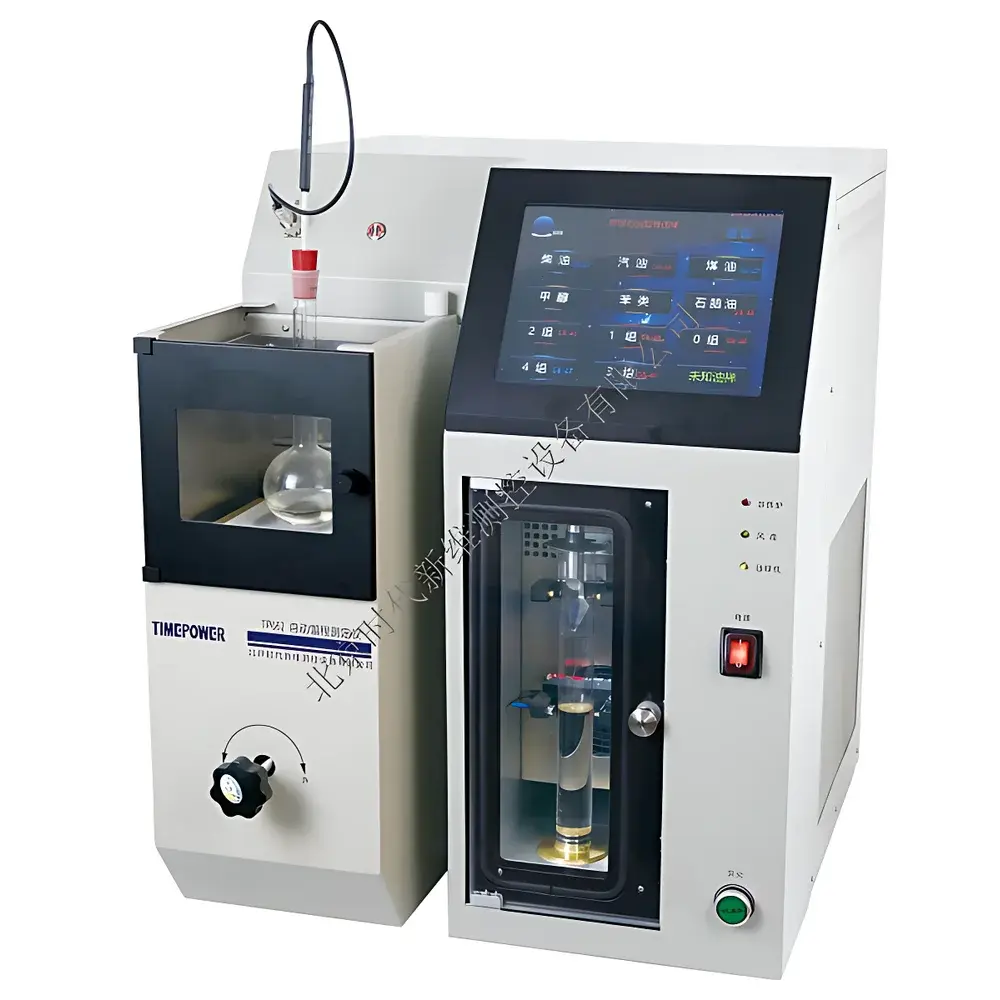
TimePower TP662 Automated Distillation Apparatus for Petroleum Products
| Brand | TimePower |
|---|---|
| Origin | Beijing, China |
| Manufacturer | TimePower Instrument Co., Ltd. |
| Model | TP662 |
| Temperature Range | 0–400 °C |
| Temperature Accuracy | ±0.1 °C |
| Cold Bath Temperature Range | 0–60 °C |
| Distillation Rate | 1–11 mL/min |
| Volume Measurement Range | 1–111 mL |
| Volume Resolution | 0.1 mL |
Overview
The TimePower TP662 Automated Distillation Apparatus is a fully integrated, ASTM D86-23 and ISO 3405 compliant instrument engineered for precise determination of distillation characteristics in petroleum products and volatile organic liquids. It implements standardized atmospheric distillation methodology—where a representative sample is heated under controlled conditions, and the temperature at which specific volume fractions (e.g., 10%, 50%, 90% recovered) are collected is recorded. The system operates on a closed-loop thermal control architecture with real-time vapor temperature sensing, automated liquid-level tracking via high-stability photoelectric detection, and dynamic pressure compensation to correct boiling point readings to standard atmospheric pressure (101.325 kPa). Designed for routine QC/QA laboratories in refineries, independent testing labs, and R&D facilities, the TP662 eliminates operator-dependent variability while maintaining full traceability and procedural fidelity to international distillation standards.
Key Features
- 10.4-inch high-resolution color touchscreen interface with intuitive workflow navigation and multilingual support (English, Spanish, Arabic)
- Pt100 platinum resistance temperature sensors (certified to IEC 60751 Class A) mounted at critical thermal zones: vapor thermometer well, condenser outlet, and recovery chamber
- Imported Danfoss (Secop) hermetic compressor for stable cold-bath temperature control (0–60 °C), enabling reproducible condensation efficiency across wide ambient ranges
- Auto-compensated atmospheric pressure correction using built-in digital barometric sensor; all reported temperatures normalized to standard pressure per ASTM D1078 and IP 123 guidelines
- Optical volume detection system with imported photoelectric tracking module—achieving ±0.1 mL volumetric accuracy over 0–100 mL range
- Programmable termination logic: user-selectable stop criteria based on either cumulative recovered volume or final vapor temperature threshold
- Integrated nitrogen purge and manual emergency shutdown circuit for rapid flame suppression during high-boiling or unstable samples
- Adjustable recovery chamber temperature control (10–40 °C) to minimize post-condensation evaporation losses and improve repeatability for light ends
Sample Compatibility & Compliance
The TP662 supports distillation analysis of gasoline, aviation gasoline (AVGAS), jet fuel (Jet A/A-1), naphtha, diesel fuel, kerosene, solvent naphthas, and industrial-grade organic solvents (e.g., toluene, xylene, acetone). Its hardware configuration conforms to the mechanical and procedural requirements of ASTM D86 (Standard Test Method for Distillation of Petroleum Products at Atmospheric Pressure), ASTM D1078 (Volatility of Volatile Organic Liquids), ISO 3405, and GB/T 6536 (Chinese national standard aligned with ISO 3405). All thermal and volumetric calibrations are performed using NIST-traceable reference standards prior to shipment. The system supports GLP-compliant operation through audit-trail-enabled software logging (user actions, parameter changes, calibration events) and meets foundational requirements for FDA 21 CFR Part 11 readiness when deployed with validated IT infrastructure.
Software & Data Management
The embedded firmware provides real-time graphical display of vapor temperature vs. recovered volume curves, with simultaneous numeric readouts of key endpoints (IBP, 10%, 50%, 90%, FBP), loss, and residue. Data export is supported via USB 2.0 port in CSV and PDF formats—structured to align with LIMS ingestion protocols. Optional PC-based software (TP-Distill Suite v3.2) enables method library management, multi-instrument fleet monitoring, statistical process control (SPC) charting, and automated report generation compliant with ISO/IEC 17025 documentation requirements. All measurement data includes timestamps, operator ID, atmospheric pressure value, and instrument serial number for full analytical traceability.
Applications
- Quality control of finished gasoline blends for Reid Vapor Pressure (RVP) correlation and volatility grading
- Verification of cut-point specifications in crude fractionation units and hydrotreater product streams
- Compliance testing for jet fuel specification limits (e.g., ASTM D1655 Table 1 distillation bands)
- Stability assessment of biofuel blends (e.g., ethanol-gasoline E10/E15) under thermal stress conditions
- Raw material qualification of solvent-grade hydrocarbons used in pharmaceutical extraction and polymer synthesis
- Root-cause investigation of distillation curve anomalies linked to contamination, oxidation, or improper blending
FAQ
What distillation standards does the TP662 support?
ASTM D86, ASTM D1078, ISO 3405, IP 123, and GB/T 6536 — with hardware and software calibrated to meet their respective apparatus and procedural requirements.
Is atmospheric pressure compensation automatic?
Yes. An integrated barometric sensor continuously measures local ambient pressure and applies real-time corrections to all temperature readings per ASTM D1078 Annex A1.
Can the instrument be integrated into a laboratory information management system (LIMS)?
Yes. Raw data export in CSV format supports direct ingestion; optional TP-Distill Suite provides ODBC connectivity and HL7-compatible metadata tagging.
What safety features prevent thermal runaway or fire hazards?
Manual nitrogen purge activation, overtemperature cutoff at 410 °C, and auto-shutdown upon abnormal vapor temperature ramp rate or condenser flow interruption.
Does the system require external calibration services after installation?
No. Factory calibration is performed using NIST-traceable references; users may perform verification checks using certified distillation standards (e.g., NIST SRM 2721), with full calibration logs retained in device memory.