
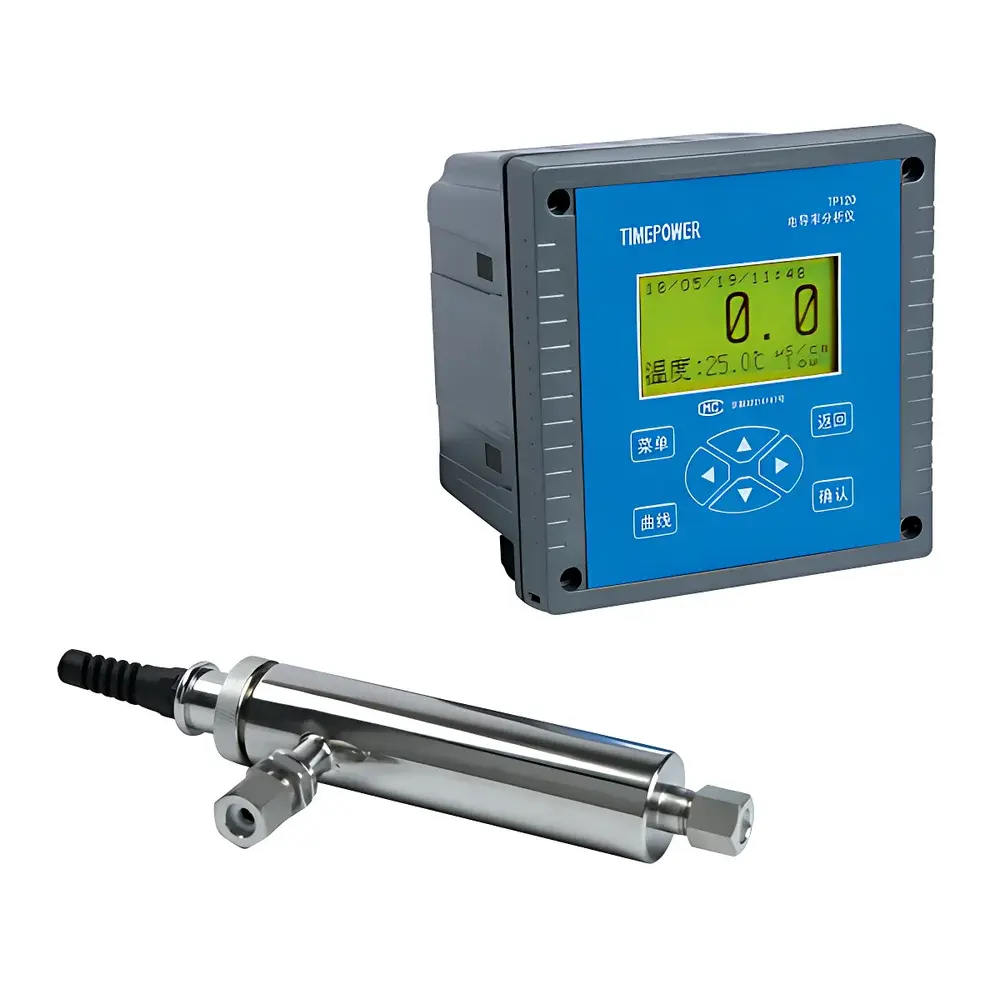
Timepower TP120 Online Conductivity Analyzer
| Brand | Timepower |
|---|---|
| Origin | Beijing, China |
| Manufacturer Type | Manufacturer |
| Model | TP120 |
| Measurement Parameter | Single-parameter (Conductivity/TDS/Resistivity/Salinity/Temp) |
| Portability | Portable |
| Application | Industrial online monitoring |
| Conductivity Range | 0–300 mS/cm |
| TDS Range | 0–100 g/L |
| Resistivity Range | 0–100 MΩ·cm |
| Salinity Range | 0–100 ppt |
| Temperature Range | 5–45 °C |
| Accuracy | ±1% FS |
| Minimum Resolution | 0.001 µS/cm |
| Display | 128×64 dot-matrix LCD with Chinese interface |
| Temperature Sensor | Pt1000 |
| Temp Compensation Range | 0–60 °C |
| Sample Temp Range | 5–60 °C |
| Max Sample Pressure | <0.6 MPa |
| Environmental Humidity | ≤90% RH (non-condensing) |
| IP Rating | IP65 |
| Power Supply | AC 85–265 V, 45–65 Hz |
| Power Consumption | ≤15 W |
| Dimensions | 145 × 120 × 150 mm |
| Panel Cutout | 138 × 138 mm |
| Weight | 0.64 kg |
| Output Options | Isolated 0–10 mA / 0–20 mA / 4–20 mA (load <300 Ω) |
| Relay Outputs | 2 SPST, configurable, AC 220 V / 3 A or DC 30 V / 3 A |
| Data Storage | Cyclic non-volatile memory, >10 years retention after power loss |
Overview
The Timepower TP120 Online Conductivity Analyzer is an industrial-grade, microprocessor-controlled electrochemical instrument engineered for continuous, real-time monitoring of aqueous solution conductivity in demanding process environments. It operates on the fundamental principle of two-electrode (or four-electrode) conductometric measurement: a known alternating current excitation signal (1–3 kHz sinusoidal voltage) is applied across a pair of fixed-geometry electrodes immersed in the sample, and the resulting current is measured to calculate solution conductance. By incorporating temperature compensation via integrated Pt1000 sensing and applying standardized cell constant (K = 0.01, 0.1, 1.0, or 10.0 cm⁻¹) calibration, the TP120 delivers traceable, reproducible conductivity values compliant with ISO 7888, ASTM D1125, and GB/T 6908—specifically validated for boiler feedwater and cooling water analysis in thermal power generation.
Key Features
- High-resolution measurement capability down to 0.001 µS/cm, supporting ultra-pure water (≤1 µS/cm) and high-conductivity brines (up to 300 mS/cm) through selectable electrode constants and auto-ranging circuitry.
- Integrated Pt1000 temperature sensor with automatic temperature compensation (ATC) across 0–60 °C, ensuring accuracy per IEC 60746-3 requirements for conductivity instrumentation.
- Optically isolated analog outputs (0–10 mA, 0–20 mA, or 4–20 mA) with load impedance <300 Ω—designed for noise-immune signal transmission over extended distances in electrically noisy plant environments.
- Dual programmable relay outputs (AC 220 V / 3 A or DC 30 V / 3 A), configurable for high/low alarms, pump control, or system interlock functions per ISA-84 safety lifecycle guidelines.
- Robust front-panel design rated IP65, enabling reliable deployment in outdoor, humid, or washdown-prone locations without enclosure retrofitting.
- Non-volatile cyclic memory retaining >10 years of timestamped measurement history (conductivity, TDS, resistivity, salinity, temperature) with automatic overwrite—supporting GLP-compliant data traceability and internal audit readiness.
- Modular electrode compatibility: supports K=0.01 cm⁻¹ (for ultrapure water), K=0.1 cm⁻¹ (for deionized water), K=1.0 cm⁻¹ (standard process water), and K=10.0 cm⁻¹ (high-salinity media) platinum or stainless-steel electrodes, including optional sealed flow-through cells for low-conductivity applications.
Sample Compatibility & Compliance
The TP120 is validated for continuous monitoring of aqueous streams across diverse industrial sectors—including fossil-fueled and nuclear power plant water-chemistry loops, chemical process effluents, municipal drinking water distribution systems, pharmaceutical purified water (PW) and water-for-injection (WFI) recirculation lines, and food & beverage rinse-water circuits. Its measurement architecture adheres to key regulatory and technical frameworks: compliance with GB/T 6908 for boiler water quality verification; alignment with USP for conductivity testing of purified water; and functional suitability for FDA 21 CFR Part 11 environments when paired with external audit-trail-capable SCADA or DCS systems. The instrument’s pressure rating (<0.6 MPa) and temperature operating envelope (5–60 °C sample, 5–45 °C ambient) meet standard ASME B31.1 piping system interface requirements.
Software & Data Management
While the TP120 operates as a standalone, embedded-system analyzer with no onboard PC software, its analog and relay outputs are fully compatible with industry-standard automation platforms—including Siemens PCS7, Emerson DeltaV, Honeywell Experion, and Rockwell FactoryTalk. All measurement parameters (σ, TDS, ρ, salinity, T) are simultaneously available via isolated current output, enabling redundant trending in historian databases (e.g., OSIsoft PI, GE Proficy). Internal data logging follows a first-in-first-out (FIFO) protocol with time-stamped records stored in EEPROM; retrieval requires manual query via front-panel navigation. For systems requiring electronic record integrity, integration with a 21 CFR Part 11-compliant LIMS or MES platform is recommended to capture and archive all operational events—including calibration logs, alarm triggers, and configuration changes—with user-level access control and immutable audit trails.
Applications
- Real-time conductivity surveillance in high-pressure boiler feedwater systems to detect condenser tube leakage or ion exchange resin breakthrough.
- Continuous TDS monitoring in reverse osmosis (RO) permeate and reject streams for membrane fouling assessment and recovery optimization.
- Salinity control in closed-loop cooling towers to prevent corrosion and scaling per CTI Guidelines and ASTM D511.
- Resistivity verification of pharmaceutical purified water (PW) and water-for-injection (WFI) per USP Stage 1 and Stage 2 limits.
- Effluent discharge compliance tracking against local environmental regulations (e.g., EPA NPDES permit thresholds).
- Batch concentration control in electroplating, etching, and cleaning baths where ionic strength directly impacts process kinetics.
FAQ
What electrode constant should I select for ultrapure water (≤0.1 µS/cm)?
For sub-1 µS/cm measurements, a K=0.01 cm⁻¹ or K=0.1 cm⁻¹ electrode is mandatory; use of a sealed, temperature-controlled flow cell is strongly recommended to minimize atmospheric CO₂ interference and ensure measurement stability.
Does the TP120 support four-electrode (inductive) conductivity measurement?
No—the TP120 uses contact-type two-electrode conductometry with selectable cell constants. Four-electrode or toroidal sensors require separate instrumentation due to fundamental differences in excitation methodology and signal conditioning.
Can the device be calibrated in-situ without removing the electrode from the pipe?
Yes—full two-point (zero and span) calibration is supported using standard KCl reference solutions while the electrode remains installed in the process line, provided flow conditions allow stable immersion and temperature equilibrium.
Is the analog output intrinsically safe for hazardous area installation?
The TP120’s current output is not intrinsically safe certified; it must be installed in non-hazardous zones or connected via approved Zener barriers or galvanic isolators when interfacing with field devices in Class I Div 1 or ATEX Zone 1 areas.
How often does the instrument require verification against NIST-traceable standards?
Per ISO/IEC 17025 and ASTM D1125 guidance, routine verification is recommended at intervals not exceeding 30 days for critical applications (e.g., PW/WFI), or quarterly for general process monitoring—documented with certified reference materials and recorded in the unit’s internal log.




