
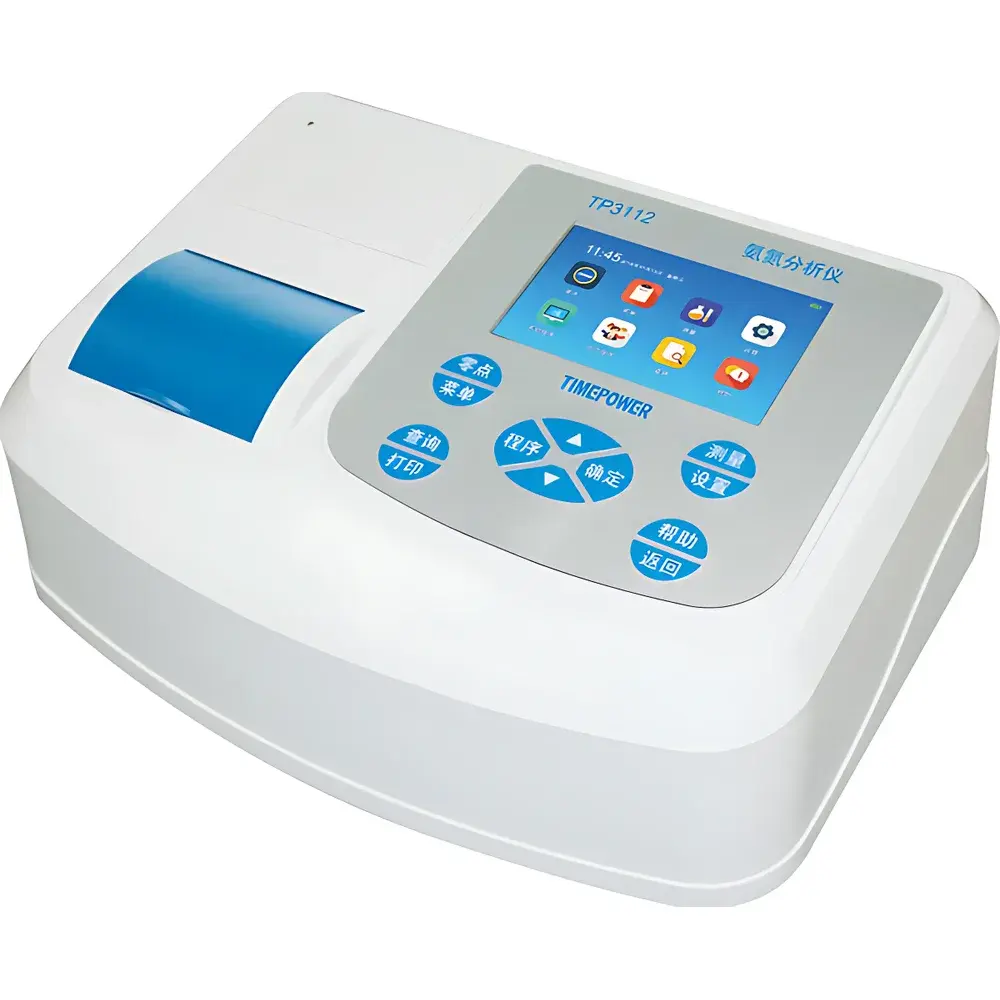
Timepower TP3112 Laboratory Ammonia Nitrogen Analyzer
| Brand | Timepower |
|---|---|
| Origin | Beijing, China |
| Manufacturer Type | Manufacturer |
| Product Category | Domestic |
| Model | TP3112 |
| Instrument Type | Benchtop Laboratory Analyzer |
| Measurement Principle | Colorimetric Method (Nessler Reagent Spectrophotometry) |
| Measurement Range | 0.02–25 mg/L (dual-range: 0–5 mg/L and 5–25 mg/L |
| Accuracy | ±3% of Full Scale |
| Detection Limit | 0.01 mg/L |
| Analysis Time | 10 minutes per sample |
| Batch Capacity | 10 water samples simultaneously |
| Display | 5.0-inch color LCD (English/Chinese switchable) |
| Data Storage | 30,000 measurement records + 96 customizable calibration curves (including pre-loaded HJ/T 535–2009 compliant curves) |
| Interface | USB 2.0, RJ45 Ethernet |
| Printer | Built-in thermal printer |
| Optical Source | Imported cold-light LED (rated lifetime ≥100,000 h) |
| Power Supply | AC 220 V ±10%, 50 Hz ±0.5 Hz |
| Power Consumption | ≤5 W |
| Operating Environment | 5–40 °C, RH ≤85% (non-condensing) |
| Dimensions | 348 × 250 × 145 mm |
| Weight | 2.6 kg (main unit) |
| Compliance | HJ/T 535–2009 “Water Quality — Determination of Ammonia Nitrogen — Nessler Reagent Spectrophotometric Method” |
Overview
The Timepower TP3112 Laboratory Ammonia Nitrogen Analyzer is a benchtop photometric instrument engineered for precise, trace-level quantification of ammonia nitrogen (NH₃-N) in aqueous matrices using the standardized Nessler reagent spectrophotometric method. It operates on the fundamental principle of Lambert-Beer law: absorbance at 420 nm is linearly proportional to ammonia nitrogen concentration in the presence of Nessler’s reagent, which forms a yellow-brown colloidal complex with ammonium ions under alkaline conditions. Designed specifically to meet the technical requirements of China’s HJ/T 535–2009 standard—fully aligned with internationally recognized colorimetric validation frameworks—the TP3112 delivers robust performance in routine regulatory testing, process control, and environmental research applications. Its optical architecture integrates a temperature-stabilized, long-life cold-light LED source and precision interference filters to ensure minimal spectral drift and high photometric reproducibility across extended operational cycles.
Key Features
- Benchtop design optimized for laboratory workflow efficiency: compact footprint (348 × 250 × 145 mm), low power consumption (≤5 W), and ambient operation (5–40 °C, ≤85% RH non-condensing).
- Dual-range measurement capability (0.02–5 mg/L and 5–25 mg/L) with automatic range recognition and optional manual dilution protocol support for samples exceeding upper detection limits.
- High-fidelity optical system featuring imported cold-light LED illumination (≥100,000 h lifetime) and narrow-bandpass filtering at 420 nm, minimizing stray light and enhancing signal-to-noise ratio.
- Integrated thermal printer enabling immediate hardcopy output of current results, calibration logs, and historical data summaries—critical for GLP-compliant documentation and audit readiness.
- Configurable operating modes: single-point standard measurement for compliance verification or continuous batch mode for throughput optimization (up to 10 samples per cycle, ~10 min total assay time).
- Onboard data management: 30,000 measurement records stored with timestamps, user IDs, and method identifiers; supports export via USB or Ethernet to LIMS or laboratory informatics platforms.
- Preloaded analytical curves conforming to HJ/T 535–2009, plus 96 programmable user-defined calibration curves—enabling method flexibility across diverse matrix types (e.g., wastewater, surface water, pharmaceutical effluents).
Sample Compatibility & Compliance
The TP3112 is validated for use with clarified, non-turbid aqueous samples including municipal wastewater, industrial effluents (e.g., from chemical synthesis, dyeing, food processing), hospital discharges, and natural surface waters. Turbid or highly colored samples require pretreatment (e.g., coagulation/filtration per HJ/T 535–2009 Section 7.2) prior to analysis. The instrument satisfies core metrological requirements outlined in HJ/T 535–2009, including detection limit (≤0.01 mg/L), accuracy (±3% F.S.), repeatability (≤5%), and linearity (R² ≥0.999 over working range). While not certified to ISO/IEC 17025 by default, its architecture supports traceability through NIST-traceable secondary standards and enables full audit trails when paired with compliant data handling protocols—making it suitable for laboratories implementing GLP or GMP-aligned quality systems.
Software & Data Management
The TP3112 runs embedded firmware supporting dual-language UI (English/Chinese), intuitive menu navigation, and context-sensitive help prompts. All calibration events, measurement logs, and curve edits are timestamped and attributed to operator IDs. Data export is supported via USB mass storage mode (CSV format) or TCP/IP socket communication over Ethernet—facilitating integration with enterprise LIMS, ELN, or statistical process control (SPC) software. Internal memory retains all records during power interruption (non-volatile flash storage), and firmware updates are delivered via secure USB-based patching. For regulated environments, optional PC software provides enhanced features: automated report generation (PDF/Excel), multi-user access control, electronic signature capture, and 21 CFR Part 11–compliant audit trail configuration.
Applications
- Regulatory compliance monitoring for municipal wastewater treatment plants (WWTPs) and industrial discharge permits under local environmental protection bureau mandates.
- Process optimization in nitrogen removal units (e.g., nitrification/denitrification basins), where rapid NH₃-N feedback informs real-time DO and carbon dosing adjustments.
- Quality assurance in pharmaceutical manufacturing—verifying ammonia levels in purified water (PW) and water-for-injection (WFI) systems per USP and EP 2.2.43.
- Academic and research laboratories conducting nutrient cycling studies, eutrophication modeling, or toxicity assessments involving ammonium-sensitive aquatic organisms.
- Emergency response scenarios requiring field-deployable lab-grade analysis—enabled by portable power adapters and ruggedized transport cases (optional accessory).
FAQ
Does the TP3112 comply with international standards such as ISO 7150-1 or ASTM D1426?
The TP3112 implements the Nessler reagent methodology specified in HJ/T 535–2009, which is technically equivalent to ISO 7150-1:1984 and ASTM D1426–15 (Standard Test Methods for Nitrogen in Water). While the instrument itself is not third-party certified to those standards, its optical performance, calibration traceability, and procedural alignment allow direct method equivalence validation by end users.
Can the TP3112 be integrated into a centralized laboratory data network?
Yes—via built-in Ethernet (RJ45) and USB interfaces, the analyzer supports TCP/IP-based data streaming and file transfer to networked servers, LIMS, or cloud-hosted QA/QC dashboards using standard CSV or XML schema.
What maintenance is required to sustain measurement accuracy?
Routine optical path cleaning (cuvette holder and LED window), quarterly verification with certified reference materials (CRM), and annual photometric calibration using neutral density filters are recommended. No consumable optical components require replacement within the first five years of operation.
Is reagent lot-to-lot variability compensated for in the calibration routine?
Yes—each Nessler reagent kit includes lot-specific calibration slope and intercept values encoded in QR-coded packaging. Scanning the code auto-loads correction parameters into the instrument’s curve database, ensuring consistent inter-lot measurement fidelity.
How does the TP3112 handle interfering substances like chloride or heavy metals?
HJ/T 535–2009 specifies pretreatment steps—including tartaric acid masking for metal interference and distillation for high-chloride matrices (>1000 mg/L Cl⁻). The TP3112’s firmware includes dedicated assay templates for these workflows, guiding operators through validated sample preparation sequences.







