
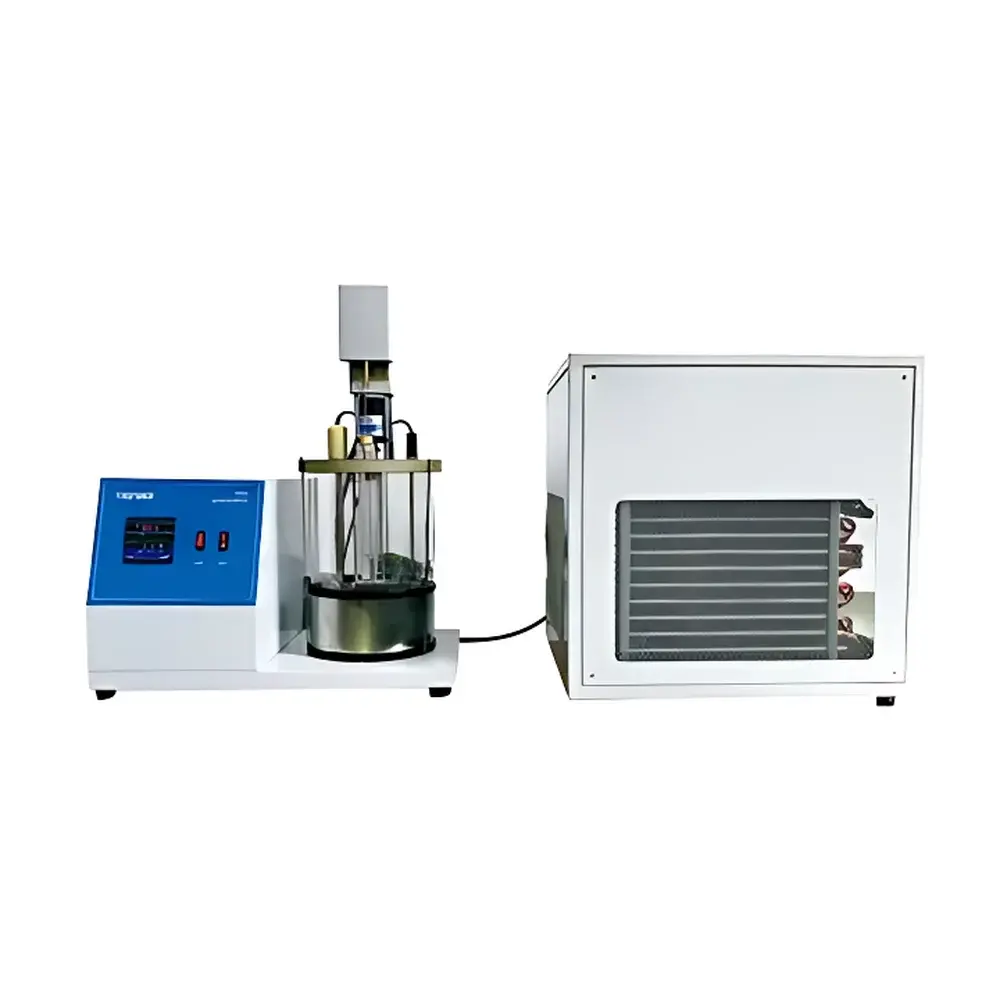
Timepower TP6251 Kinematic Viscosity Tester for Petroleum Products
| Brand | Timepower |
|---|---|
| Origin | Beijing, China |
| Manufacturer | Timepower Instrument Co., Ltd. |
| Country of Origin | China |
| Model | TP6251 |
| Pricing | Upon Request |
| Temperature Control Range | −70 °C to +40 °C |
| Temperature Stability | ≤ ±0.1 °C |
| Bath Configuration | Dual-position circular constant-temperature bath (2 capillary mounting stations) |
| Cooling System | Cascade refrigeration with Danfoss compressors |
| Bath Vessel | Vacuum-insulated Dewar-type bath |
| Power Supply | AC 220 V ±10%, 50 Hz ±10% |
| Heating Power | ≤1000 W |
| Refrigeration Power | 400 W / 500 W |
| Dimensions (Main Unit) | 400 × 400 × 620 mm |
| Dimensions (Refrigeration Unit) | 500 × 570 × 600 mm |
| Net Weight | 80 kg |
| Compliance | GB/T 265–1988 (equivalent to ASTM D445, ISO 3104) |
Overview
The Timepower TP6251 Kinematic Viscosity Tester is a precision-engineered instrument designed specifically for the standardized determination of kinematic viscosity in liquid petroleum products and other Newtonian fluids. It operates on the capillary viscometry principle—measuring the time required for a fixed volume of fluid to flow under gravity through a calibrated glass capillary tube immersed in a thermally stabilized bath. This method conforms rigorously to GB/T 265–1988, which is technically aligned with international standards including ASTM D445 (Standard Test Method for Kinematic Viscosity of Transparent and Opaque Liquids), ISO 3104 (Petroleum products — Determination of kinematic viscosity and calculation of dynamic viscosity), and IP 71. The instrument delivers traceable, repeatable results in mm²/s (cSt), supporting quality control, specification verification, and regulatory compliance across refining, lubricant formulation, fuel blending, and third-party testing laboratories.
Key Features
- High-stability dual-zone temperature control system featuring digital PID regulation, enabling precise setpoint maintenance from −70 °C to +40 °C with deviation ≤ ±0.1 °C—critical for low-temperature diesel, jet fuel, and synthetic lubricant testing.
- Circular Dewar-type constant-temperature bath constructed from vacuum-insulated stainless steel, minimizing thermal gradients and eliminating frost formation during sub-zero operation.
- Dual-capillary mounting stations allow simultaneous conditioning of two viscometers—reducing turnaround time and enhancing throughput without compromising thermal equilibrium.
- Cascade refrigeration architecture incorporating industrial-grade Danfoss compressors ensures reliable, continuous cooling performance even under sustained low-temperature duty cycles.
- Adjustable leveling feet and rigid mechanical design ensure bath horizontal alignment—essential for consistent capillary orientation and gravitational flow integrity per standard requirements.
- Integrated microprocessor-based controller provides real-time display of setpoint and actual bath temperature, intuitive key-based test initiation, and automatic timing and calculation of kinematic viscosity values.
Sample Compatibility & Compliance
The TP6251 is validated for use with transparent and opaque Newtonian liquids—including base oils, finished lubricants, aviation turbine fuels (Jet A-1, JP-8), diesel fuels, biodiesel blends, and hydraulic fluids—provided they meet the cleanliness and volatility criteria specified in GB/T 265 and ASTM D445. Capillary selection (e.g., Ubbelohde, Cannon-Fenske, or Ostwald types) must be matched to expected viscosity range and sample density per standard guidelines. The instrument’s mechanical and thermal architecture supports full compliance with GLP (Good Laboratory Practice) environments; its stable temperature profile, documented calibration traceability, and operator-auditable test logs facilitate audit readiness for ISO/IEC 17025-accredited laboratories and regulatory submissions under CNAS or CMA frameworks.
Software & Data Management
While the TP6251 operates as a standalone benchtop instrument with embedded firmware, it supports manual data recording and export via RS232 serial interface (optional) for integration into LIMS or custom laboratory informatics platforms. All temperature setpoints, measured efflux times, capillary constants, and calculated kinematic viscosity values are retained in non-volatile memory for minimum 100 test cycles. The control unit maintains timestamped event logs—including power-on, temperature stabilization confirmation, test start/stop, and error flags—enabling full procedural traceability. When deployed in regulated environments (e.g., refinery QC labs subject to internal QA protocols or contract testing facilities serving API-certified clients), the device supports 21 CFR Part 11-compliant data handling when paired with validated external software for electronic signature and audit trail generation.
Applications
- Quality assurance of mineral and synthetic lubricants per OEM specifications (e.g., SAE J300, API categories).
- Batch release testing of aviation turbine fuels per ASTM D1655 Annex A1 and DEF STAN 91-91.
- Monitoring viscosity stability during long-term oxidation studies (ASTM D2896, D4310).
- Verification of cold-flow properties in winter-grade diesel (EN 590, ASTM D975) via low-temperature kinematic viscosity assessment at −20 °C or −30 °C.
- Supporting R&D of bio-based lubricants and alternative fuels where viscosity-temperature behavior dictates pumpability and film strength.
- Calibration verification of secondary viscometers using certified reference oils (CRM) traceable to NIST SRM 2783 or equivalent.
FAQ
What standards does the TP6251 comply with?
It fully implements GB/T 265–1988 and is functionally compatible with ASTM D445, ISO 3104, and IP 71 for kinematic viscosity measurement.
Can the instrument operate continuously at −70 °C?
Yes—the cascade refrigeration system and Dewar bath design enable sustained operation at −70 °C, provided ambient conditions remain within 5–40 °C and relative humidity ≤80% RH.
Is capillary calibration included with the instrument?
No—capillary viscometers must be individually calibrated by an accredited metrology lab; Timepower supplies certified capillary constant certificates upon request when purchasing matched viscometer sets.
How is temperature uniformity verified across the bath?
The circular geometry, insulated construction, and dual-point immersion probe placement (per GB/T 265 Annex B) ensure axial and radial thermal homogeneity within ±0.05 °C over the active measurement zone.
Does the TP6251 support automated data export?
Standard configuration includes manual readout; optional RS232 output enables ASCII-formatted data streaming for integration with external acquisition or LIMS software.



