
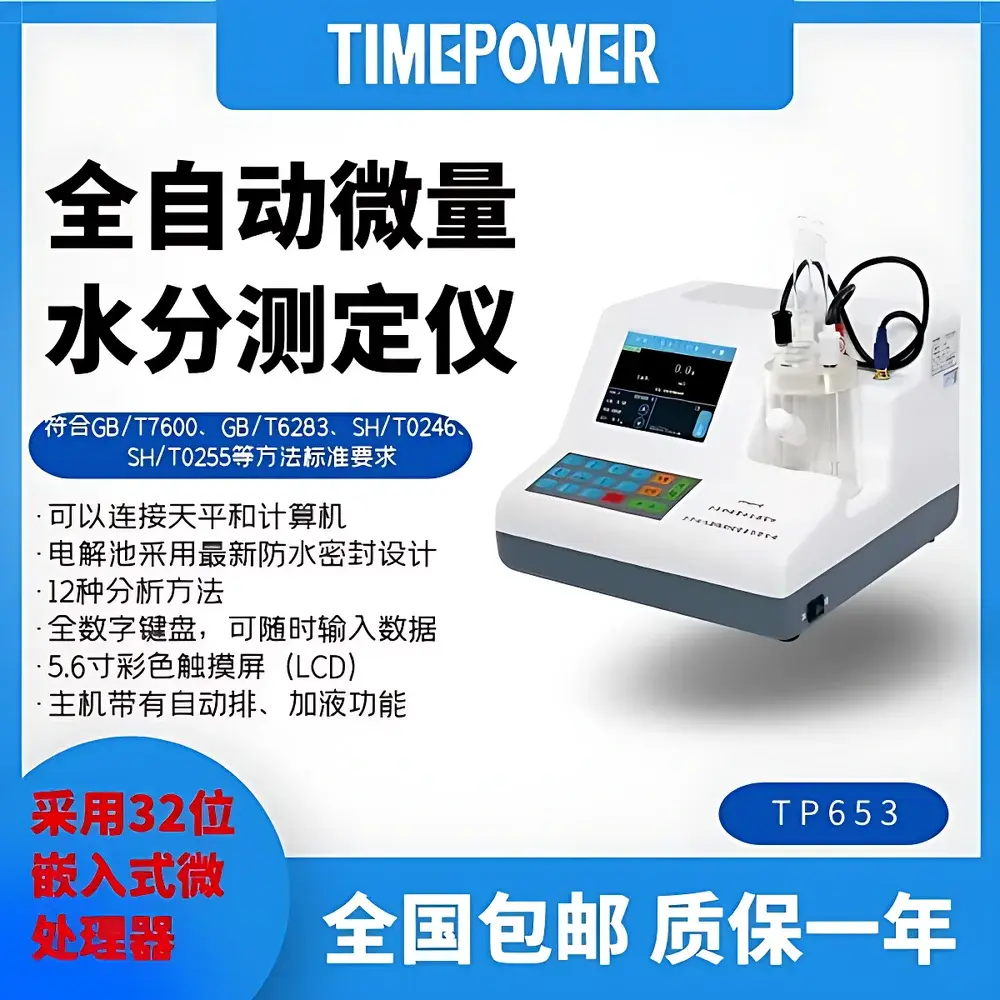
TimePower TP653 Automated Coulometric Karl Fischer Moisture Analyzer
| Brand | TimePower |
|---|---|
| Model | TP653 |
| Principle | Coulometric Karl Fischer Titration |
| Measurement Range | 3 µg – 100 mg H₂O |
| Resolution | 0.1 µg |
| Accuracy | ±3 µg (for 3 µg–1 mg), ±0.3% (for >1 mg, excluding sample introduction error) |
| Electrolysis Current | 0–400 mA (auto-controlled) |
| Display | 5.6-inch color TFT touchscreen LCD |
| Data Interface | RS-232 for balance & PC connectivity |
| Printer | Built-in thermal printer |
| Operating Environment | 20–30 °C, ≤85% RH |
| Power Supply | AC 220 V ±10%, 50 Hz ±10% |
| Power Consumption | ≤40 W |
| Dimensions | 300 × 290 × 200 mm |
| Weight | 3.7 kg |
| Compliance | GB/T 7600, GB/T 6283, SH/T 0246, SH/T 0255 |
| Application Scope | Liquids, solids, and gases across petroleum, power, pharmaceutical, chemical, agrochemical, and food industries |
Overview
The TimePower TP653 Automated Coulometric Karl Fischer Moisture Analyzer is an engineered solution for trace water quantification in laboratory and quality control environments where high sensitivity, repeatability, and regulatory alignment are critical. It operates on the fundamental electrochemical principle of coulometric Karl Fischer titration—where iodine is generated *in situ* via controlled electrolysis at the anode, reacting stoichiometrically with water according to the Faraday law (1 mole of I₂ ≡ 1 mole of H₂O). This method eliminates the need for standardized titrant solutions, thereby removing volumetric calibration drift and enabling sub-microgram-level detection without manual reagent standardization. The instrument is specifically designed for applications demanding compliance with internationally referenced test methods—including GB/T 7600 (for insulating oils), GB/T 6283 (general chemical products), SH/T 0246 (light petroleum products), and SH/T 0255 (additives)—making it suitable for routine use in ISO/IEC 17025-accredited labs and GMP-regulated facilities.
Key Features
- Coulometric generation of iodine with fully automated current regulation (0–400 mA), ensuring optimal reaction kinetics across diverse sample matrices
- High-resolution detection limit of 0.1 µg water, with verified accuracy of ±3 µg for measurements between 3 µg and 1 mg, and ±0.3% RSD for quantities above 1 mg
- Integrated 5.6-inch color TFT touchscreen interface with intuitive icon-driven navigation and dual-input support (touch + physical keys) for glove-compatible operation
- Onboard thermal printer for immediate hardcopy reporting with timestamp, sample ID, result, and method parameters
- RS-232 serial interface supporting bidirectional communication with analytical balances and host PCs for automated mass input and data export
- Compact benchtop architecture (300 × 290 × 200 mm; 3.7 kg) optimized for space-constrained QC laboratories and production floor deployment
- Low-power design (<40 W) with wide-input AC tolerance (220 V ±10%, 50 Hz ±10%) for stable operation in variable utility conditions
Sample Compatibility & Compliance
The TP653 accommodates a broad spectrum of sample types—including volatile liquids (e.g., methanol, acetone, THF), viscous oils (transformer oil, lubricants), hygroscopic solids (APIs, excipients, catalysts), and pressurized gas samples (via optional gas sampling kit). Its coulometric cell configuration minimizes reagent consumption and cross-contamination risk, particularly advantageous for low-water-content samples (<100 ppm) or when analyzing reactive solvents such as aldehydes or ketones. Method validation documentation supports alignment with pharmacopeial requirements (USP , EP 2.5.12) and industrial standards (ASTM D6304, ASTM D4928). The system’s fixed electrode geometry and sealed cell design ensure long-term stability under GLP/GMP audit conditions, with full traceability of measurement events—including operator ID, calibration logs, and environmental monitoring flags.
Software & Data Management
While the TP653 operates autonomously via its embedded firmware, its RS-232 interface enables integration into LIMS or ELN platforms through ASCII-based command protocols. All measurement records include mandatory metadata: date/time stamp, sample identifier, electrode status, electrolysis charge (coulombs), calculated water mass (µg), and %RSD against method-defined replicates. Audit trail functionality—though not native to the device firmware—is supported via external logging software compliant with FDA 21 CFR Part 11 when paired with validated PC-based acquisition tools. Raw data export (CSV format) preserves all intermediate values for statistical process control (SPC) analysis and trending per ICH Q5E guidelines.
Applications
- Power industry: moisture verification in transformer oil per IEC 60814 and GB/T 7600 to prevent dielectric breakdown
- Petrochemical QA: water content screening in jet fuel (ASTM D6304), biodiesel (EN 14971), and refinery intermediates
- Pharmaceutical manufacturing: residual solvent analysis in lyophilized products and raw material release testing per USP
- Agrochemical development: quantification of water in pesticide formulations and active ingredient batches
- Food-grade solvent certification: verification of anhydrous ethanol, glycerin, and propylene glycol per AOAC 982.12
- Research laboratories: kinetic studies of hydrolysis reactions and moisture sorption isotherms in polymer films
FAQ
What sample types can be analyzed using the TP653?
Liquid, solid, and gaseous samples—provided they are compatible with Karl Fischer chemistry and do not react with iodine, sulfur dioxide, or methanol.
Is the instrument compliant with 21 CFR Part 11 for electronic records?
The TP653 itself does not provide built-in Part 11 features (e.g., electronic signatures, audit trails); however, its data output is compatible with validated third-party software that implements these controls.
How often does the reagent require replacement?
Reagent lifetime depends on usage frequency and sample water load; typical capacity is 1–2 g of water per 100 mL of electrolyte, with end-of-life signaled by prolonged endpoint stabilization or increased background current.
Can the TP653 be used for Karl Fischer titration of aldehydes or ketones?
Yes—its coulometric mode reduces side-reaction interference compared to volumetric methods; however, use of aldehyde-specific reagents (e.g., two-component systems with imidazole-based buffers) is recommended for improved accuracy.
Does the system support automatic sample weighing integration?
Yes—via RS-232 connection to METTLER TOLEDO, SARTORIUS, or other ASCII-compatible analytical balances; mass data is auto-imported upon stabilization.







