
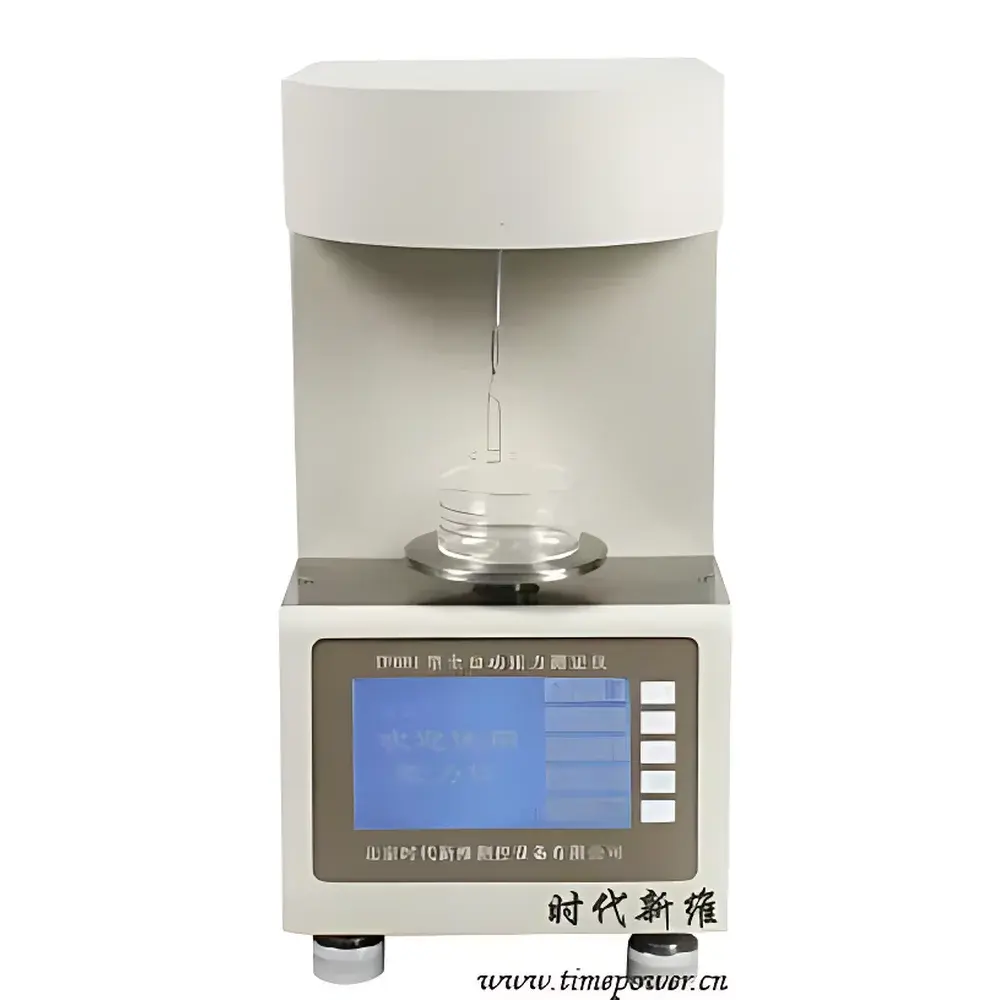
TimePower TP681 Automatic Interfacial Tensiometer
| Brand | TimePower |
|---|---|
| Origin | Beijing, China |
| Manufacturer | TimePower Measurement & Control Co., Ltd. |
| Type | Domestic Industrial Instrument |
| Model | TP681 |
| Price | Upon Request |
| Measuring Principle | Du Noüy Ring Method (Non-equilibrium Mode) |
| Full Scale Range | 5–100 mN/m (for insulating oils) |
| Accuracy | ±0.5% of full scale |
| Resolution | 0.1 mN/m |
| Sensitivity | 0.1 mN/m |
| Temperature Compensation | Automatic, with integrated Pt100 sensor |
| Data Storage | Up to 255 test records with timestamp (RTC-backed, 10-year battery-backed retention) |
| Communication Interface | RS-232 serial port |
| Display | Backlit LCD (character-based, Chinese-capable) |
| Printer | Built-in thermal printer (36-character line, Chinese/English support) |
| Power Supply | AC 220 V ±20%, 50 Hz, max. 40 W |
| Operating Environment | 10–30 °C, ≤85% RH |
| Lifting Speed | 0.3–0.4 mm/s |
| Dimensions (W×D×H) | 265 × 190 × 375 mm |
| Weight | 8.84 kg |
| Compliance | GB/T 6541–2015, ISO 6295:1983, ASTM D971 (indirectly applicable via ring method equivalence) |
Overview
The TimePower TP681 Automatic Interfacial Tensiometer is an industrial-grade analytical instrument engineered for precise and repeatable measurement of surface tension and interfacial tension (IFT) between immiscible liquid phases—particularly mineral oil and water—using the standardized Du Noüy ring method under controlled non-equilibrium conditions. Designed in strict accordance with GB/T 6541–2015 and ISO 6295:1983, the system delivers traceable, metrologically sound results essential for quality control in transformer oil laboratories, petrochemical R&D, lubricant formulation, and insulating fluid monitoring. Its core measurement architecture relies on electromagnetic force compensation, where the vertical pull required to detach a calibrated platinum-iridium ring from the liquid interface is quantified in real time. This principle enables direct determination of interfacial energy in mN/m, with built-in temperature sensing and automatic thermal correction ensuring data integrity across ambient fluctuations.
Key Features
- Dual-CPU microcontroller architecture for synchronized motor control, sensor signal processing, and real-time arithmetic correction
- Multi-point linearization algorithm applied to electromagnetic force sensor output, compensating for inherent nonlinearity across the full dynamic range
- Integrated Pt100 temperature probe with auto-sampling at test initiation; temperature-dependent correction applied per ASTM D1250 and IEC 60296 guidelines
- Non-volatile memory storage supporting up to 255 complete test records—including date, time, tension value, temperature, and operator ID—retained for 10 years without power
- Real-time clock (RTC) with calendar function and battery backup, enabling GLP-compliant audit trails for regulatory documentation
- Thermal line printer with native Chinese character support (GB2312 encoding), producing hard-copy reports with 36-character width and embedded metadata
- RS-232 serial interface compliant with EIA/TIA-232-F standards, facilitating integration into LIMS or custom QC software via ASCII command protocol
- Intelligent screen-saver logic reducing LCD duty cycle by >70%, extending display lifetime in continuous operation environments
Sample Compatibility & Compliance
The TP681 is validated for use with insulating oils (e.g., naphthenic and paraffinic transformer oils), hydrocarbon-based lubricants, diesel fuels, and aqueous electrolyte solutions. It reliably detects hydrophilic oxidation byproducts—including low-molecular-weight carboxylic acids and alcohols—that reduce interfacial tension at the oil–water boundary—a critical indicator of aging and contamination per IEEE C57.106 and IEC 60429. The instrument meets national standard GB/T 6541–2015 (equivalent to ISO 6295) for interfacial tension testing of insulating oils and conforms to the physical measurement requirements outlined in ASTM D971 (Standard Test Method for Interfacial Tension of Oil Against Water by the Ring Method). While not certified to FDA 21 CFR Part 11, its data logging architecture supports ALCOA+ principles (Attributable, Legible, Contemporaneous, Original, Accurate, Complete, Consistent, Enduring, Available) when deployed within GxP-aligned workflows.
Software & Data Management
No proprietary PC software is bundled; however, the RS-232 interface supports ASCII-based communication using standard AT-style command sets (e.g., “READ?”, “STORE”, “CLEAR”). Raw output includes timestamped tension values (mN/m), measured temperature (°C), and status flags (e.g., “OK”, “OVERLOAD”, “TEMP_ERR”). Third-party applications—including LabVIEW VI templates, Python pySerial scripts, and Excel VBA macros—are widely deployed in user labs for automated report generation and statistical process control (SPC). All stored records are retrievable via serial query or printed directly; no encryption or digital signature is applied, maintaining transparency for internal validation protocols.
Applications
- Condition monitoring of transformer insulating oils per IEEE Std C57.104 and IEC 60429
- Quality assurance of new and reclaimed turbine oils and hydraulic fluids
- Quantification of surfactant efficacy in enhanced oil recovery (EOR) formulations
- Stability assessment of oil-in-water emulsions in food-grade lubricants
- Detection of polar contaminants and oxidation degradation products in hydrocarbon streams
- Research-grade interfacial thermodynamics studies requiring reproducible ring-method data
FAQ
What standards does the TP681 comply with?
It complies with GB/T 6541–2015 and ISO 6295:1983 for interfacial tension measurement of insulating oils and petroleum products.
Is temperature compensation automatic?
Yes—the integrated Pt100 sensor samples temperature at test initiation and applies correction using polynomial coefficients derived from calibration data.
Can test data be exported to a computer?
Yes, via RS-232 serial interface using ASCII commands; no driver installation is required.
How many test results can be stored internally?
Up to 255 full records, each containing tension value, temperature, date, time, and sequence ID.
What is the lifting speed of the platinum ring?
0.3–0.4 mm/s, optimized for consistent meniscus detachment in accordance with ISO 6295 Annex A.
Does the instrument support GLP documentation requirements?
It provides timestamped, operator-identifiable records and battery-backed RTC—sufficient for basic GLP traceability when paired with procedural controls.





