
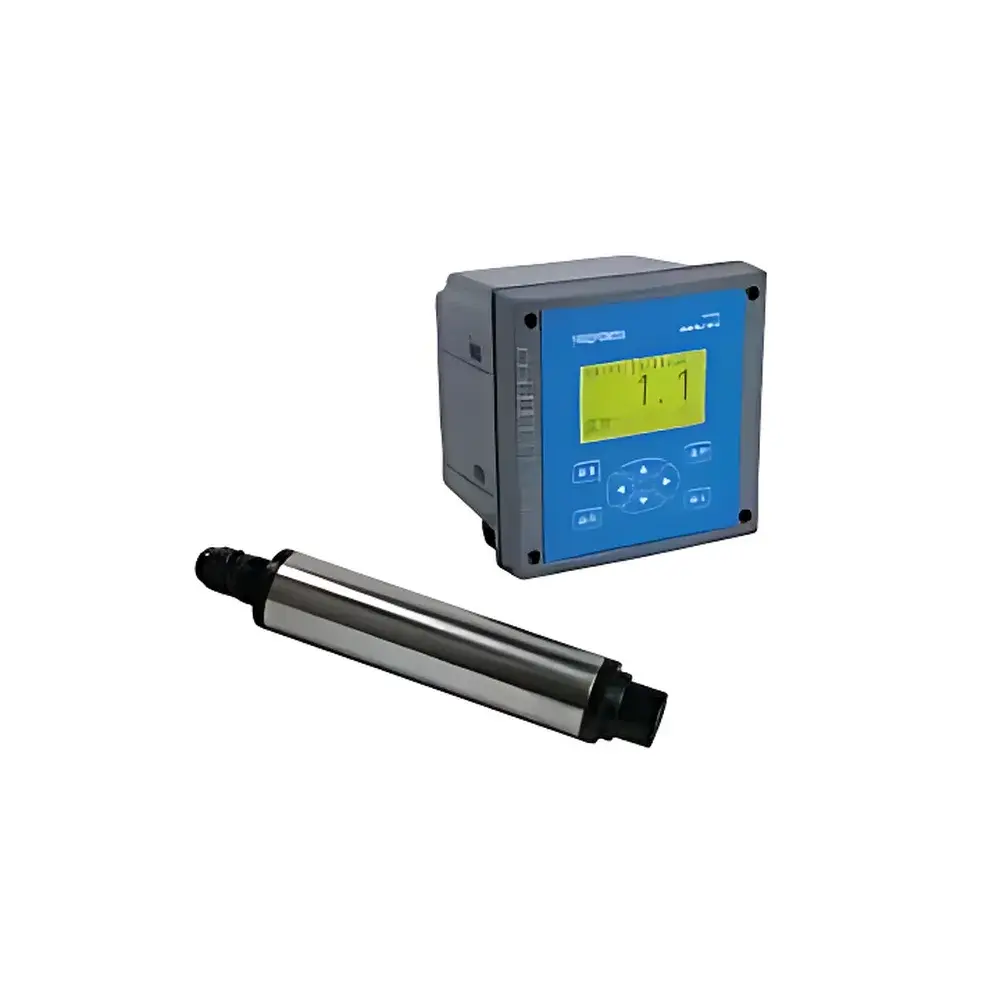
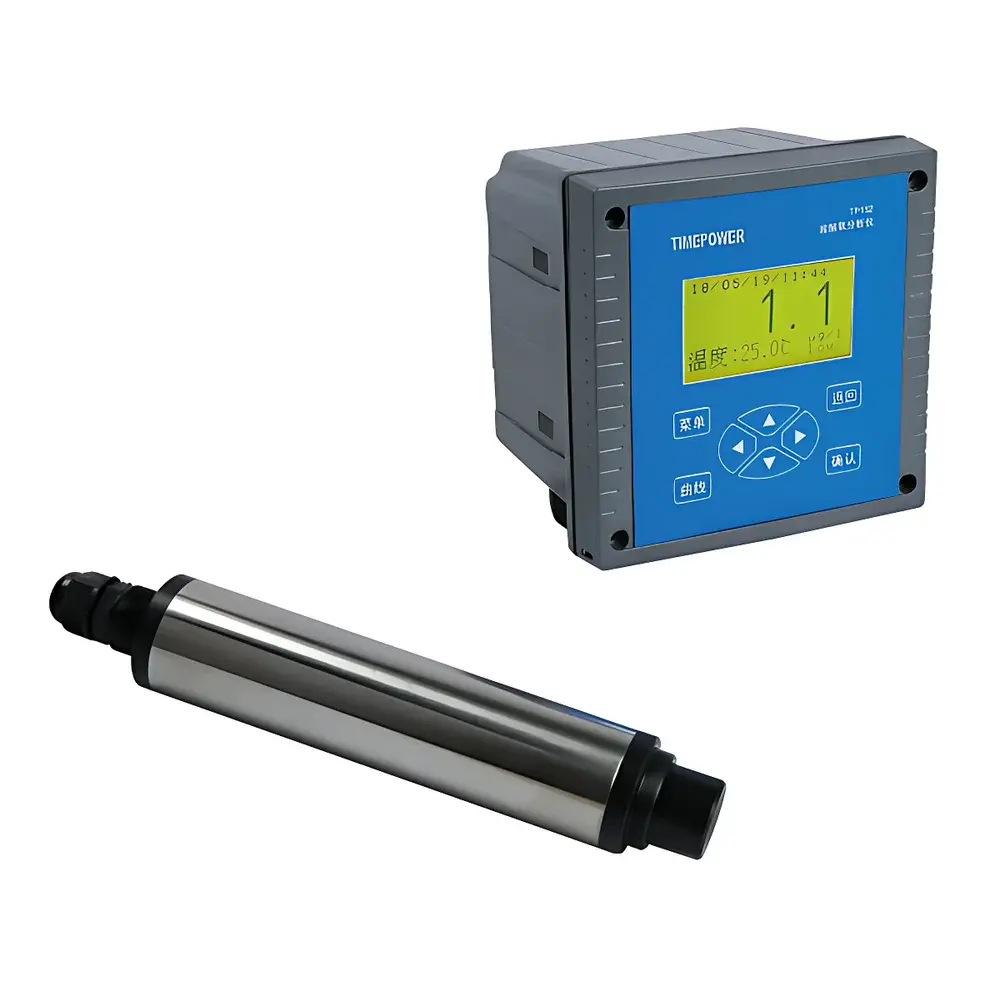
Timepower TP152 Fluorescence-Based Dissolved Oxygen Monitor
| Brand | Timepower |
|---|---|
| Origin | Beijing, China |
| Manufacturer Type | OEM/ODM Manufacturer |
| Country of Origin | China |
| Model | TP152 |
| Output Signals | (0–10) mA, (0–20) mA, (4–20) mA (selectable) |
| Load Impedance | < 300 Ω |
| Relay Output | AC 220 V / 3 A or DC 30 V / 3 A |
| Power Supply | AC (85–265) V, 45–65 Hz |
| Power Consumption | ≤ 15 W |
| Display | 128 × 64 LCD, Chinese interface |
| Measurement Range | (0.00–20.00) mg/L |
| Resolution | 0.01 mg/L |
| Repeatability | ≤ 1% |
| Accuracy | ±1.5% FS |
| Response Time (T90) | < 5 min at 25 °C |
| Temperature Compensation Range | (0.0–60.0) °C |
| Sample Temperature Range | (5–60) °C |
| Ambient Temperature Range | (5–45) °C |
| Relative Humidity | ≤ 90% RH (non-condensing) |
| Storage & Transport Temp. | (−25–55) °C (electrode ≥ 0 °C) |
| Enclosure Rating | IP65 |
| Dimensions (H×W×D) | 145 mm × 120 mm × 150 mm |
| Panel Cutout | 138 mm × 138 mm |
| Weight | 0.64 kg |
| Data Retention | > 10 years after power loss |
Overview
The Timepower TP152 is a high-stability, fluorescence-based online dissolved oxygen (DO) monitor engineered for continuous, maintenance-light operation in environmental monitoring, wastewater treatment, aquaculture, and industrial process control applications. It operates on the principle of fluorescence quenching—where molecular oxygen modulates the lifetime and intensity of fluorescent emission from a specialized luminophore embedded in a sensing cap. Upon excitation by blue light (typically ~470 nm), the fluorophore emits red light (~600 nm); the presence of dissolved O₂ molecules non-radiatively deactivates the excited state, shortening the phase shift and reducing emission intensity in proportion to DO concentration. Unlike electrochemical Clark-type sensors, the TP152 requires no membrane replacement, electrolyte refilling, anode polishing, or polarization time—eliminating drift sources and enabling true static-water measurement without flow dependency.
Key Features
- Fluorescence lifetime-phase detection method ensures long-term stability, zero oxygen consumption, and immunity to common interferents including H₂S, CO₂, Cl⁻, and heavy metal ions.
- Integrated stainless-steel housing with IP65-rated enclosure provides electromagnetic shielding and corrosion resistance suitable for harsh indoor/outdoor installations.
- No calibration required under stable operating conditions; optional one-point air-saturation or zero-oxygen (sodium sulfite) calibration supported via intuitive Chinese-language menu navigation.
- Dual-channel signal output: configurable analog current output (0–10 mA, 0–20 mA, or 4–20 mA) with load impedance < 300 Ω, plus programmable relay alarm (AC 220 V / 3 A or DC 30 V / 3 A).
- Onboard data logging with circular buffer storage; retained measurements persist >10 years after power interruption via non-volatile memory.
- Robust optical sensor design: fluorophore-coated cap withstands minor abrasion and partial fouling; cleaning requires only mild detergent and soft cloth—no solvent immersion or mechanical scrubbing.
- Wide operational temperature range (5–60 °C sample; 5–45 °C ambient) with automatic temperature compensation (0.0–60.0 °C) meeting ASTM D888 and ISO 5814 requirements for DO measurement consistency.
Sample Compatibility & Compliance
The TP152 is validated for use across freshwater, seawater (with salinity compensation enabled), municipal and industrial wastewater, bioreactor effluents, and recirculating aquaculture systems. Its optical sensing mechanism avoids electrochemical cross-sensitivity, making it compatible with chemically aggressive matrices where traditional amperometric probes fail. The instrument complies with general functional safety expectations for Class I, Division 2 hazardous locations (when installed per local electrical codes) and supports traceable calibration documentation required under GLP and ISO/IEC 17025 laboratory quality systems. While not pre-certified to UL/CE for standalone listing, its power supply meets IEC 61000-4 EMC immunity standards, and its analog outputs conform to NAMUR NE43 signal fault detection conventions.
Software & Data Management
The TP152 operates as a stand-alone analyzer with no external software dependency. All configuration—including relay setpoints, output scaling, damping factor, and temperature compensation mode—is accessible through its built-in 128×64 monochrome LCD with tactile keypad. Logged data (timestamped DO values, temperature, and system status flags) can be reviewed directly on-screen or exported via optional RS485 Modbus RTU interface (not standard; available upon request). When integrated into SCADA or DCS platforms, the device supports full read/write register access for remote parameter adjustment and alarm acknowledgment—enabling audit-trail-capable operation aligned with FDA 21 CFR Part 11 principles when paired with compliant host systems.
Applications
- Real-time DO surveillance in activated sludge basins, oxidation ditches, and membrane bioreactors (MBRs)
- Process optimization in aerobic digesters and nitrification-denitrification control loops
- Environmental compliance monitoring at wastewater discharge points per EPA Method 360.1 and ISO 5815-1
- Quality assurance in pharmaceutical water-for-injection (WFI) distribution loops (supplemental use)
- Long-term ecological studies in rivers, lakes, and estuarine zones using fixed-mount or buoy-deployed configurations
- Recirculating aquaculture system (RAS) health management, including hypoxia early-warning deployment
FAQ
Does the TP152 require regular recalibration?
Under stable installation conditions and clean sensor caps, recalibration is not routinely necessary. However, periodic verification against a certified reference standard (e.g., Winkler titration or NIST-traceable DO standard solution) is recommended every 3–6 months for regulatory reporting or QA/QC workflows.
Can the TP152 be used in seawater applications?
Yes—the optical sensor is inherently insensitive to chloride ion interference. For accurate absolute concentration reporting in saline media, users must enable salinity compensation in the instrument’s setup menu using measured conductivity or known salinity value.
What mounting options are available for the DO probe?
The sensor supports submersible (direct immersion), flanged (ANSI/DIN 150/300 mm), flow-through (inline adapter kits), and custom-engineered fixtures—including underwater housings and retractable assemblies—subject to engineering consultation.
Is the analog output intrinsically safe?
No—the standard 4–20 mA output is non-isolated and not intrinsically safe rated. For hazardous area installations, a separately powered, certified isolator or barrier must be deployed between the TP152 and the receiving control system.
How is firmware updated?
Firmware revision is factory-programmed and not field-upgradable. Timepower releases hardware revisions (e.g., TP152-V2) with enhanced thermal stability and extended low-temperature performance; legacy units may be upgraded via authorized service centers.
Related Products






