
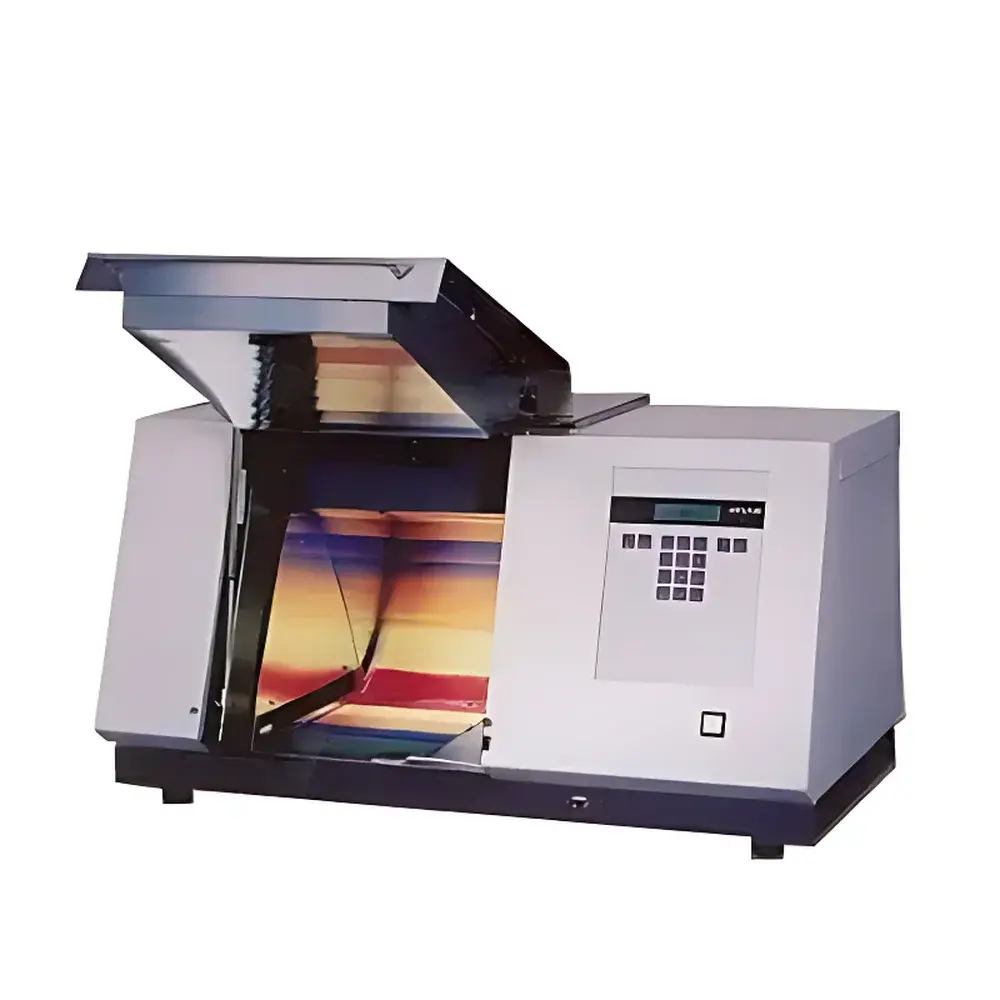
GZRM-AIR-X11 Xenon Arc Weathering Test Chamber
| Origin | Tianjin, China |
|---|---|
| Manufacturer Type | Authorized Distributor |
| Origin Category | Domestic (China) |
| Model | GZRM-AIR-X11 |
| Pricing | Available Upon Request |
| Cooling Method | Air-Cooled Xenon Lamp |
| Lamp Power | 1100 W |
| Exposure Area | 560 cm² |
| Spectral Range for Irradiance Control | 300–800 nm |
| Irradiance Control Range | 250–765 W/m² |
| Black Standard Temperature Control & Monitoring | Yes |
| Chamber Air Temperature Control & Monitoring | Yes |
| Microprocessor-Based Control System with LCD Display | Yes |
| End-of-Test Trigger Options | Time or Cumulative Irradiance (kJ/m²) |
| Communication Interface | RS232 Serial Port |
| Alarm Notification System | Yes |
| Electrical Protection Features | Yes |
Overview
The GZRM-AIR-X11 Xenon Arc Weathering Test Chamber is an engineered environmental simulation system designed to replicate the damaging effects of full-spectrum sunlight, heat, and moisture on material surfaces. It employs a 1100 W air-cooled xenon arc lamp as its radiation source, delivering spectral energy distribution closely aligned with natural solar irradiance—particularly critical in the 300–800 nm range where photodegradation, fading, chalking, cracking, and gloss loss are initiated. Unlike UV fluorescent or metal halide sources, xenon arc technology provides broadband irradiance that includes near-UV, visible, and near-infrared wavelengths, enabling realistic assessment of photochemical and thermal degradation mechanisms. This chamber is purpose-built for accelerated weathering evaluation in quality assurance, R&D, and regulatory compliance workflows across textile, polymer, automotive, coating, and packaging industries.
Key Features
- Air-cooled 1100 W xenon arc lamp with calibrated spectral output compliant with CIE 85:2014 and ISO 4892-2 requirements
- Precise irradiance control across 300–800 nm, adjustable from 250 to 765 W/m² with real-time feedback and digital display
- Black standard temperature (BST) regulation (typically 30–100°C range) with PID-controlled heating and high-stability thermocouple monitoring
- Chamber air temperature control (typically 10–80°C) integrated with forced convection and humidity management interface
- Microprocessor-based controller with backlit LCD interface supporting programmable test profiles, multi-step cycles, and event logging
- Configurable termination criteria: elapsed time or cumulative radiant exposure (kJ/m²), traceable and auditable
- RS232 serial communication port for remote parameter upload/download, data export, and integration into LIMS or MES environments
- Comprehensive safety architecture including over-temperature cutoff, lamp arc fault detection, door interlock, and mains surge protection
Sample Compatibility & Compliance
The GZRM-AIR-X11 accommodates flat-panel specimens up to 560 cm² total exposure area, compatible with standard specimen holders per ASTM D6695 and ISO 11341. Its optical geometry and filter configuration support multiple exposure configurations—including open-face, closed-face, and filtered irradiance modes—to meet application-specific spectral requirements. The system is validated for conformance with internationally recognized standards including ASTM G151 (standard practice for exposing nonmetallic materials), ASTM G155 (xenon-arc exposure apparatus), ASTM D3424 (colorfastness to light), ISO 4892-2 (plastics—methods of exposure to laboratory light sources), ISO 11341 (paints and varnishes), ICH Q1B (photostability testing of pharmaceuticals), and Qualicoat/EN 12206-1 for architectural aluminum coatings. All operational parameters are traceable to NIST-traceable radiometric calibration protocols.
Software & Data Management
While the GZRM-AIR-X11 operates autonomously via its embedded microcontroller, its RS232 interface enables bidirectional communication with external PCs running Windows-based configuration and reporting software (optional). Users may define multi-segment test programs—including irradiance ramping, BST setpoint transitions, and dwell periods—and download them directly to the controller. Real-time operational data—including irradiance value, BST, chamber temperature, elapsed time, and cumulative dose—is timestamped and stored internally. Exported logs comply with GLP/GMP documentation requirements, supporting audit-ready records for FDA 21 CFR Part 11–aligned environments when paired with appropriate electronic signature and audit trail add-ons.
Applications
- Evaluation of colorfastness and photostability in dyed textiles, leather, and synthetic fibers per AATCC TM16, ISO 105-B02, and GB/T 8427
- Accelerated aging of automotive interior trims, exterior body panels, and headlamp lenses under SAE J2412/J2527 protocols
- Photodegradation resistance testing of architectural coatings, PVC window profiles, and roofing membranes per ASTM D4329 and ISO 11979-5
- Stability assessment of printed packaging substrates (flexographic, gravure, digital inks) under simulated retail lighting conditions
- Regulatory photostability studies for medical device polymers and pharmaceutical packaging per ICH Q1B and USP <1122>
- Outdoor durability qualification of geotextiles, marine ropes, and camping gear per RILEM DBS and EPA/ASTM E896 guidelines
FAQ
What spectral filters are supported by the GZRM-AIR-X11?
The chamber supports standard Daylight (Q/B), Window Glass (WG), and Extended UV (XU) filter combinations, each configured to meet specific ASTM and ISO spectral cut-off requirements.
Is humidity control integrated into this model?
The base GZRM-AIR-X11 does not include built-in humidification; however, it features a dedicated port and control interface for optional external humidifier integration per ISO 4892-2 Annex A.
How is irradiance calibrated and maintained?
Calibration is performed using a NIST-traceable reference spectroradiometer prior to commissioning. Field verification is supported via user-accessible calibration mode and periodic recalibration using certified reference sensors.
Can test data be exported in CSV or XML format?
Yes—via RS232, the controller supports ASCII-formatted data dumps compatible with spreadsheet applications and LIMS ingestion pipelines.
Does the system support GLP-compliant audit trails?
The embedded controller logs all parameter changes, alarm events, and test completions with timestamps. Full GLP compliance requires supplemental software with electronic signatures and immutable audit trail generation.



