
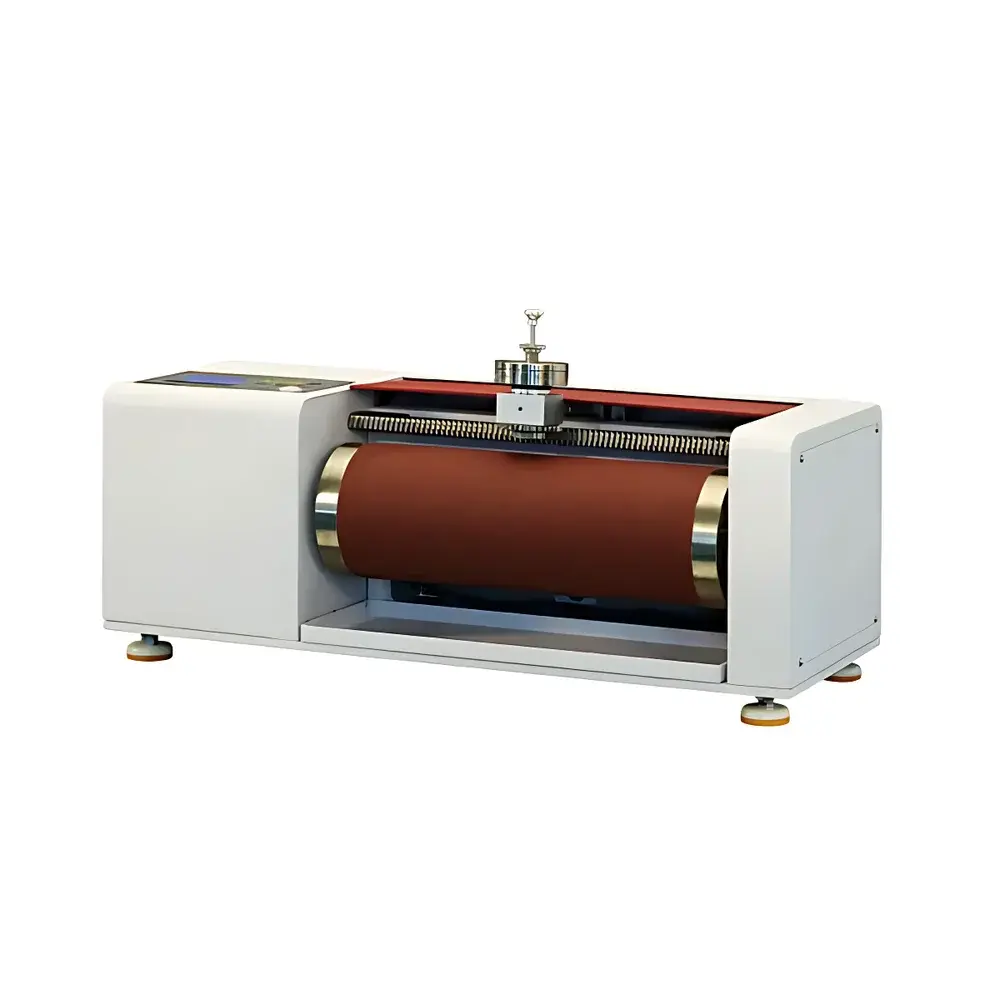
DIN Abrasion Tester HY-766-1 by HENGYU
| Brand | HENGYU |
|---|---|
| Origin | Tianjin, China |
| Model | HY-766-1 |
| Roller Diameter | 150 mm |
| Test Modes | Rotating & Non-Rotating Specimen Mounting |
| Dimensions (L×W×H) | 95 × 66 × 31 cm |
| Weight | 55 kg |
| Power Supply | AC 220 V, 50 Hz, 500 W |
| Operating Environment | 23 ± 2 °C, 50 ± 5 % RH |
| Compliance | GB/T 9867–2008, ISO 4649:2002, GB/T 26703–2011, DIN 53516 |
Overview
The DIN Abrasion Tester HY-766-1 is a precision-engineered tribological testing instrument designed to quantify the abrasive wear resistance of elastomeric and polymeric materials under standardized mechanical stress. It operates on the principle of controlled abrasive contact between a rotating abrasive wheel (150 mm diameter) and a flat, clamped test specimen—mimicking real-world service conditions such as rolling friction in conveyor belts, tread wear in tires, or sole abrasion in footwear. Unlike dynamic sliding or pin-on-disk configurations, the DIN method employs a fixed-angle, constant-load geometry where the specimen either rotates with the abrading wheel (rotating mode) or remains stationary (non-rotating mode), enabling direct comparison across material batches per ISO 4649:2002 and DIN 53516. The system delivers quantifiable metrics including mass loss (mg), volume loss (mm³), surface profile degradation, and wear depth—parameters directly traceable to field performance and essential for QC/QA release protocols in rubber compound development and production.
Key Features
- Compliant dual-mode operation: supports both rotating and non-rotating specimen configurations per DIN 53516 and ISO 4649:2002 requirements
- Stable, low-inertia 150 mm abrasive roller with precise axial alignment and consistent surface finish to ensure inter-laboratory reproducibility
- Fixed-load loading mechanism delivering calibrated normal force without pneumatic or servo variability—optimized for long-duration wear cycles
- Robust cast-iron frame and vibration-damped base structure ensuring mechanical stability during extended test runs (up to 1,000 revolutions)
- Integrated digital timer and revolution counter with manual reset functionality for accurate cycle tracking and endpoint determination
- Modular specimen holder accommodating standard rectangular specimens (e.g., 25 × 25 × 6 mm) with repeatable clamping pressure and edge alignment
- Compact footprint (95 × 66 × 31 cm) and 55 kg mass optimized for benchtop deployment in ISO 17025-accredited laboratories
Sample Compatibility & Compliance
The HY-766-1 is validated for use with vulcanized rubber compounds, thermoplastic elastomers (TPEs), polyurethane soles, synthetic turf infill materials, and asphalt-modified polymer surfaces. It meets the dimensional, loading, and procedural specifications outlined in GB/T 9867–2008 (equivalent to ISO 4649), GB/T 26703–2011 (for rubber track surfaces), and DIN 53516 (German standard for rubber abrasion testing). While not temperature-controlled, its design assumes ambient conditioning per ISO 23529:2016—requiring specimens to be equilibrated at 23 ± 2 °C and 50 ± 5 % RH for minimum 16 hours prior to testing. Results are reported in accordance with ISO 5725 for precision estimation and support GLP documentation workflows when paired with certified analytical balances (0.1 mg resolution) and calibrated micrometers.
Software & Data Management
The HY-766-1 is a manually operated, hardware-only instrument with no embedded microcontroller or digital interface. All data acquisition—including pre-test mass (measured on external analytical balance), post-test mass, specimen dimensions, and revolution count—is recorded manually into laboratory notebooks or LIMS-compatible spreadsheets. This architecture ensures full auditability, eliminates firmware-related validation burdens, and aligns with FDA 21 CFR Part 11 Annex 11 expectations for instruments used in GMP-regulated environments where electronic records are not generated at the device level. Users are advised to implement SOPs covering calibration of ancillary equipment (e.g., balances traceable to NIST standards), environmental monitoring logs, and technician training verification—practices routinely verified during ISO/IEC 17025 accreditation audits.
Applications
- Quality control of rubber conveyor belt compounds across mining, logistics, and food processing industries
- Tread compound screening during tire R&D, supporting correlation studies between DIN abrasion index and road mileage
- Footwear sole formulation optimization, particularly for athletic, industrial, and safety footwear segments
- Performance validation of synthetic running track surfaces per IAAF (now World Athletics) technical specifications
- Comparative wear assessment of recycled rubber crumb blends used in playground surfacing and noise-dampening mats
- Supplier qualification testing where ISO 4649 compliance is contractually mandated
FAQ
Does the HY-766-1 include temperature or humidity control?
No. The instrument is designed for ambient-condition testing per ISO 23529:2016. Environmental control must be maintained externally via laboratory HVAC systems.
Is the abrasive wheel supplied with the unit?
Yes—the system includes one standard DIN-certified abrasive wheel (Al₂O₃, grain size P100, bonded to steel hub) compliant with ISO 4649 Annex A.
Can test results be exported to LIMS?
Direct export is not supported. However, structured manual entry into LIMS or Excel-based templates is fully compatible with 21 CFR Part 11-compliant electronic signatures when paired with documented procedures.
What maintenance is required?
Monthly visual inspection of roller surface integrity, cleaning of dust accumulation from the specimen chamber, and annual verification of load application accuracy using calibrated deadweights.
Is third-party calibration certification available?
HENGYU provides factory verification reports. Full ISO/IEC 17025 calibration services are available through accredited metrology providers using traceable reference standards for mass, length, and rotational count.



