
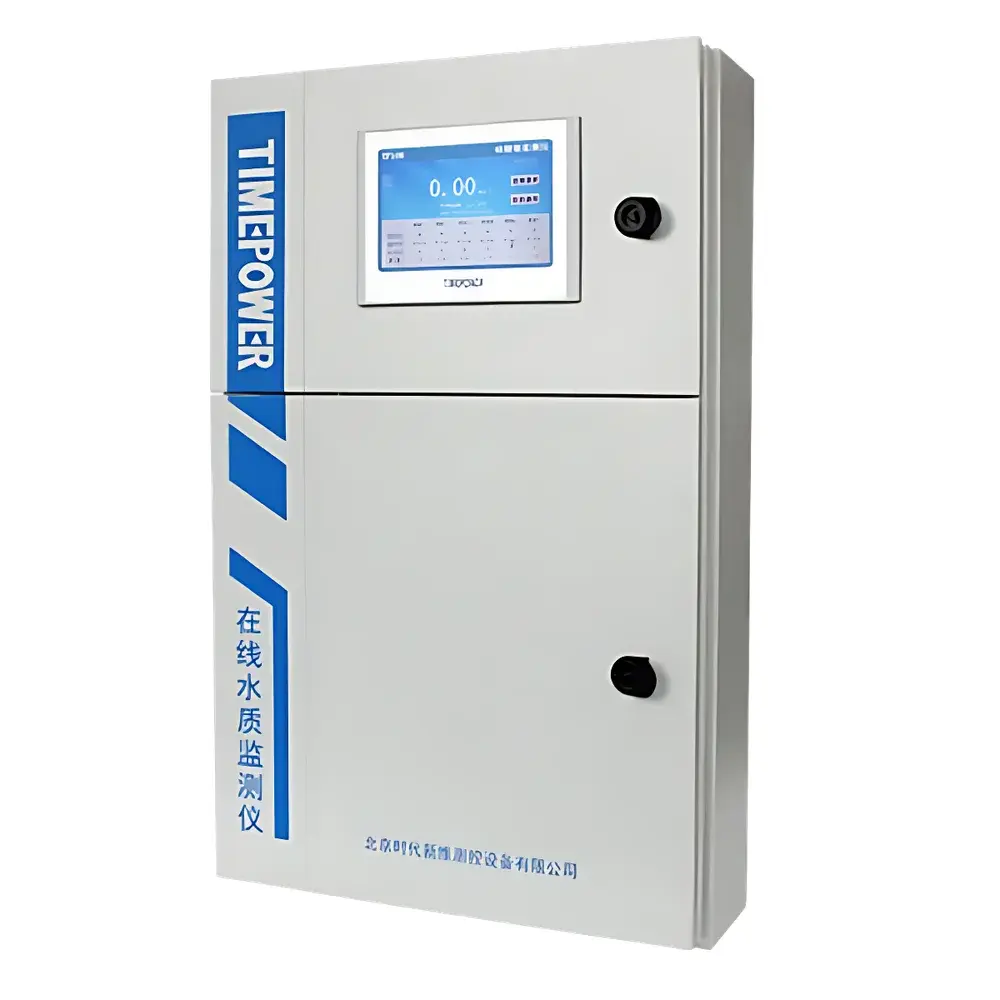
TimePower TP106 Online Silicate Analyzer
| Brand | TimePower |
|---|---|
| Origin | Beijing, China |
| Manufacturer Type | Manufacturer |
| Country of Origin | Domestic (China) |
| Model | TP106 |
| Price | Upon Request |
| Measurement Principle | Molybdenum Blue Photometric Method |
| Measurement Range | 0.0–200.0 μg/L or 0.0–2000 μg/L (selectable) |
| Accuracy | ±2% FS |
| Repeatability | ≤±1% FS |
| Drift | <±1% FS/24 h |
| Response Time | <10 min |
| Cycle Time | ~10 min per channel |
| Sample Flow Rate | 10–40 L/h |
| Sample Temperature | 5–50 °C |
| Sample Particulates | <5 µm, non-colloidal |
| Light Source | Monochromatic Cold LED |
| Display | 7.0-inch Color TFT Touchscreen (Chinese UI) |
| Channels | 1–6 selectable |
| Data Storage | 30 days local history |
| Environmental Operating Conditions | 5–45 °C, ≤90% RH (non-condensing) |
| Power Supply | AC 85–265 V, 45–65 Hz |
| Power Consumption | ≤100 W |
| Dimensions (W×H×D) | 460×720×280 mm |
| Panel Cutout | 670×410 mm |
| Weight | 22 kg |
| Output Signals | Isolated 0–20 mA / 4–20 mA / 0–10 mA (configurable) |
| Alarm Outputs | Independent per channel — high/low limit, flow interruption |
| Reagent Consumption | ~3 L/month per reagent (4 reagents total) |
| Valves | Imported High-Precision Electromagnetic Valves |
| Compliance | Designed for continuous industrial water quality monitoring in regulated environments |
Overview
The TimePower TP106 Online Silicate Analyzer is an industrial-grade photometric analyzer engineered for continuous, real-time quantification of dissolved silicate (SiO32− or reactive silica) in aqueous process streams. It operates on the well-established molybdenum blue method—a standardized colorimetric technique recognized in ASTM D859 and ISO 10523 for trace silica analysis in low-conductivity water matrices. In acidic conditions (pH 1.1–1.3), soluble silicate reacts with ammonium molybdate to form a yellow heteropoly acid complex (silicomolybdic acid), which is then selectively reduced by 1-amino-2-naphthol-4-sulfonic acid (1-2-4 acid) to yield an intense blue chromophore—silicomolybdenum blue. The absorbance of this complex at 630–650 nm is measured using a stable monochromatic cold LED light source and precision photodiode detection, enabling quantitation via the Lambert–Beer law. The instrument is purpose-built for high-reliability deployment in steam-cycle water chemistry control, where sub-ppb to low-ppb silica excursions can precipitate as silica scale in turbine blades and heat exchangers—directly impacting thermal efficiency and equipment longevity.
Key Features
- Modular multi-channel architecture supporting 1–6 independent measurement streams—optimized for cost-effective monitoring across boiler feedwater, condensate, and demineralized water loops;
- Imported high-precision electromagnetic valves ensure repeatable fluid handling, minimizing carryover and cross-contamination between cycles;
- 7.0-inch color TFT touchscreen with intuitive Chinese-language interface; simultaneous display of real-time concentration trends and historical curves for all active channels;
- Robust optical design featuring a long-life monochromatic cold LED source and temperature-compensated photodetector—delivering superior signal stability (50,000-hour operational lifetime;
- Configurable analog outputs (0–20 mA, 4–20 mA, or 0–10 mA) with galvanic isolation—fully compatible with DCS, PLC, and automated chemical dosing systems;
- Onboard data logging retains 30 days of timestamped measurements (including alarm events and reagent usage logs), supporting root-cause analysis and regulatory documentation;
- Compact panel-mount design (460 × 720 × 280 mm) with standardized cutout (670 × 410 mm); field-serviceable modules reduce mean time to repair (MTTR).
Sample Compatibility & Compliance
The TP106 is validated for use with low-turbidity, low-particulate water samples meeting the specification: suspended solids <5 µm, absence of colloidal silica or organic fouling agents. It complies with operational requirements outlined in EPRI TR-102122 (Guidelines for Silica Monitoring in Power Plant Water Chemistry) and supports alignment with ASME PTC 19.11 and IAPWS Technical Guidance Document on Steam Purity. While not certified to FDA 21 CFR Part 11 out-of-the-box, its audit-trail-capable data logging, user-access controls, and configurable alarm/event tagging provide a foundational architecture for GLP/GMP validation in pharmaceutical and biotech clean steam applications. Reagent kits—including NIST-traceable 10 µg/mL silicate standard—are supplied with lot-specific certificates of analysis.
Software & Data Management
Data acquisition and system configuration are managed locally via the embedded touchscreen HMI. All measurement events—including calibration timestamps, reagent depletion warnings, flow fault detections, and upper/lower limit breaches—are time-stamped and stored in non-volatile memory. Export is supported via USB port (CSV format). For integration into centralized SCADA or MES platforms, optional Modbus RTU (RS-485) or Ethernet/IP communication modules are available. Firmware updates are performed offline using signed binary packages to maintain integrity. System diagnostics include valve actuation test routines, optical path verification, and blank/reference absorbance trending—facilitating predictive maintenance planning.
Applications
- Real-time silica surveillance in fossil fuel and nuclear power plant secondary coolant circuits;
- Monitoring of silica breakthrough in mixed-bed ion exchange polisher effluents;
- Process water quality assurance in semiconductor ultrapure water (UPW) distribution loops;
- Effluent compliance tracking in chemical manufacturing and fertilizer production wastewater streams;
- Feedwater control in industrial boilers serving food processing, dairy, and beverage facilities;
- Environmental discharge monitoring per local regulatory thresholds (e.g., EPA 200.7, ISO 15588).
FAQ
What is the recommended sample filtration requirement prior to analysis?
A 5-µm inline particulate filter is mandatory; colloidal silica or iron oxide precipitates must be removed upstream to prevent optical cell fouling and valve clogging.
Can the TP106 be calibrated using customer-prepared standards?
Yes—calibration is performed using two-point (zero and span) methodology; users may employ certified reference materials traceable to NIST or equivalent national metrology institutes.
Is remote access or cloud-based data hosting supported?
The base unit does not include built-in cellular or cloud connectivity; however, third-party IoT gateways or edge servers can ingest its analog or Modbus outputs for secure remote visualization.
How often must reagents be replaced, and are they temperature-sensitive?
Reagents (ammonium molybdate, 1-2-4 acid, sulfuric acid, and reducing buffer) require replenishment approximately every 30 days at nominal flow rates; storage at 15–25 °C is recommended to preserve stability.
Does the analyzer meet explosion-proof or hazardous area certification?
No—the TP106 is rated for general-purpose indoor installation (IP54 enclosure); for Zone 2 or Class I Div 2 environments, it must be housed in an approved purge cabinet or located outside the classified zone with sample transport via conditioned line.





