
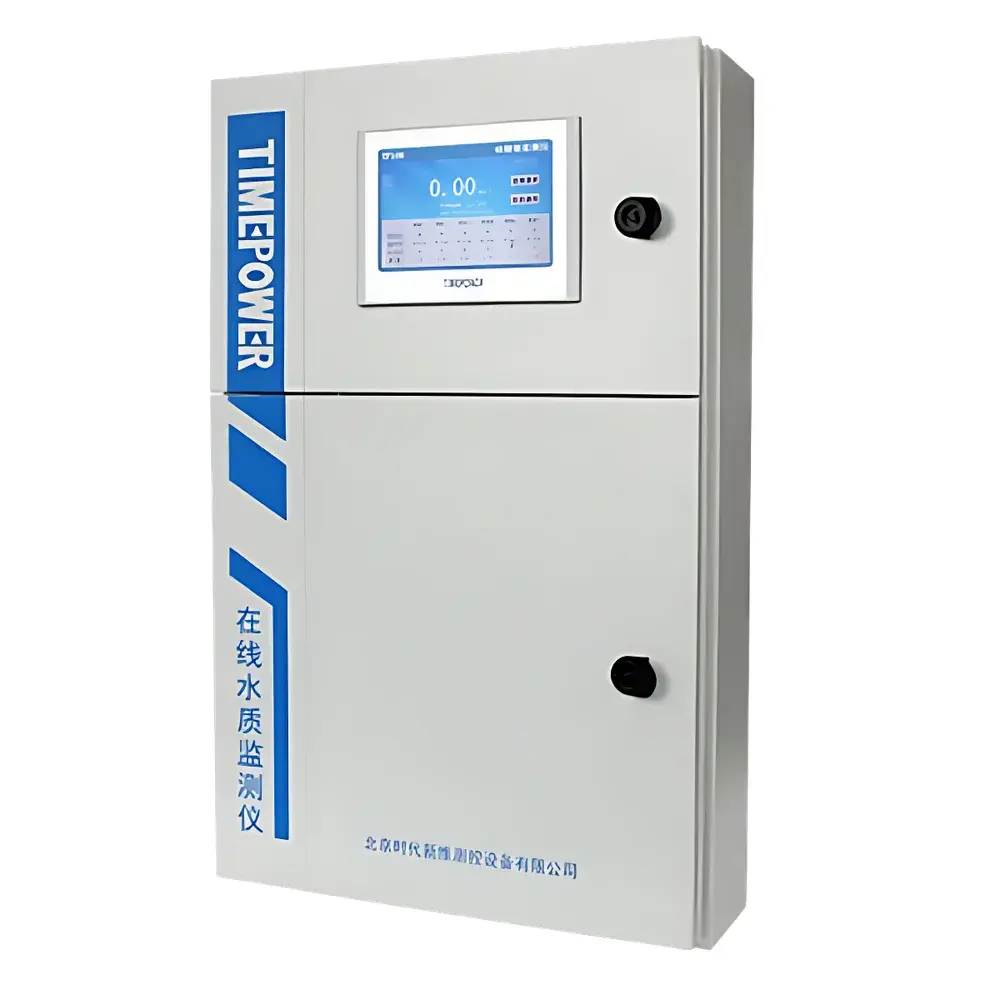
Timepower TP106 Silicate Analyzer
| Brand | Timepower |
|---|---|
| Origin | Beijing, China |
| Manufacturer Type | Manufacturer |
| Product Category | Domestic |
| Model | TP106 |
| Instrument Type | Online Analyzer |
| Pricing | Upon Request |
Overview
The Timepower TP106 Silicate Analyzer is an online photometric analyzer engineered for continuous, real-time quantification of soluble silicate (as SiO₂) in aqueous process streams. It operates on the established colorimetric principle of the molybdenum blue method—standardized in GB/T 12149–2017 (“Determination of Silicon in Industrial Circulating Cooling Water and Boiler Feed Water”) and aligned with internationally recognized wet-chemistry protocols such as ASTM D859 and ISO 10583. In acidic medium (pH 1.1–1.3), orthosilicic acid reacts with ammonium molybdate to form a yellow heteropolyacid complex; subsequent reduction by 1-amino-2-naphthol-4-sulfonic acid (1-2-4 acid) yields an intensely colored silicon-molybdenum blue species. Absorbance is measured at a fixed wavelength (typically ~650 nm) using a stable monochromatic cold light source. The instrument applies the Lambert–Beer law to convert optical density into quantitative silicate concentration, ensuring trace-level sensitivity and high reproducibility under industrial operating conditions.
Key Features
- Multi-channel architecture: Configurable for 1–6 independent measurement channels—enabling simultaneous monitoring of multiple sample points or redundancy without requiring separate analyzers.
- Precision fluid handling: Equipped with imported high-reliability solenoid valves and peristaltic metering pumps; ensures accurate reagent dosing, consistent sample aspiration, and long-term valve service life (>500,000 cycles).
- Intuitive human-machine interface: 7.0-inch full-color TFT LCD touchscreen with native Chinese language support; displays real-time trend curves, historical data overlays, and status diagnostics across all active channels.
- Robust optical system: Integrated monochromatic cold LED light source with thermal stabilization—delivering >20,000 hours of operational lifetime and minimal drift (<±1% FS/24 h).
- Flexible signal integration: Four isolated analog outputs (0–20 mA / 4–20 mA / 0–10 mA, user-selectable per channel); supports direct interfacing with DCS, PLC, or automated chemical dosing systems.
- Embedded data retention: Internal non-volatile memory stores up to 30 days of timestamped measurement records (including raw absorbance, calculated concentration, alarm flags, and maintenance logs) with automatic overwrite policy.
Sample Compatibility & Compliance
The TP106 is validated for use with low-turbidity water samples meeting the following specifications: suspended solids <5 µm particle size, absence of colloidal silica or polymeric siloxanes, temperature range 5–50 °C, and flow rate 10–40 L/h. It complies with national standard GB/T 12149–2017 and supports laboratory verification against reference materials traceable to NIM (National Institute of Metrology, China). While not certified to IEC 61508 or SIL-2, its architecture adheres to functional safety principles appropriate for non-safety-critical monitoring in utility-grade boiler feedwater, condensate, and demineralized water loops. All reagent consumption data (≈3 L/month per reagent type; total of four reagents) is documented for routine maintenance planning and regulatory recordkeeping.
Software & Data Management
The embedded firmware provides audit-ready data integrity features including time-stamped event logging (e.g., calibration, reagent refill, alarm activation), password-protected configuration access, and configurable alarm thresholds (high/low limit, flow loss, reagent depletion). Raw absorbance values and final concentration results are timestamped and stored with millisecond resolution. Data export is supported via USB host port (CSV format) for offline analysis in Excel or LIMS environments. Though not natively 21 CFR Part 11 compliant, the system supports manual electronic record archiving compatible with GLP/GMP documentation workflows when deployed with controlled access procedures and periodic backup protocols.
Applications
The TP106 serves critical monitoring roles across industries where silica scaling poses operational risk: high-pressure steam generation in thermal power plants; ultrapure water loops in semiconductor and pharmaceutical manufacturing; pretreatment and RO feed monitoring in municipal and industrial desalination; and process control in fertilizer and chemical synthesis facilities. Its dual-range capability (0.0–200.0 µg/L and 0.0–2000 µg/L) allows detection of sub-ppb-level silica breakthrough in polishing stages as well as higher-concentration monitoring in blowdown or cooling tower sidestreams.
FAQ
What is the recommended calibration frequency for routine operation?
Calibration verification using certified silicate standard solution (e.g., 10 µg/mL SiO₂) is advised before each shift or at least every 24 hours in critical applications; full multi-point calibration should be performed weekly or after reagent replacement.
Can the TP106 operate unattended for extended periods?
Yes—the analyzer supports continuous 24/7 operation with automatic self-diagnostics, flow monitoring, and reagent-level alerts; however, scheduled preventive maintenance (e.g., tubing replacement, optical path cleaning) is required every 3–6 months depending on water quality.
Is remote monitoring or network connectivity supported?
The standard TP106 does not include Ethernet or Modbus TCP; however, analog outputs can be integrated into existing SCADA networks via third-party gateways, and optional RS-485 Modbus RTU communication modules are available upon request.
How is compliance with GB/T 12149–2017 demonstrated during validation?
Validation includes verification of reagent lot traceability, linearity testing across both ranges (R² ≥0.999), recovery testing using spiked samples (85–115% recovery), and comparison against reference methods (e.g., ICP-OES) per Clause 7.3 of the standard.
What maintenance components require periodic replacement?
Peristaltic pump tubing (every 3 months), filter cartridges (every 2 weeks under typical feedwater conditions), and colorimetric cuvettes (annually or if optical fouling is observed) constitute the primary consumables.
Related Products







