
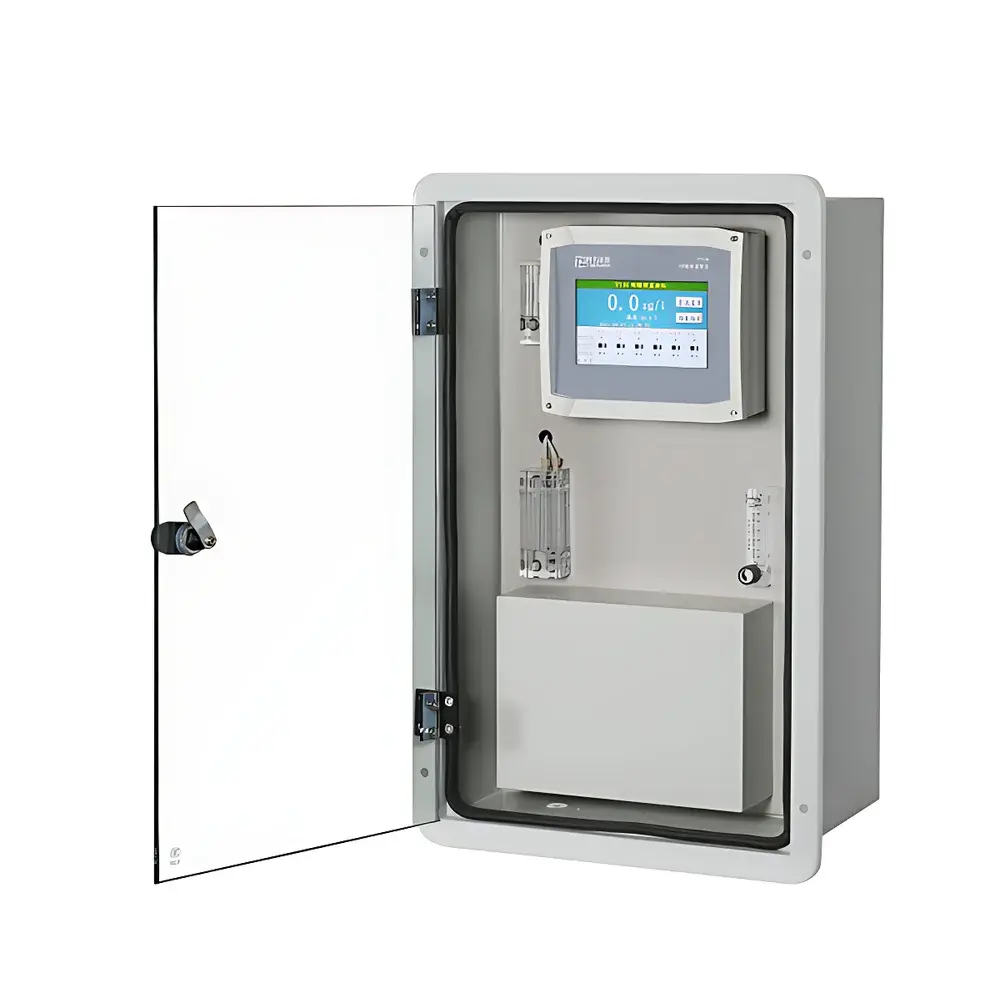
TimePower TP-108 Multi-Channel Hydrazine Analyzer (1–6 Channels Configurable)
| Brand | TimePower |
|---|---|
| Origin | Beijing, China |
| Manufacturer | TimePower Technologies Co., Ltd. |
| Model | TP-108 |
| Measurement Range | 0.0–100.0 µg/L |
| Display | 7.0-inch color TFT touchscreen (Chinese UI) |
| Accuracy | ±2% F.S. |
| Repeatability | ≤±1% F.S. |
| Drift | <±1% F.S./24 h |
| Response Time | <4 min |
| Cycle Time | ~3 min per channel |
| Sample Flow Rate | 10–40 L/h |
| Sample Temp. | 5–50 °C |
| Sample Particulates | <5 µm, non-colloidal |
| Ambient Temp. | 5–45 °C |
| Ambient Humidity | ≤90% RH (non-condensing) |
| Light Source | Monochromatic cold LED |
| Valves | Imported high-precision solenoid valves |
| Calibration | Automated dual-point standard calibration on user-defined schedule |
| Data Storage | 30 days of historical data per channel |
| Outputs | Isolated analog current signals (0–20 mA / 4–20 mA / 0–10 mA, programmable) |
| Alarms | Per-channel independent alarms (flow loss, upper/lower limit) |
| Power | AC 85–265 V, 45–65 Hz |
| Power Consumption | ≤100 W |
| Dimensions (W×D×H) | 460 × 280 × 720 mm |
| Panel Cutout | 670 × 410 mm |
| Weight | 22 kg |
Overview
The TimePower TP-108 Multi-Channel Hydrazine Analyzer is a dedicated photometric analyzer engineered for continuous, trace-level hydrazine (N2H4) quantification in aqueous process streams. It operates on the principle of acid-catalyzed diazotization: under controlled acidic conditions, hydrazine reacts stoichiometrically with p-dimethylaminobenzaldehyde (DMAB) to form a stable yellow azo chromophore. Absorbance is measured at a fixed wavelength using a monochromatic cold LED light source and high-stability optical path. Quantification follows the Lambert–Beer law—absorbance is linearly proportional to hydrazine concentration within the 0.0–100.0 µg/L range. Designed for unattended operation in demanding industrial environments, the TP-108 supports 1 to 6 independent analytical channels in a single instrument chassis, enabling parallel monitoring of multiple sample points without cross-channel interference. Its architecture meets fundamental requirements for long-term reliability in power plant feedwater, chemical synthesis loops, pharmaceutical water systems, and environmental effluent streams where hydrazine serves as an oxygen scavenger or intermediate.
Key Features
- Modular channel configuration (1–6 channels), optimized for cost-effective deployment across distributed sampling locations;
- Imported high-precision solenoid valves ensuring repeatable reagent dispensing, precise sample metering, and >500,000-cycle service life;
- Automated dual-point calibration routine scheduled per user-defined interval (e.g., every 6, 12, or 24 hours), minimizing manual intervention while maintaining measurement integrity over extended periods;
- Stable monochromatic cold LED light source with >50,000-hour operational lifetime and negligible thermal drift, eliminating lamp replacement and warm-up delays;
- Isolated, programmable 4–20 mA (or 0–20 mA / 0–10 mA) analog outputs per channel—fully compatible with DCS, PLC, and automated chemical dosing controllers;
- 7.0-inch color TFT touchscreen interface with real-time multi-channel trend visualization—each curve rendered in distinct color for immediate status differentiation;
- Onboard data logging retains 30 days of timestamped concentration values, cycle diagnostics, calibration logs, and alarm events—supporting root-cause analysis and regulatory review;
- Compact panel-mount design (460 × 280 × 720 mm) with standardized cutout (670 × 410 mm), facilitating retrofit into existing control room enclosures or field-mounted cabinets.
Sample Compatibility & Compliance
The TP-108 accepts raw or pre-filtered water samples meeting defined physical specifications: flow rate 10–40 L/h, temperature 5–50 °C, suspended solids <5 µm, and absence of colloidal material that could foul reaction coils or optical windows. It complies with core functional safety and electromagnetic compatibility requirements per IEC 61326-1 (industrial EMC) and IEC 61010-1 (electrical safety). While not certified to ISO/IEC 17025 for accredited testing, its measurement traceability aligns with ASTM D3776 (Standard Test Method for Hydrazine in Water) when operated with NIST-traceable hydrazine standards (e.g., 10 µg/mL certified reference material supplied with the system). The analyzer supports audit-ready operation under GLP and GMP frameworks via time-stamped calibration records, alarm logs, and user-accessible data export (USB).
Software & Data Management
Embedded firmware provides full local control without external PC dependency. All configuration—including channel enable/disable, calibration point assignment, alarm thresholds, output scaling, and auto-calibration timing—is accessible via intuitive touchscreen menus. Historical data is stored in non-volatile memory with cyclic overwrite protection. Data export is supported via USB flash drive in CSV format, retaining timestamps, channel ID, measured value (µg/L), status flags (e.g., “CAL”, “ALARM”, “FLOW_LO”), and system diagnostics. No proprietary software is required for data retrieval or report generation. The system supports basic 21 CFR Part 11 readiness through unique operator login credentials, electronic signature prompts for critical actions (e.g., calibration initiation), and immutable audit trails of all parameter changes.
Applications
- Boiler feedwater and condensate monitoring in fossil and nuclear power plants (ASTM D1066 / EPRI guidelines);
- In-line hydrazine residual control in high-purity water systems for semiconductor manufacturing and biopharmaceutical facilities;
- Process stream verification in hydrazine-based catalyst regeneration units (e.g., ammonia synthesis plants);
- Environmental compliance monitoring of wastewater discharges from aerospace propulsion testing or rocket fuel handling sites;
- Quality control of hydrazine-containing formulations in agrochemical and specialty polymer synthesis;
- Research-grade kinetic studies requiring multi-point temporal resolution of hydrazine decomposition or scavenging efficiency.
FAQ
What is the minimum detectable hydrazine concentration?
The lower limit of quantitation (LLOQ) is 0.5 µg/L, validated per ICH Q2(R2) principles using signal-to-noise ratio ≥10 and precision ≤10% RSD at this level.
Can the TP-108 be integrated with a central SCADA system?
Yes—via isolated 4–20 mA analog outputs per channel; Modbus RTU over RS-485 is available as an optional firmware upgrade.
How often must reagents be replaced?
DMAB reagent consumption averages ~3 L/month per active channel under typical 3-minute cycle operation; shelf life is 12 months unopened, 6 months after opening when refrigerated.
Is sample filtration mandatory?
A 5-µm inline filter (included) is required for all applications; additional particulate or organic fouling may necessitate upstream cartridge filtration per site-specific water quality assessment.
Does the analyzer support remote diagnostics?
Local Ethernet port is reserved for future firmware updates; current remote access requires integration via DCS historian or third-party OPC-UA gateway connected to its analog outputs and dry-contact alarm relays.




