
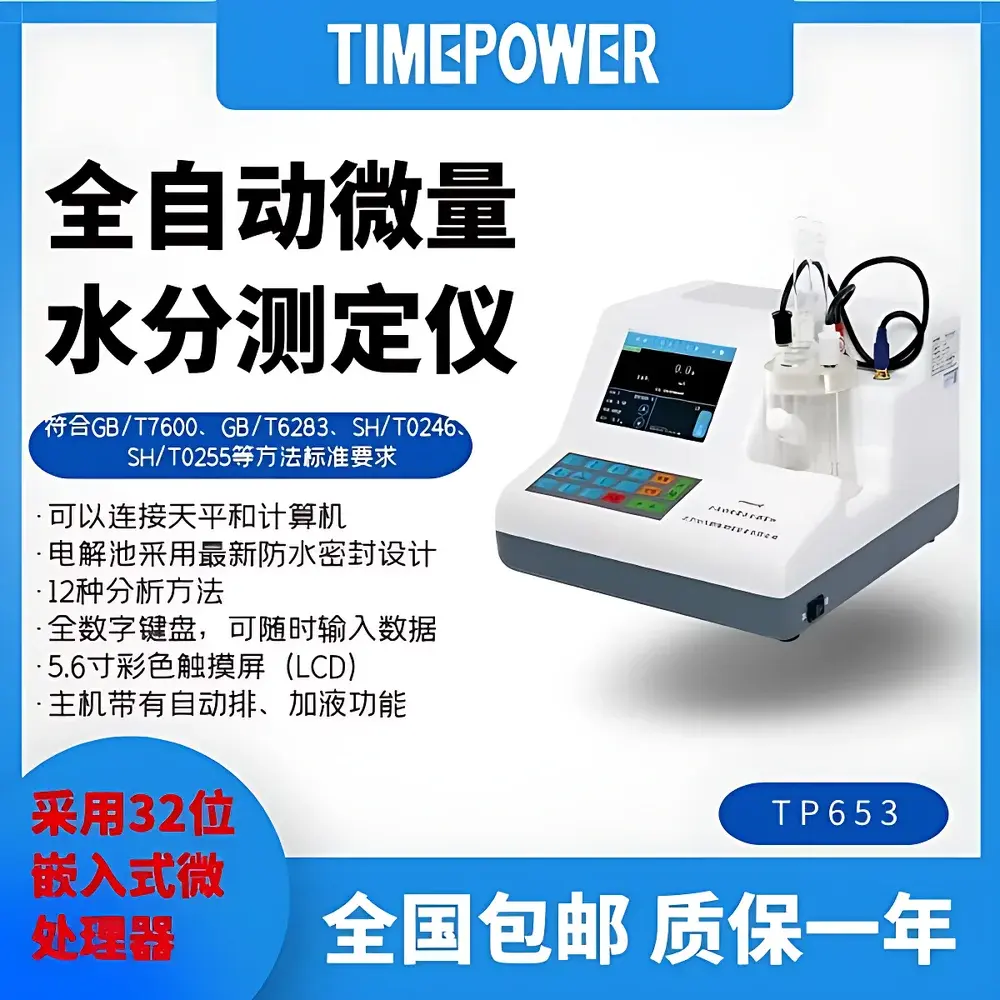
TimePower TP.653 Automated Coulometric Karl Fischer Moisture Analyzer
| Brand | TimePower |
|---|---|
| Origin | Beijing, China |
| Manufacturer Type | Direct Manufacturer |
| Instrument Type | Coulometric Karl Fischer Titrator |
| Measurement Principle | Coulometric Titration (Faraday’s Law) |
| Water Content Range | 3 µg – 100 mg H₂O |
| Resolution | 0.1 µg |
| Accuracy | ±20% at 3 µg, ±10% at 10 µg, ±1% at 100 µg, ±0.5% above 100 µg (excluding sample introduction error) |
| Minimum Dispensing Increment | 0.1 µL |
| Electrolysis Current Range | 0–400 mA |
| Detection Current Resolution | ±0.1 µA |
| Built-in Data Storage | Yes |
| Display | Backlit LCD with Chinese interface |
| Printer | Thermal, 36-character, Chinese-capable |
| Operating Temperature | 10–40 °C |
| Power Supply | AC 220 V ±10%, 50 Hz ±10% |
| Power Consumption | <200 W |
| Dimensions (W×D×H) | 310 × 315 × 215 mm |
| Weight | 3.5 kg |
Overview
The TimePower TP.653 Automated Coulometric Karl Fischer Moisture Analyzer is a precision laboratory instrument engineered for trace-level water quantification in hygroscopic, volatile, or thermally sensitive samples. Unlike volumetric KF systems, the TP.653 employs coulometric titration—based on Faraday’s law—to electrogenerate iodine *in situ* within a sealed titration cell. This method eliminates reagent standardization, minimizes drift, and delivers superior reproducibility for measurements below 100 µg of water. Designed for compliance-critical environments, it supports routine analysis across pharmaceutical raw materials, petrochemical intermediates, lithium battery electrolytes, and high-purity solvents where residual moisture directly impacts stability, shelf life, or reaction yield.
Key Features
- 32-bit embedded microprocessor with real-time operating system for deterministic control loop timing and stable current regulation
- Dual-circuit balanced titration architecture to suppress baseline noise and enhance signal-to-noise ratio during low-water detection
- Hermetically sealed, PTFE-coated electrolytic cell with optimized electrode geometry—reducing equilibration time by up to 40% and extending reagent lifetime beyond 300 analyses per fill
- Automated reagent dispensing and waste evacuation—eliminating manual handling of toxic KF reagents and reducing operator exposure risk
- Real-time electrolysis current curve display with dynamic baseline compensation—enabling immediate assessment of reagent activity and cell contamination
- Integrated thermal printer supporting bilingual (Chinese/English) character sets and GLP-compliant audit trail output including date, time, operator ID, and result metadata
- Engineered housing of corrosion-resistant engineering plastics (PC/ABS blend), rated IP20 for laboratory benchtop use
- Onboard non-volatile memory storing ≥10,000 measurement records with timestamp, sample ID, method name, and raw current-integration data
Sample Compatibility & Compliance
The TP.653 accommodates liquid, solid, and gaseous samples via optional accessories—including oven couplers (for Karl Fischer oven sampling per ASTM E203 Annex A3), gas-tight syringes, and solid-sample adapters. It meets methodological requirements of GB/T 1600 (pesticides), GB/T 7600 (transformer oils), GB/T 683 (organic solvents), GB/T 11133 (hydrocarbon liquids), SH/T 0246 (gasoline), and SH/T 0255 (lubricating oils). While not pre-certified to ISO/IEC 17025 or FDA 21 CFR Part 11, its architecture supports full traceability: all results include digital signatures (user-defined ID), immutable timestamps, and change logs. When deployed with validated SOPs and periodic verification using certified water standards (e.g., Hydranal® 1.00 mg/g), it fulfills GMP/GLP documentation requirements for QC laboratories.
Software & Data Management
The analyzer operates standalone with menu-driven navigation and six programmable calculation formulas—supporting custom units (ppm, % w/w, % w/v), dilution factors, and density corrections. All data exports via USB 2.0 to CSV or proprietary .TPD format; no cloud dependency or vendor-locked software required. Audit trails are stored locally and printable on demand—ensuring compliance with internal QA protocols without third-party validation overhead. Firmware updates are delivered as signed binary packages via USB stick, preserving integrity verification prior to installation.
Applications
- Pharmaceuticals: Quantifying residual moisture in lyophilized APIs and excipients per USP <921> and EP 2.5.12
- Petrochemicals: Measuring water in jet fuel (ASTM D6304), transformer oil (IEC 60814), and LNG condensates
- Battery Materials: Verifying <10 ppm H₂O in LiPF₆ electrolytes and cathode precursors—critical for SEI formation control
- Agrochemicals: Validating dryness of technical-grade pesticides and wettable powders per CIPAC MT 30
- Electronics: Monitoring moisture in photoresists, etchants, and carrier solvents used in semiconductor fabrication
- Food & Feed: Analyzing low-water-content spices, dried dairy powders, and animal feed additives where enzymatic degradation correlates with hydration
FAQ
What distinguishes coulometric from volumetric Karl Fischer titration?
Coulometric KF generates iodine electrochemically within the titration cell, enabling sub-microgram water detection with no burette calibration drift. Volumetric KF relies on pre-standardized iodine solutions and is typically used for samples containing >100 µg water.
Can the TP.653 analyze viscous or suspended samples?
Yes—when paired with a heated sample injector or ultrasonic homogenizer adapter, it handles slurries, pastes, and high-viscosity oils (e.g., silicone fluids, heavy fuel oils) without clogging.
Is method validation support available?
TimePower provides application notes aligned with ICH Q2(R2) guidelines, including linearity (3–100 µg), LOD/LOQ determination, and robustness testing protocols—intended for internal lab validation, not regulatory submission.
How often must the electrolyte be replaced?
Under typical use (20–30 assays/day), the dual-compartment reagent lasts ≥300 determinations. Replacement is indicated by prolonged endpoint stabilization (>120 s) or >15% deviation in replicate 10-µg standard recovery.
Does the instrument comply with 21 CFR Part 11?
It does not include electronic signature modules or role-based access control out-of-the-box. However, its audit trail structure (timestamped, uneditable records) serves as foundational evidence for labs implementing supplemental procedural controls to meet Part 11 expectations.




