
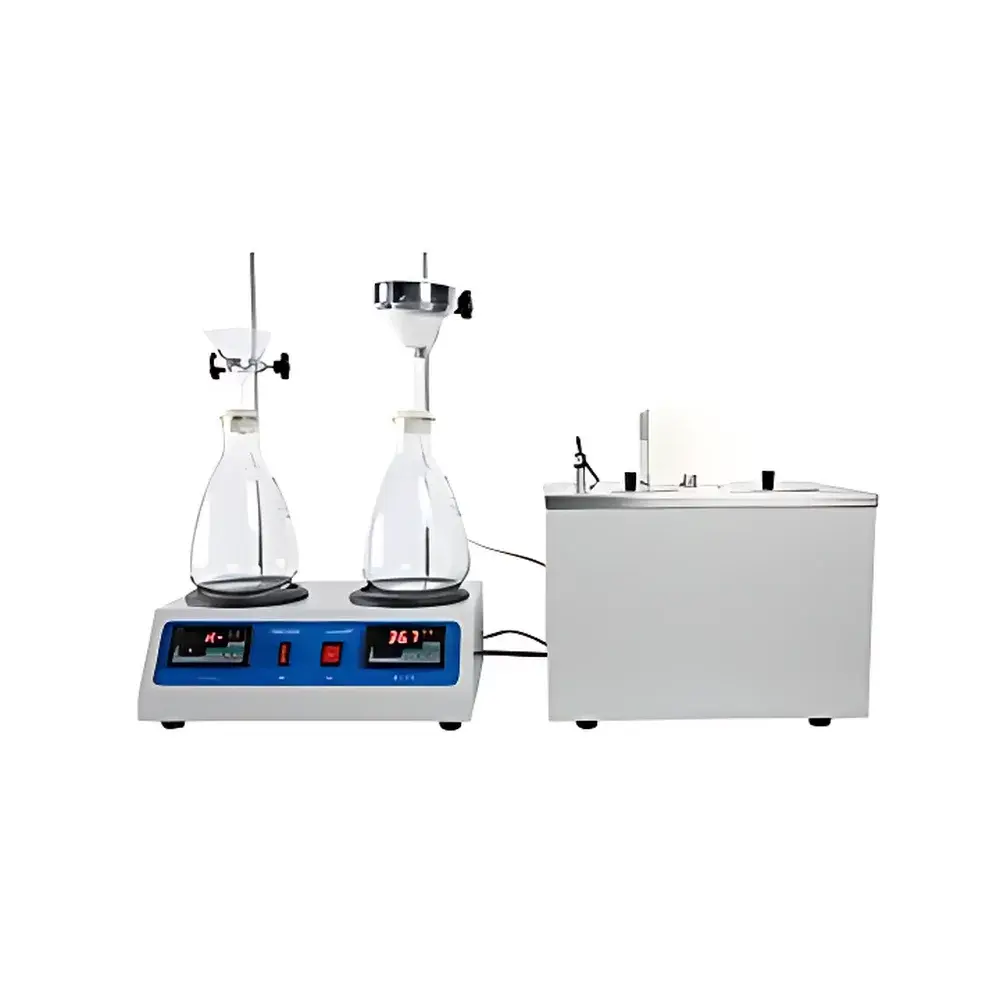
TimePower TP539 Mechanical Impurities Tester for Lubricating Oils and Petroleum Products
| Brand | TimePower |
|---|---|
| Origin | Beijing, China |
| Manufacturer Type | Direct Manufacturer |
| Product Category | Domestic Lab Instrument |
| Model | TP539 |
| Detection Parameter | Mechanical Impurities (by Gravimetric Method per GB/T 511) |
| Power Supply | AC 220 V ±10%, 50 Hz ±10% |
| Operating Temperature Range | 5–40 °C |
| Relative Humidity | ≤85% RH |
| Overall Power Consumption | ≤1200 W |
| Control Box Dimensions | 390 × 260 × 130 mm |
| Water Bath Dimensions | 90 × 290 × 370 mm |
| Net Weight | 4.8 kg |
| Water Bath Temperature Control Range | Ambient to 90 °C |
| Temperature Control Accuracy | ±1 °C |
| Funnel Temperature Control Range | Ambient to 90 °C |
| Funnel Temperature Display | LED Digital |
| Solvent Compatibility | Toluene (≤80 °C), Ethanol–Toluene Mixture (heated to 60 °C) |
Overview
The TimePower TP539 Mechanical Impurities Tester is a dedicated gravimetric laboratory instrument engineered for the quantitative determination of mechanically insoluble particulate matter in petroleum products—including base oils, finished lubricants, fuel oils, and additive packages—according to the rigorous procedural requirements of GB/T 511, the Chinese national standard equivalent to ASTM D4294 (for elemental analysis context) and aligned with ISO 3735 and IP 178 methodologies for solid contaminant quantification. The instrument implements a standardized hot-solvent filtration protocol: samples are dissolved or suspended in pre-heated toluene (≤80 °C) or, when necessary, an ethanol–toluene mixture (60 °C), followed by vacuum-assisted filtration through pre-weighed filter paper or sintered glass crucibles. Residual solids are dried, cooled in a desiccator, and re-weighed to calculate mechanical impurity content as mass percent (% w/w). Its architecture integrates precise thermal regulation, electrical isolation, and reproducible fluid handling—ensuring compliance with GLP-aligned laboratory practices and traceable data generation.
Key Features
- Independent dual-zone temperature control: digitally regulated water bath (ambient to 90 °C, ±1 °C accuracy) and heated funnel assembly (ambient to 90 °C), both with LED digital displays for real-time monitoring and verification.
- Enhanced electrical safety via opto-isolated, anti-parallel silicon-controlled rectifier (SCR) circuitry—enabling smooth, stepless voltage adjustment (0–220 V AC) to the heating element for programmable ramp-rate thermal profiles per GB/T 511 Section 6.2.
- Integrated vacuum filtration system with corrosion-resistant diaphragm pump and calibrated flow path—optimized for consistent filtrate draw without filter rupture or premature clogging.
- Motor-driven automatic stirring module ensures homogeneous suspension of particulates prior to filtration, minimizing settling bias and improving measurement repeatability (RSD < 3% across replicate runs under controlled conditions).
- Modular glassware set compliant with GB/T 511 Annex A specifications—including flat-bottom extraction flasks, standardized funnels, and calibrated graduated cylinders—supplied with full dimensional certification documentation.
- Compact benchtop footprint (total assembled volume < 0.04 m³) and low thermal mass design facilitate rapid cooldown between analyses and reduce ambient heat load in shared lab environments.
Sample Compatibility & Compliance
The TP539 supports a broad matrix range: light distillates (e.g., kerosene, diesel), heavy residual fuels (e.g., bunker C), mineral and synthetic lubricating oils (ISO VG 32 to VG 680), greases (after solvent dilution), and concentrated additive packages (e.g., ZDDP, detergents, dispersants). It accommodates both non-polar (toluene) and polar-aqueous co-solvent systems (ethanol–toluene 1:1 v/v) for complete dissolution of resinous or polymeric residues that resist single-solvent extraction. All operational parameters—including temperature ramp profiles, hold times, and vacuum levels—are fully documented and auditable, supporting adherence to ISO/IEC 17025 clause 7.2.2 (method validation), ASTM D4057 (sampling), and internal QA/QC protocols requiring traceable instrument calibration logs and environmental condition records (temperature/humidity).
Software & Data Management
The TP539 operates as a standalone hardware platform with embedded electronic controls—no proprietary software or PC interface is required for routine operation. However, its digital temperature controllers feature RS-232 output capability (optional adapter), enabling connection to LIMS or ELN systems for automated logging of setpoints, actual temperatures, and run timestamps. All thermal and vacuum parameters meet FDA 21 CFR Part 11 readiness prerequisites when integrated into validated environments: audit trails, user access levels, and electronic signature support can be implemented at the host system level. Calibration certificates for temperature sensors (traceable to NIM, China) and vacuum gauges are supplied with each unit; annual recalibration is recommended per ISO/IEC 17025 Section 6.5.
Applications
- Quality assurance of finished lubricants prior to shipment—verifying compliance with OEM specifications (e.g., API SP, ACEA C6) regarding particulate cleanliness.
- Root-cause analysis of filter plugging or wear debris in field-used oils—supporting predictive maintenance programs in power generation and marine propulsion systems.
- Stability assessment of additive packages during accelerated aging studies (ASTM D2893, D5704).
- Verification of filtration efficiency in lube oil reclamation units and mobile purification skids.
- Regulatory submission testing for customs clearance (CIQ, CNCA) and third-party certification (e.g., SGS, Bureau Veritas) of imported/exported petroleum products.
FAQ
What solvents are validated for use with the TP539?
Toluene (heated to ≤80 °C) is the primary solvent specified in GB/T 511. For samples containing polar contaminants (e.g., oxidation sludge, degraded additives), a 1:1 (v/v) mixture of ethanol and toluene—pre-heated to 60 °C—is permitted as a secondary wash solvent per Clause 8.3 of the standard.
Can the TP539 be used for water-contaminated samples?
No. The method explicitly excludes emulsified or free water. Samples must be dehydrated (e.g., via ASTM D95 or D6304 Karl Fischer titration) prior to analysis, as water interferes with solvent miscibility and filter integrity.
Is the instrument suitable for ISO Cleanliness Code (ISO 4406) particle counting?
No. The TP539 performs gravimetric quantification only. It does not provide particle size distribution or count data. For ISO 4406 classification, a separate liquid particle counter (e.g., HIAC, Pamas) is required.
How often should temperature sensors be recalibrated?
Annually—or after any physical impact, extended high-temperature operation (>85 °C for >200 h), or observed drift exceeding ±0.5 °C against a NIST-traceable reference thermometer.
Does the system include certified reference materials?
No. CRM validation (e.g., NIST SRM 2781) must be performed externally using user-supplied standards; the instrument’s performance verification relies on repeat analysis of control samples with known impurity content.





