
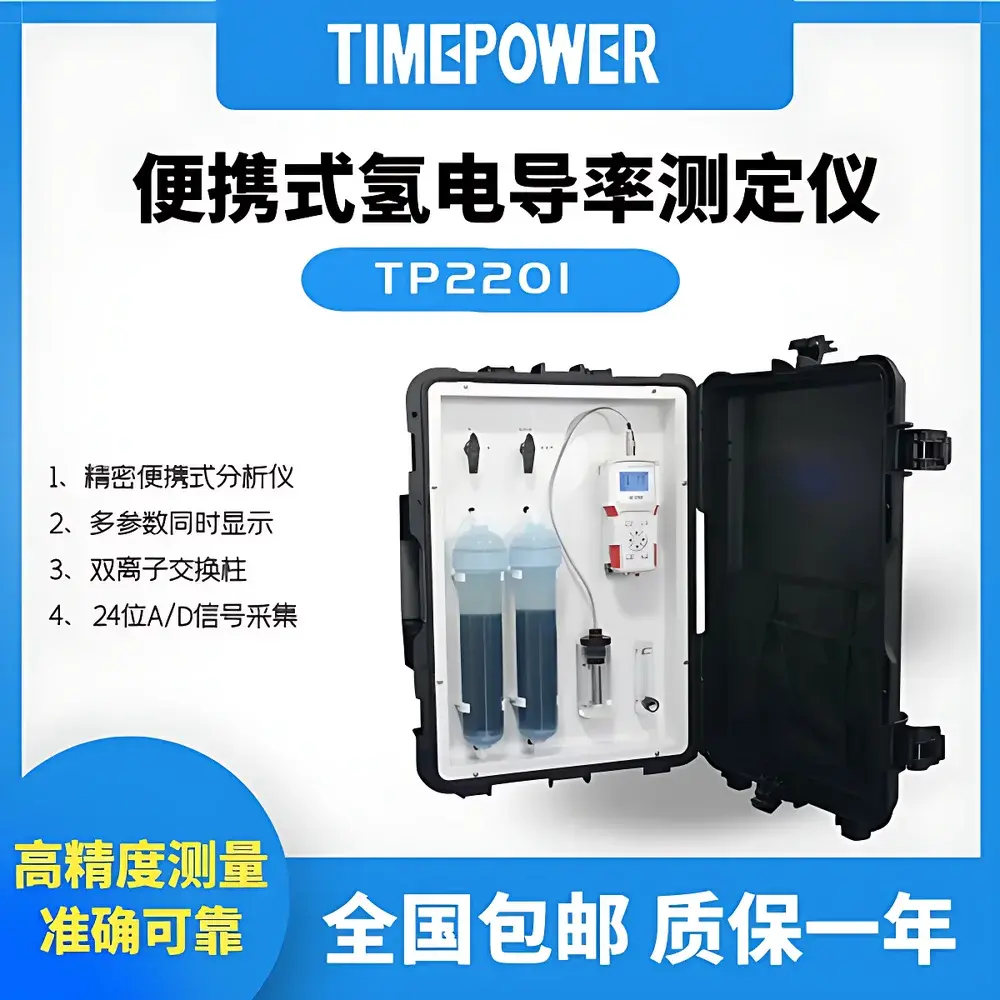
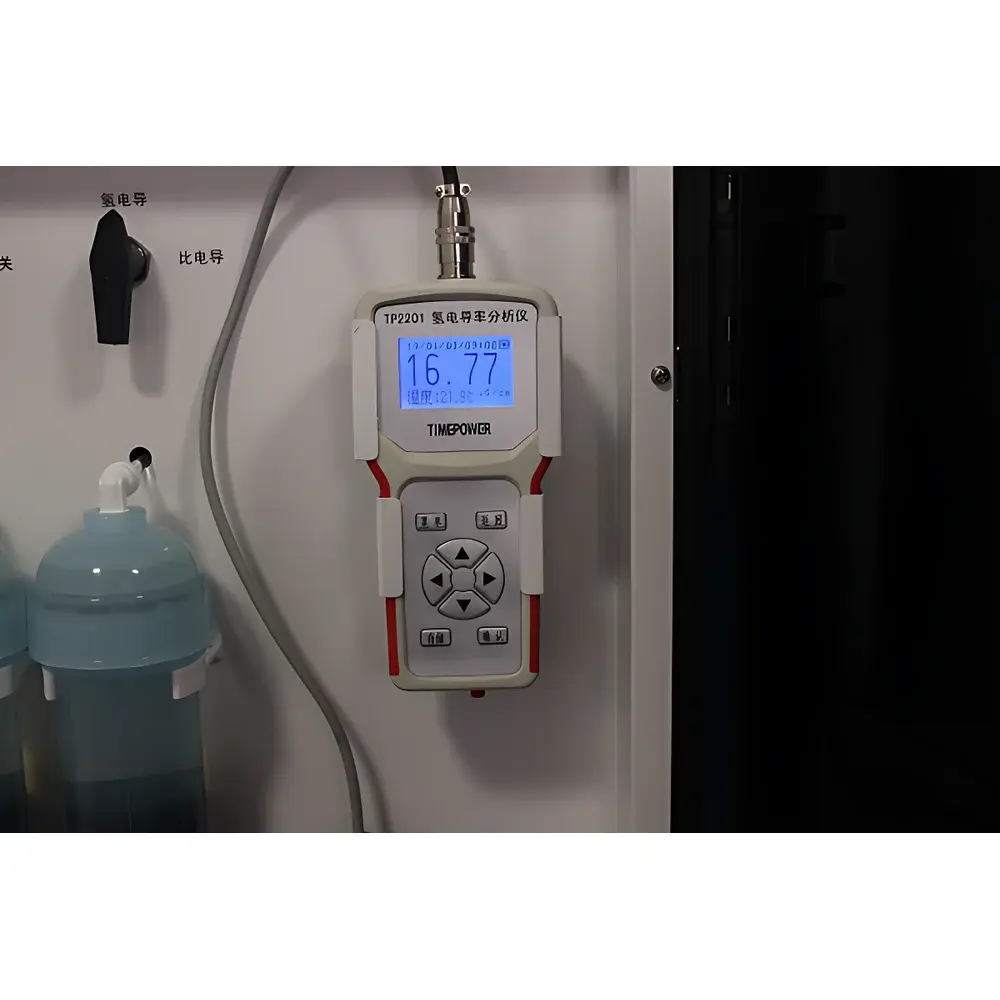
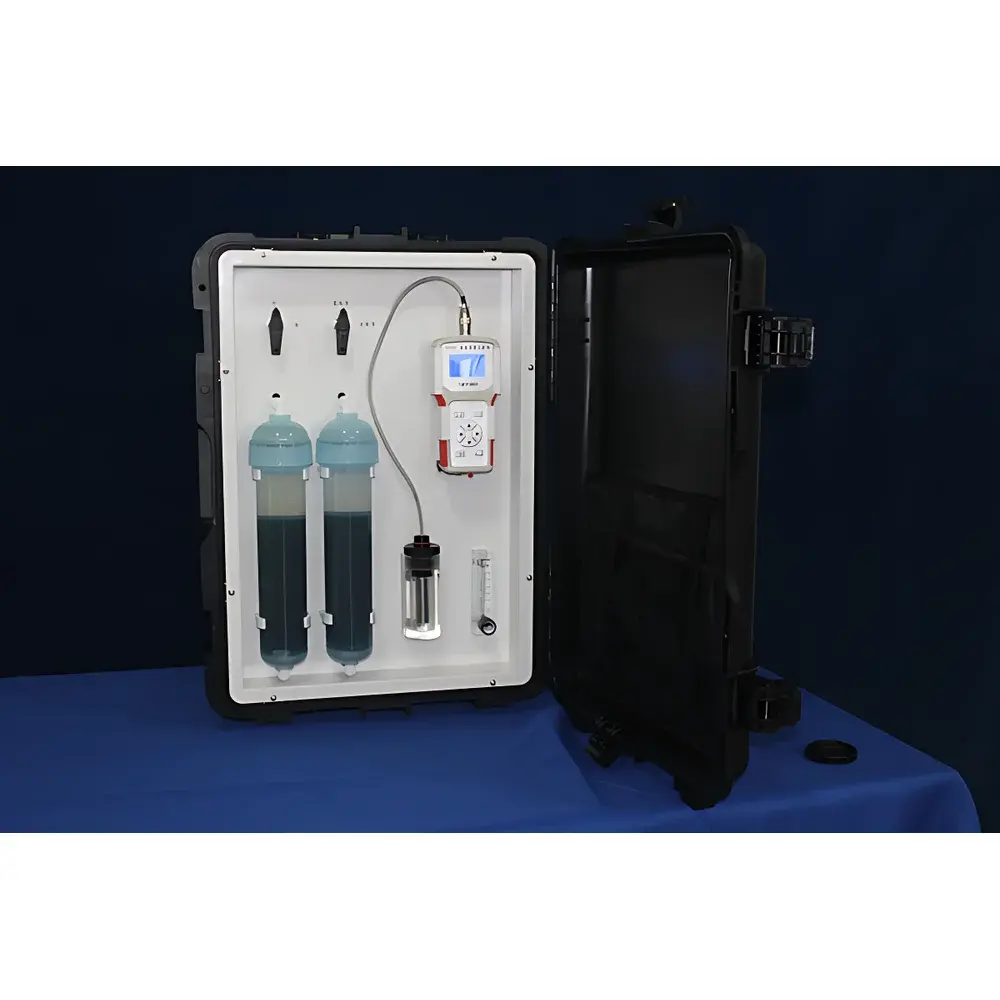
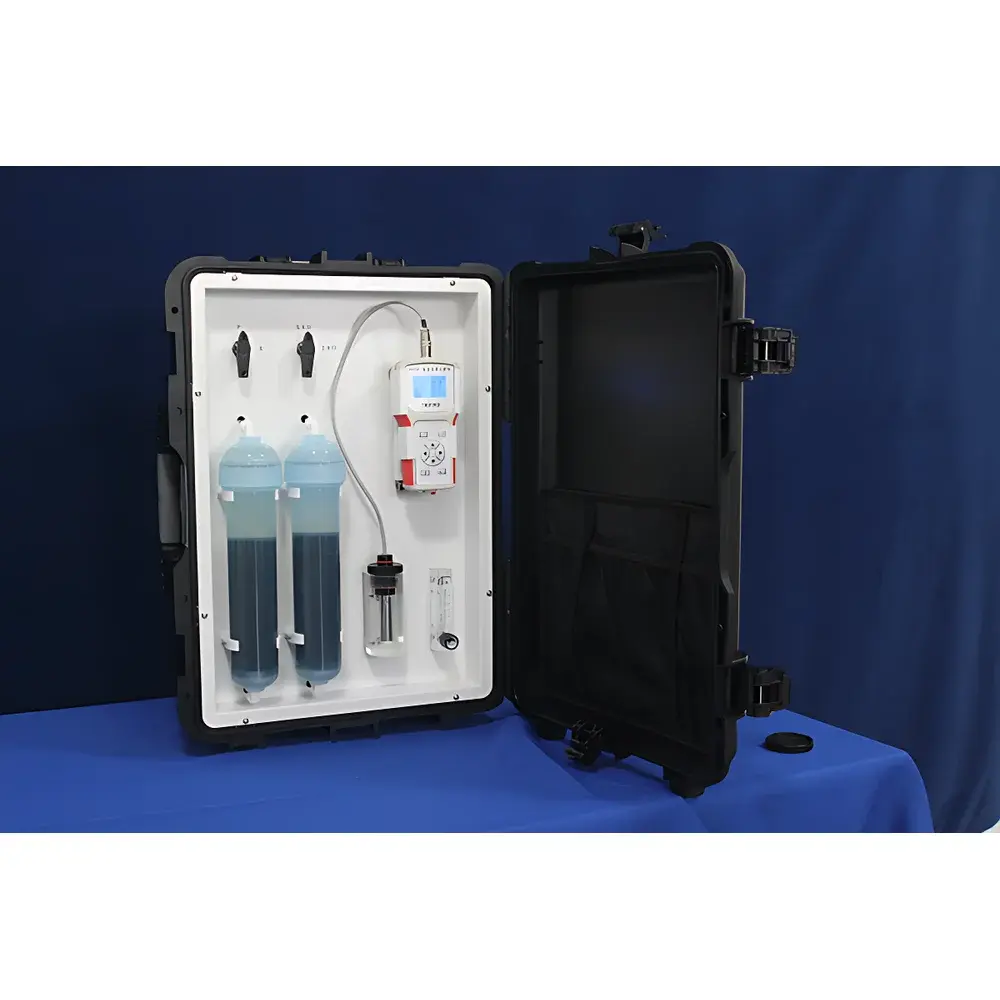
TimePower TP2201 Portable Hydrogen Conductivity Analyzer
| Brand | TimePower |
|---|---|
| Model | TP2201 |
| Type | Portable Hydrogen-Specific Conductivity Meter |
| Measurement Principle | Cation-exchange + Conductivity Detection |
| Conductivity Ranges | (0.000–3.000) µS/cm (K = 0.01 cell) and (0.00–30.00) µS/cm |
| Accuracy | ±1.5% F.S. |
| Resolution | 0.001 µS/cm |
| Temperature Compensation | Automatic (NTC sensor) |
| Power Supply | Rechargeable Li-ion battery (≥8 h continuous operation) |
| Data Storage | Circular memory with non-volatile storage (>10 years retention after power loss) |
| Enclosure | IP65-rated integrated sealed housing |
| Compliance | Designed for ASTM D4582, ASTM D1125, ISO 7888, and IAPWS guidelines for ultrapure water monitoring in power plant secondary loops |
Overview
The TimePower TP2201 Portable Hydrogen Conductivity Analyzer is an engineered solution for real-time, field-deployable measurement of hydrogen conductivity and specific conductivity in ultrapure water systems—primarily used in thermal power plants, nuclear steam supply systems, and semiconductor process water loops. Unlike standard conductivity meters, the TP2201 integrates a cation-exchange column (hydrogen-form resin) upstream of the conductivity cell to convert all cations (e.g., Na⁺, NH₄⁺, Ca²⁺) into H⁺ ions, thereby eliminating alkalinity interference and enabling detection of trace ionic contamination at sub-ppb equivalent levels. This configuration adheres to the fundamental principle defined in ASTM D4582 (“Standard Practice for Measuring Hydrogen Conductivity of Ultrapure Water”) and supports compliance with IAPWS Technical Guidance Document TR-05 for turbine condensate and feedwater quality assurance. The instrument employs a dual-range, temperature-compensated conductivity cell (cell constant K = 0.01 cm⁻¹), optimized for low-conductivity applications where measurement integrity depends on minimizing polarization error and thermal drift.
Key Features
- Integrated hydrogen-form cation exchange column with visual resin exhaustion indicator—enables proactive maintenance without system shutdown.
- Dual automatic-ranging conductivity measurement: high-sensitivity range (0.000–3.000 µS/cm) and extended range (0.00–30.00 µS/cm), both with 0.001 µS/cm resolution.
- 24-bit analog-to-digital conversion with low-noise signal conditioning ensures repeatability ≤ ±1.5% full-scale accuracy under field conditions.
- Onboard flow meter (0.1–1.0 L/min range) allows precise flow rate control per ASTM D1125 requirements, minimizing residence time effects and ensuring representative sampling.
- Sealed, IP65-rated monolithic enclosure with integrated sample path eliminates external leakage paths and reduces ambient humidity influence on low-µS measurements.
- Rechargeable lithium-ion battery supporting ≥8 hours of continuous operation; non-volatile memory retains calibration history, timestamps, and >10,000 measurement records with 10+ year data retention post-power-loss.
Sample Compatibility & Compliance
The TP2201 is validated for use with deionized water, condensate, boiler feedwater, and nuclear primary coolant samples containing total dissolved solids (TDS) < 50 µg/L. It meets mechanical and electrical safety requirements per IEC 61010-1 (2019) and electromagnetic compatibility (EMC) per IEC 61326-1. Its measurement methodology aligns with regulatory expectations for power generation QA/QC programs: hydrogen conductivity values serve as a key surrogate for anionic impurity ingress (e.g., Cl⁻, SO₄²⁻) when paired with cation conductivity interpretation per EPRI TR-102523. The device supports audit-ready operation through timestamped data logging and is compatible with GLP/GMP documentation workflows when interfaced via optional RS-232 or USB export.
Software & Data Management
Data acquisition and review are supported via the optional TimePower PC Utility v3.2, which enables calibration certificate generation (including cell constant verification), trend analysis over time, and export to CSV or PDF formats compliant with 21 CFR Part 11 requirements (when used with user authentication and electronic signature modules). All stored records include embedded metadata: conductivity value, temperature (°C), measurement timestamp, flow rate, resin status flag, and calibration ID. No cloud connectivity or proprietary firmware updates are required—field recalibration is performed using NIST-traceable KCl standards (e.g., 100 µS/cm and 1.413 mS/cm).
Applications
- Monitoring hydrogen conductivity in turbine condensate polishing systems to detect early-stage corrosion product release (e.g., Fe²⁺/Fe³⁺ hydrolysis).
- Verification of mixed-bed demineralizer performance in fossil and nuclear power plant makeup water treatment trains.
- Field validation of online conductivity analyzers during commissioning or periodic verification per ASME PTC 19.11.
- Supporting root cause analysis during steam cycle chemistry excursions by correlating hydrogen conductivity spikes with simultaneous pH and sodium measurements.
- Calibration and troubleshooting of permanent installed conductivity sensors in distributed control system (DCS) environments.
FAQ
How does hydrogen conductivity differ from specific conductivity?
Hydrogen conductivity measures the conductivity of a water sample after passing through a hydrogen-form cation exchange resin, converting all cations to H⁺. This eliminates buffering effects from weak acids (e.g., NH₃) and reveals true anionic contamination load.
What is the recommended flow rate during measurement?
0.3–0.6 L/min is optimal—verified per ASTM D1125 to ensure complete ion exchange and minimize pressure drop across the resin column.
Can the TP2201 be used for non-ultrapure water samples?
No. Conductivity above 30 µS/cm saturates the low-range cell; elevated TDS or particulate content risks resin fouling and invalidates hydrogen-mode interpretation.
How often should the hydrogen resin column be replaced?
Typically every 3–6 months under continuous operation; visual color change (from amber to dark brown) and ≥10% rise in baseline conductivity indicate exhaustion.
Is temperature compensation adjustable or fixed?
Automatic linear compensation using built-in NTC thermistor (25°C reference); coefficient follows ASTM D1125 default (2.0%/°C) but can be user-verified against certified standards.
Related Products





