
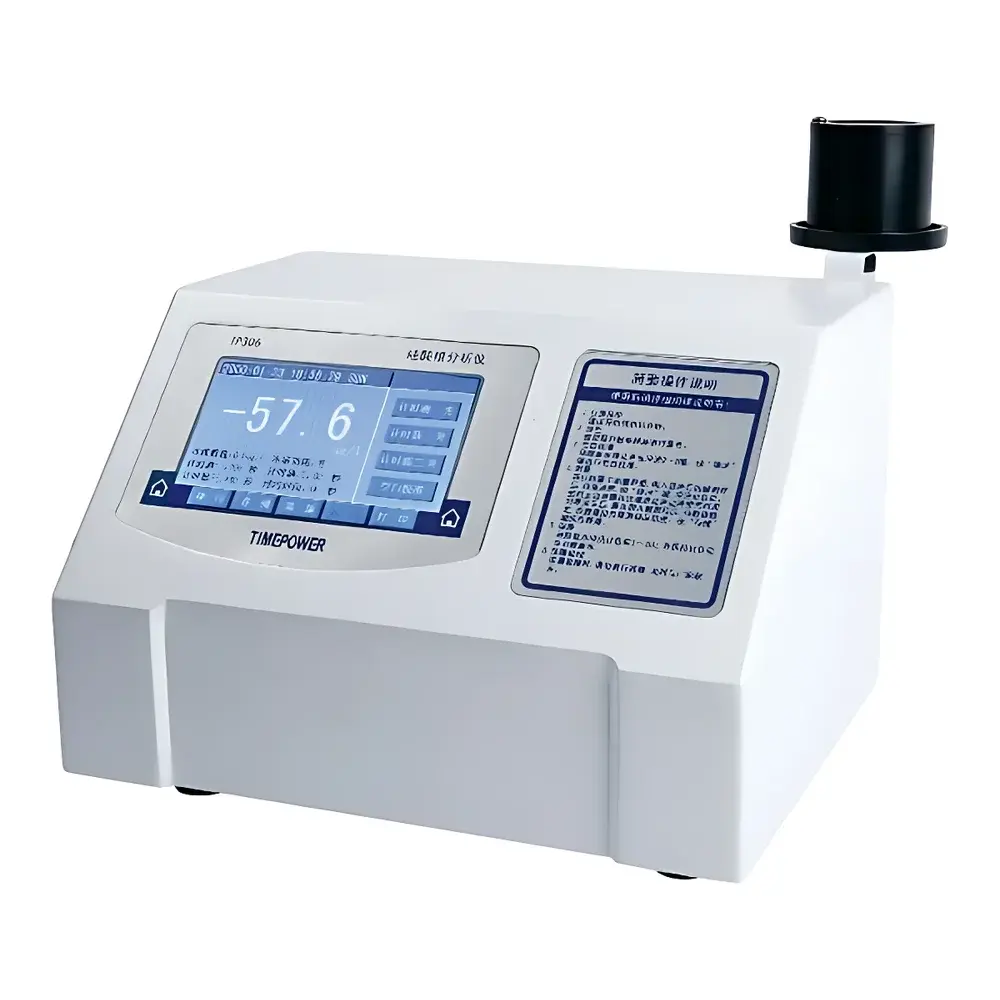
Timepower TP306 Laboratory Silica Analyzer
| Brand | Timepower |
|---|---|
| Model | TP306 |
| Type | Benchtop Laboratory Analyzer |
| Origin | Beijing, China |
| Manufacturer | Timepower (Producer) |
| Measurement Principle | Photometric Colorimetry (Molybdenum Blue Method) |
| Detection Range | 0.0–200.0 μg/L or 0.0–2000 μg/L |
| Accuracy | ±2% F.S. |
| Resolution | 0.1 μg/L |
| Repeatability | ≤1% |
| Stability | ±1% F.S./4 h |
| Display | 5.0-inch TFT color touchscreen (Chinese UI) |
| Power Supply | AC 85–265 V, 45–65 Hz |
| Power Consumption | ≤30 W |
| Dimensions | 260 × 200 × 180 mm |
| Weight | 3.2 kg |
| Environmental Operating Conditions | 5–45 °C, ≤90% RH (non-condensing) |
| Data Storage | 256 entries with auto-overflow overwrite |
| Key Features | Built-in blank calibration, baseline compensation, automatic timing prompt, cold LED light source, single-chip microcontroller architecture, SMT-based high-integration PCB design |
Overview
The Timepower TP306 Laboratory Silica Analyzer is a benchtop photometric instrument engineered for precise quantification of dissolved silica—primarily as soluble silicon dioxide (SiO₂) and silicate ions—in ultra-pure water streams across power generation, semiconductor manufacturing, pharmaceutical production, and fine chemical processing. It operates on the standardized molybdenum blue colorimetric method (ASTM D859, ISO 10578, and GB/T 12149), wherein soluble silica reacts with ammonium molybdate under strictly controlled acidic conditions (pH 1.1–1.3) to form a yellow heteropoly acid complex. This intermediate is subsequently reduced by 1-amino-2-naphthol-4-sulfonic acid (1-2-4 acid) to yield an intensely colored blue chromophore—the “silicomolybdenum blue”—whose absorbance at ~630 nm is directly proportional to silica concentration per the Lambert–Beer law. The TP306 integrates optical, electronic, and fluidic subsystems into a compact, self-contained platform optimized for routine QC/QA in controlled laboratory environments where trace-level silica monitoring (sub-ppb to low-ppb sensitivity) is critical to steam purity, boiler integrity, and wafer cleaning validation.
Key Features
- High-stability cold LED light source with narrow spectral bandwidth and minimal thermal drift—ensuring long-term photometric reproducibility without lamp replacement.
- Advanced surface-mount technology (SMT) PCB architecture and monolithic microcontroller design deliver low power consumption (<30 W), robust electromagnetic compatibility (EMC), and extended mean time between failures (MTBF).
- Integrated baseline compensation algorithm corrects for inherent optical background and reagent blank variability—critical for reliable sub-10 μg/L silica measurement in ultrapure water matrices.
- Onboard automatic timing function triggers reduction reaction incubation intervals precisely, eliminating manual stopwatch dependency and reducing operator-induced variance.
- Full-range dual-scale detection (0.0–200.0 μg/L and 0.0–2000 μg/L) with 0.1 μg/L resolution enables flexible method selection without hardware modification.
- 256-point cyclic data storage with timestamping supports GLP-compliant recordkeeping; overflow management ensures continuous logging without manual intervention.
- Zero-point stabilization via programmable blank calibration compensates for electronic offset, photodiode aging, and cuvette path-length inconsistencies—enhancing inter-day measurement fidelity.
Sample Compatibility & Compliance
The TP306 is validated for use with Type I ultrapure water (resistivity ≥18.2 MΩ·cm, TOC <1 ppb) generated by high-performance mixed-bed ion exchange or electrodeionization systems. Sample introduction requires pre-filtered (0.45 µm PTFE membrane), particle-free aliquots free of suspended solids, oxidants (e.g., chlorine), or interfering cations (e.g., Fe³⁺, Ti⁴⁺) above threshold levels defined in ASTM D859 Annex A1. The analyzer conforms to IEC 61010-1 safety standards for electrical equipment for measurement, control, and laboratory use. While the instrument itself does not carry FDA 21 CFR Part 11 certification, its data logging structure—including immutable timestamps, user-access logs, and audit-ready export (via USB)—supports alignment with GMP/GLP documentation requirements when deployed within validated analytical workflows.
Software & Data Management
The TP306 features an embedded real-time operating system (RTOS) with a localized Chinese-language GUI displayed on a 5.0-inch capacitive touchscreen. No external PC or proprietary software is required for operation or data review. All calibration parameters (zero, span, curve order), measurement history, and system diagnostics are stored internally. Data export is supported via standard USB-A interface to FAT32-formatted flash drives in CSV format—enabling direct import into LIMS, Excel, or statistical process control (SPC) platforms. Calibration protocols include mandatory daily blank verification and biweekly multi-point calibration curve verification to maintain metrological traceability per ISO/IEC 17025 clause 7.7.
Applications
- Monitoring silica breakthrough in mixed-bed demineralizers and EDI units feeding boiler feedwater systems.
- Verifying silica removal efficiency in condensate polishing trains of fossil and nuclear power plants.
- Qualifying ultrapure water used in photolithography rinse steps and epitaxial reactor purges in semiconductor fabs.
- Ensuring compliance with USP conductivity and TOC limits where silica contributes indirectly to ionic load.
- Supporting cleaning validation studies in API synthesis facilities where silicate leaching from glass reactors must be quantified.
FAQ
What sample volume is required per analysis?
A minimum of 30 mL of properly filtered, particle-free sample is recommended to ensure representative aliquot delivery and rinsing of the optical cell.
Can the TP306 measure total silica (dissolved + colloidal)?
No—the method is specific to dissolved reactive silica. Colloidal or particulate silica requires acid digestion (e.g., ASTM D5117) prior to analysis and is outside the scope of this instrument’s validated range.
Is temperature compensation applied during measurement?
The instrument operates within a controlled ambient range (5–45 °C); however, no real-time solution temperature correction is implemented. Users must equilibrate samples to room temperature before analysis to minimize refractive index artifacts.
How often must the 1-2-4 acid reagent be replaced?
Due to oxidative degradation, freshly prepared 1-2-4 acid solution should be used daily. Stock solutions must be stored refrigerated in amber polyethylene bottles and discarded after 72 hours.
Does the TP306 support external printer or network connectivity?
No—it lacks Ethernet, Wi-Fi, or RS-232 ports. Hardcopy output requires manual data transcription or post-export report generation on connected workstations.







