
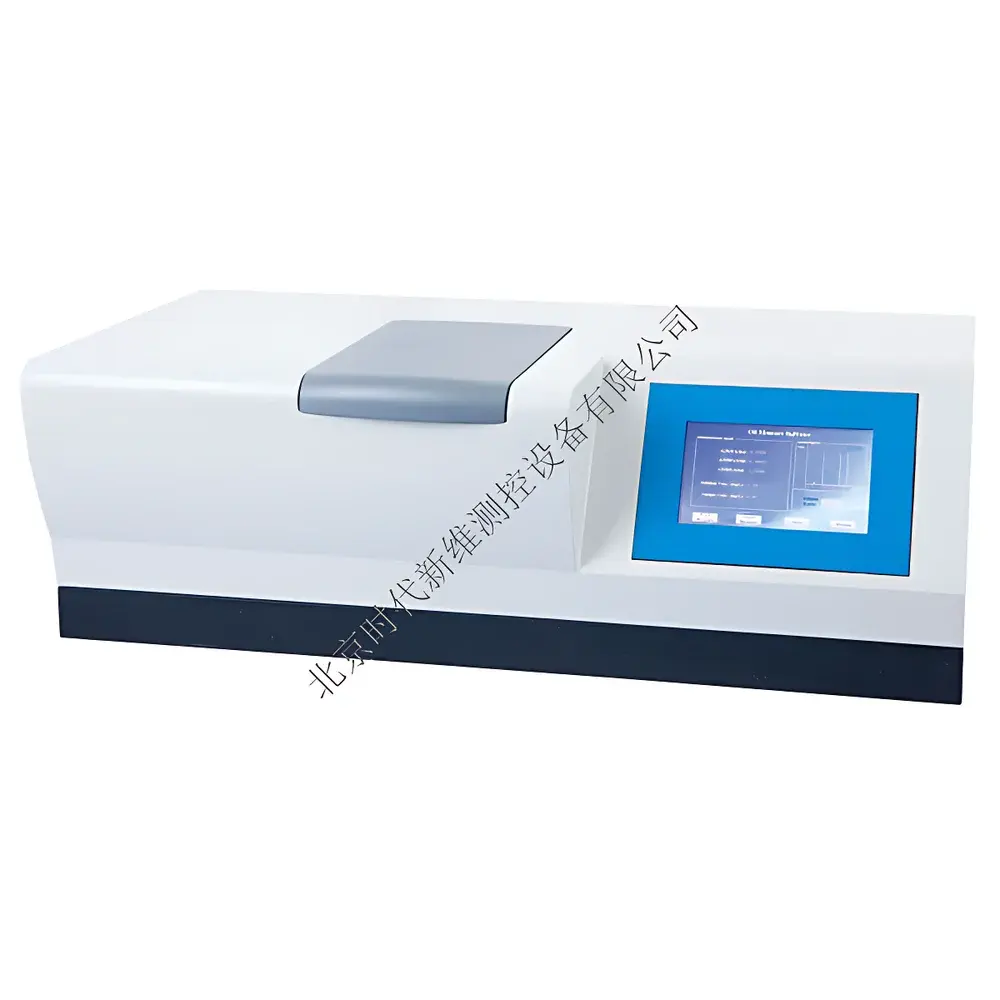
Timepower TP303 Infrared Oil Content Analyzer
| Brand | Timepower |
|---|---|
| Origin | Beijing, China |
| Manufacturer Type | Direct Manufacturer |
| Origin Category | Domestic (China) |
| Model | TP303 |
| Instrument Type | Laboratory Benchtop Analyzer |
| Measurement Principle | Infrared Absorption Spectrophotometry (Triple-Wavenumber Method per HJ 637–2018) |
| Spectral Range | 3400 cm⁻¹ to 2400 cm⁻¹ |
| Detection Limit | <0.2 mg/L (as aqueous solution concentration) |
| Accuracy | ±2% |
| Spectral Resolution | 1 cm⁻¹ |
| Measurement Frequency | 7 scans per analysis |
Overview
The Timepower TP303 Infrared Oil Content Analyzer is a dedicated benchtop spectrophotometric instrument engineered for quantitative determination of petroleum hydrocarbons and total oil content in aqueous environmental and industrial wastewater samples. It operates on the principle of infrared absorption spectroscopy, specifically implementing the triple-wavenumber algorithm defined in China’s national standard HJ 637–2018. This method relies on the characteristic C–H stretching vibrations of hydrocarbon functional groups: A2930 (CH2 asymmetric stretch), A2960 (CH3 asymmetric stretch), and A3030 (aromatic C–H stretch). By measuring absorbance at these three discrete wavenumbers in tetrachloroethylene (C2Cl4) extracts, the instrument calculates total extractable material (TEM), petroleum hydrocarbons (after silica-magnesium adsorption to remove polar interferences such as animal/vegetable oils), and implicitly derives non-petroleum hydrocarbon content (e.g., biogenic oils) by difference. The TP303 employs a fixed-pathlength cell-based optical architecture with dual-beam referencing, eliminating baseline drift and enabling direct quantitation without routine calibration curve generation—relying instead on pre-determined correction coefficients traceable to certified reference materials.
Key Features
- Compliance-ready design aligned with HJ 637–2018 methodology, including mandatory spectral band selection and arithmetic calculation protocols
- Integrated automatic sample/reference cell switching mechanism with precision mechanical positioning—minimizing alignment-induced photometric error to negligible levels
- Cosine-compensated wavenumber scanning ensures spectral registration accuracy better than ±1 cm⁻¹ across the operational range (2400–3400 cm⁻¹)
- True triple-wavenumber measurement mode: simultaneous acquisition at 2930 cm⁻¹, 2960 cm⁻¹, and 3030 cm⁻¹ without interpolation or extrapolation
- Self-contained operation capability: functions independently of external PCs; includes built-in 5.7-inch monochrome LCD with full Chinese menu navigation
- Dedicated油烟 (catering fume) measurement mode compliant with GB 18483–2001, supporting field-deployable monitoring of cooking oil emissions
- Wide-input switching power supply (220 V ±10 V, 50 Hz ±1 Hz) ensures stable operation under variable laboratory grid conditions
- Low power consumption (≤40 W) and compact footprint (540 × 246 × 160 mm) facilitate integration into constrained QC/QA lab environments
Sample Compatibility & Compliance
The TP303 is validated for use with liquid-phase extracts prepared via liquid–liquid extraction using tetrachloroethylene as the solvent, following standardized pretreatment procedures outlined in HJ 637–2018. Sample compatibility includes surface water, groundwater, municipal wastewater, industrial effluents, and catering exhaust condensates. Critical procedural controls—such as pre-extraction drying of C2Cl4, strict adherence to adsorption column conditioning (silica-magnesium), and 30-minute instrument warm-up—are embedded in the operational protocol to maintain metrological integrity. While not certified to ISO/IEC 17025 or ASTM D7066, the instrument’s algorithmic structure and performance specifications (±2% accuracy, 0.999 linearity) support data defensibility in regulatory reporting contexts where HJ 637–2018 compliance is mandated. Baseline stability (<1% drift over 4 h) meets GLP-aligned requirements for batch-wise analysis continuity.
Software & Data Management
Data acquisition and processing are handled by embedded firmware with no dependency on proprietary PC software. All calculations—including TEM, petroleum hydrocarbons, and animal/vegetable oil estimation—are executed onboard using coefficient matrices derived from NIST-traceable oil standards. Results are displayed in real time and may be printed directly via integrated thermal printer interface. When connected to a host computer via RS-232 or USB-to-serial adapter, raw absorbance values (A2930, A2960, A3030) and final concentration outputs can be exported in CSV format. Wavenumber compensation is adjustable within ±5 cm⁻¹ to accommodate minor optical aging or ambient temperature fluctuations—functionality logged with timestamped audit trail when enabled. No FDA 21 CFR Part 11 functionality is provided; however, all measurement records include date/time stamp, operator ID field, and method version identifier (HJ 637–2018).
Applications
- Regulatory monitoring of oil-in-water concentrations in municipal wastewater treatment plant influent/effluent streams
- Industrial compliance testing for petrochemical, metalworking, food processing, and textile manufacturing facilities
- Field and laboratory assessment of soil leachate and groundwater contamination plumes
- Routine quality control of cooling tower fluids and hydraulic systems where hydrocarbon ingress is a failure mode
- Environmental impact assessments requiring speciated oil quantification (petroleum vs. non-petroleum fractions)
- Catering establishment emission verification per GB 18483–2001 for air pollution control authorities
FAQ
What extraction solvent is required for TP303 operation?
Tetrachloroethylene (C2Cl4) is mandatory per HJ 637–2018; alternative solvents invalidate spectral band assignments and compromise accuracy.
Is daily calibration with standard solutions necessary?
No—TP303 uses factory-determined correction coefficients; only periodic verification with certified oil standards (e.g., SRM 1942a analogs) is recommended every 30 days or after maintenance.
Can the instrument distinguish between mineral oil and biodiesel contamination?
It quantifies total hydrocarbons and estimates non-petroleum fraction by difference; definitive speciation requires GC-MS or FTIR library matching beyond TP303’s scope.
What is the minimum sample volume required for analysis?
Standard procedure specifies 1 L of water sample for 100× preconcentration; smaller volumes may be used if adjusted for dilution factor in post-processing.
Does the TP303 support ASTM D7066 or ISO 9377-2 methods?
No—it is purpose-built for HJ 637–2018; method transfer to international standards would require full revalidation per ISO/IEC 17025 guidelines.







