
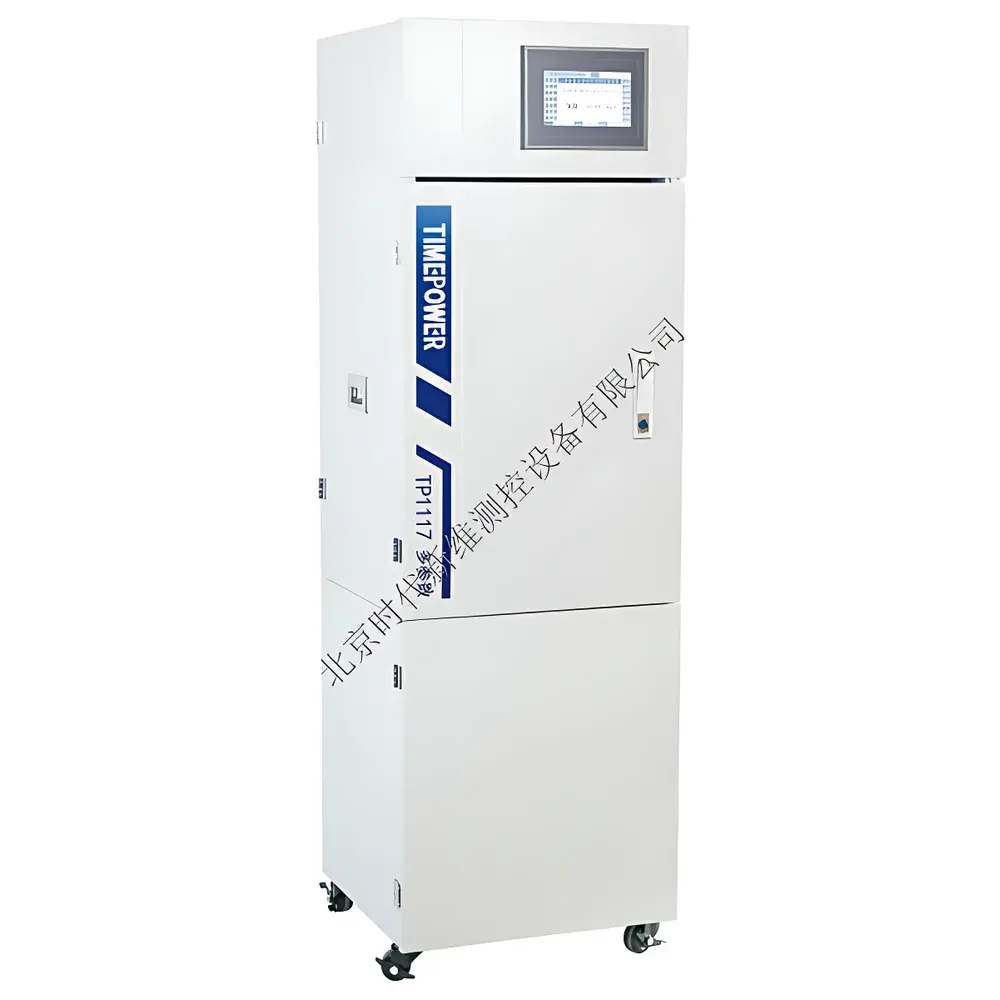
TimePower TP1117 Multi-Parameter Water Quality Analyzer
| Brand | TimePower |
|---|---|
| Origin | Beijing, China |
| Manufacturer Type | Direct Manufacturer |
| Product Origin | Domestic (China) |
| Model | TP 1117 |
| Instrument Type | Laboratory & Field-Deployable Water Quality Analyzer |
| Measurable Parameters | pH, Conductivity, Turbidity, Dissolved Oxygen (DO), Temperature, ORP, Chlorophyll-a, Oil-in-Water, Ammonia-Nitrogen |
| Sensor Interface | RS485 with MODBUS RTU protocol |
| Probe Configuration | Up to 6 digital sensor inputs (simultaneous 7-parameter measurement) |
| Calibration Storage | Embedded in each smart sensor |
| Enclosure Rating | IP68 submersible housing |
| Auto-Cleaning System | Integrated mechanical wiper and optional ultrasonic cleaning module |
| Compliance | Designed to support ISO 5814, ASTM D888, ISO 7027, ISO 7888, USP <643>, GLP-compliant data logging |
Overview
The TimePower TP1117 Multi-Parameter Water Quality Analyzer is an integrated, field-deployable analytical platform engineered for high-reliability, long-term monitoring of physicochemical water quality parameters in diverse aquatic environments—including rivers, lakes, reservoirs, coastal zones, groundwater wells, and wastewater treatment streams. It operates on a modular, sensor-centric architecture grounded in digital transduction principles: pH and ORP are measured via solid-state ISFET or glass-electrode-based digital sensors; conductivity employs a robust four-electrode cell to eliminate polarization errors across a wide dynamic range (1 µS/cm to 200 mS/cm); turbidity is quantified using near-infrared (NIR) LED excitation and fiber-optic light collection aligned to ISO 7027 optical geometry; dissolved oxygen is determined via luminescence quenching (fluorescence lifetime decay) — a method offering superior stability, zero oxygen consumption, and immunity to flow dependence compared to Clark-type electrochemical cells; temperature is acquired via precision Pt1000 RTD elements. All sensors communicate digitally over RS485 using the MODBUS RTU protocol, enabling deterministic polling, real-time diagnostics, and plug-and-play replacement without recalibration at the host unit.
Key Features
- Digital smart sensor architecture: Each probe houses its own microcontroller, non-volatile calibration memory, temperature compensation coefficients, and self-diagnostics — eliminating manual coefficient entry and ensuring traceable, sensor-specific calibration history.
- Modular multi-probe integration: Supports up to six concurrently connected digital sensors, delivering simultaneous measurement of up to seven parameters (e.g., pH, DO, turbidity, conductivity, temperature, ORP, and optional chlorophyll-a or ammonia-nitrogen).
- IP68-rated submersible housing with corrosion-resistant 316L stainless steel and PEEK wetted materials — validated for continuous immersion in freshwater, brackish, and marine environments.
- Integrated automatic cleaning system: Combines programmable mechanical wiping and optional ultrasonic transducers to mitigate biofouling, sediment adhesion, and bubble entrapment — critical for maintaining optical path integrity and electrochemical surface activity over extended unattended deployments.
- Low-power operation (<3 W typical): Compatible with solar-battery hybrid power systems for remote off-grid installations.
- Onboard data logging: Internal SD card storage (expandable to 32 GB) with timestamped, CRC-verified records compliant with GLP audit trails — including raw sensor values, diagnostic flags, calibration timestamps, and environmental metadata.
Sample Compatibility & Compliance
The TP1117 is validated for use with natural waters (surface, ground, estuarine), treated and untreated wastewaters, industrial process effluents, and aquaculture systems. Its sensor suite meets performance criteria referenced in key international standards: dissolved oxygen measurements align with ISO 5814 (optical method); turbidity conforms to ISO 7027 (nephelometric principle with 90° detection); conductivity adheres to ISO 7888; pH and ORP follow ISO 10523 and ISO 11276 respectively. The instrument’s firmware supports configurable alarm thresholds, event-triggered sampling, and export of CSV/JSON-formatted datasets compatible with LIMS and SCADA integration. Data integrity safeguards include write-protected calibration logs, user-access levels (operator/administrator), and optional 21 CFR Part 11–compliant electronic signature modules for regulated laboratories.
Software & Data Management
The TP1117 communicates natively via MODBUS RTU over RS485, enabling seamless integration into existing industrial control networks. A dedicated Windows-based configuration and visualization software (TP-Link Suite v3.x) provides real-time parameter trending, sensor health monitoring (impedance, signal-to-noise ratio, response time), batch calibration management, and automated report generation (PDF/Excel). All calibration events — including date, operator ID, standard values used, and deviation metrics — are immutably stored within each sensor’s EEPROM and mirrored in the host logger. Remote firmware updates are supported via secure HTTPS-based OTA (Over-The-Air) protocol with SHA-256 signature verification.
Applications
- Regulatory compliance monitoring for municipal wastewater discharge (EPA NPDES, EU Urban Wastewater Treatment Directive)
- Drinking water source protection and distribution system integrity assessment
- Environmental impact assessments (EIAs) and long-term ecological trend analysis in protected watersheds
- Industrial pretreatment verification for pharmaceutical, food & beverage, and semiconductor manufacturing facilities
- Research-grade limnological and oceanographic studies requiring synchronized multi-parameter time-series acquisition
- Smart irrigation and aquaculture pond management through real-time DO, pH, and conductivity feedback loops
FAQ
Does the TP1117 require recalibration after replacing a sensor?
No. Calibration coefficients are permanently stored within each digital sensor’s onboard memory. Upon connection, the analyzer automatically retrieves and applies the correct calibration profile.
Can the system operate continuously underwater for 30 days without maintenance?
Yes — when equipped with the optional ultrasonic cleaning module and deployed within specified temperature (0–40°C) and salinity (<35 ppt) limits, the TP1117 maintains metrological stability for ≥30 days between manual interventions.
Is MODBUS register mapping documentation available for SCADA integration?
Yes. Full MODBUS RTU register tables, including holding registers for live values, status flags, and diagnostic codes, are provided in the Engineering Integration Manual (Rev. 4.2, included with shipment).
How is temperature compensation handled across different sensor types?
Each sensor performs real-time, embedded temperature compensation using its integrated Pt1000 element; no external temperature probe or host-level correction is required.
What cybersecurity measures are implemented for remote data access?
Remote access via Ethernet/WiFi requires TLS 1.2 encrypted tunneling; local RS485 communication is electrically isolated and does not expose network-facing services by default.







