
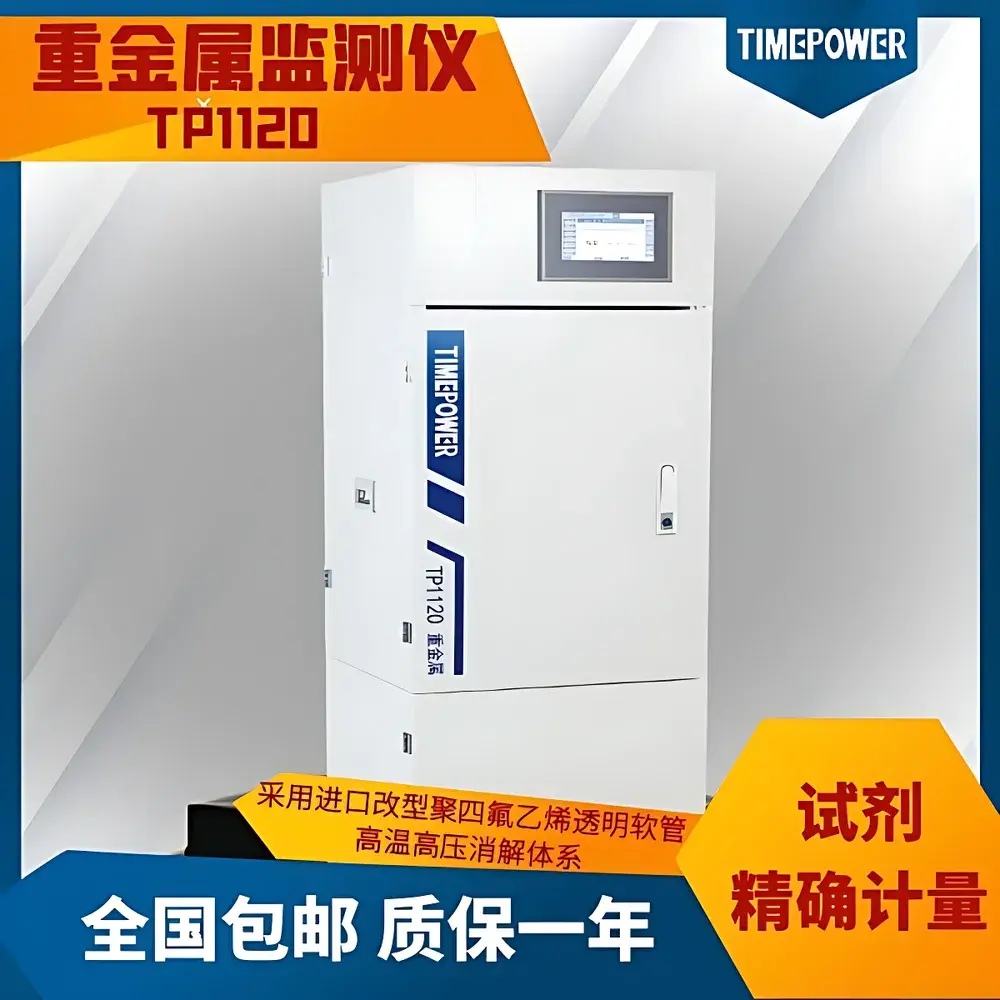
TimePower TP1120 Online Heavy Metals Analyzer for Water Quality Monitoring
| Brand | TimePower |
|---|---|
| Origin | Beijing, China |
| Manufacturer Type | Direct Manufacturer |
| Product Category | Domestic (China-made) |
| Model | TP1120 |
| Instrument Type | Online Analytical System |
| Detection Principle | Photometric Method (Colorimetric Absorption) |
| Target Metals | Dual-Parameter / Multi-Parameter Simultaneous Analysis (Total Cu, Fe, Ni, Mn, Pb, Cd, As, Zn, Cr, Cr(VI)) |
| Analysis Cycle Time | 20 minutes per sample |
| Accuracy/Precision | ±10% relative error for aqueous samples |
| Resolution | 0.1 mg/L |
| Reagent Consumption | 1 mL per assay |
| Sample Introduction | Negative-pressure aspiration via peristaltic pump with air-gap isolation |
| Digestion System | High-Temperature High-Pressure Closed-Vessel Digestion |
| Fluidic Tubing | Modified PTFE transparent tubing (ID ≥ 1.5 mm) |
| Valve Architecture | Programmable multi-position selection valve for reagent and sample routing |
| Optical System | Visible-light photometric detection with calibrated LED source and photodiode detector |
Overview
The TimePower TP1120 Online Heavy Metals Analyzer is an automated, laboratory-grade photometric system engineered for continuous, unattended monitoring of total and speciated heavy metals in surface water, industrial process streams, and wastewater effluents. It operates on the principle of colorimetric absorption photometry—where target metal ions are selectively complexed with chromogenic reagents under controlled chemical conditions, generating stable colored complexes whose absorbance intensity at defined visible wavelengths (e.g., 520 nm for Cu-BCO, 540 nm for Cr(VI)-DPC) is linearly proportional to analyte concentration. Unlike discrete benchtop spectrophotometers, the TP1120 integrates sample pretreatment—including high-temperature (up to 120 °C), high-pressure (up to 0.3 MPa) closed-vessel digestion—to ensure complete oxidation and solubilization of refractory metal species (e.g., organometallics, particulate-bound Cr(III), or colloidal As compounds), thereby delivering true “total metal” quantification compliant with ISO 11969, EPA Method 200.7, and GB/T 5750.6–2023. Its fully enclosed fluidic architecture eliminates operator exposure and minimizes environmental interference, making it suitable for deployment in Class I–III water quality monitoring stations, electroplating plant discharge points, and municipal wastewater treatment plants requiring real-time regulatory reporting.
Key Features
- Multi-parameter capability: Simultaneous or sequential analysis of up to 10 regulated metals—including total copper, iron, nickel, manganese, lead, cadmium, arsenic, zinc, chromium, and hexavalent chromium—within a single instrument footprint.
- High-integrity fluid handling: Peristaltic pumping with integrated air-gap isolation prevents reagent–tubing contact, significantly extending pump tube service life (>12 months under continuous operation) and eliminating cross-contamination risks from residual carryover.
- Precision photometric engine: LED-based optical path with temperature-stabilized photodiode detection ensures long-term signal stability (<0.5% drift over 30 days) and supports calibration traceability to NIST-traceable standards.
- Robust digestion module: Sealed PTFE-lined reaction vessels withstand aggressive acid matrices (HNO₃/HCl/HF blends) and accelerate redox reactions, achieving >95% recovery for Cr(VI) and As(III/V) within 20 min without manual intervention.
- Modular valve manifold: 12-position programmable selection valve enables flexible reagent routing, automatic standard/sampling sequence switching, and scheduled maintenance cycles—all configurable via embedded firmware without hardware modification.
- Low reagent consumption: Optimized micro-dosing (1.0 ±0.05 mL per assay) reduces operational cost and hazardous waste generation by >60% compared to conventional flow-injection systems.
Sample Compatibility & Compliance
The TP1120 accepts raw water samples with turbidity ≤100 NTU and suspended solids <50 mg/L; optional inline filtration (5 µm polypropylene) is recommended for high-solids influents. It complies with ISO/IEC 17025:2017 requirements for measurement uncertainty estimation and supports audit-ready data integrity per FDA 21 CFR Part 11 when paired with TimePower’s certified SCADA interface. All analytical methods implemented (e.g., Cr(VI) by 1,5-diphenylcarbazide, total As by silver diethyldithiocarbamate) align with USP , EU Directive 2000/60/EC Annex V, and China’s HJ 484–2009 and HJ 694–2014 standard methods. Instrument validation reports include linearity (R² ≥ 0.999), LOD (0.02–0.15 mg/L depending on element), and inter-laboratory reproducibility (RSD < 8% at 2×LOQ).
Software & Data Management
Embedded firmware (v3.2+) provides real-time status monitoring, method scheduling, auto-calibration (daily/weekly), and alarm-triggered event logging. The optional TimePower CloudLink™ platform enables secure TLS 1.2–encrypted remote access, historical trend visualization (72-hr rolling buffer), and automated report generation in PDF/CSV formats compatible with national water quality databases (e.g., China’s National Surface Water Monitoring System). All user actions—including method edits, calibration updates, and maintenance logs—are time-stamped and digitally signed to satisfy GLP/GMP documentation requirements.
Applications
- Regulatory compliance monitoring at wastewater discharge outlets subject to local environmental permits (e.g., Beijing Municipal Ecological Environment Bureau, EU IED Annex I).
- Process control in metal finishing facilities, where real-time Cu/Ni/Cr tracking enables immediate bath replenishment decisions and reduces chemical overfeed.
- Early-warning detection in drinking water source protection zones for anthropogenic heavy metal intrusion events.
- Long-term trend analysis in river basin management programs requiring high-frequency (hourly/daily) metal speciation data.
- Support for ISO 14001 environmental management system audits through verifiable, timestamped analytical records.
FAQ
What sample pretreatment is required prior to analysis?
No manual pretreatment is needed. The TP1120 performs integrated filtration (optional), acid digestion, oxidation, and complexation automatically. Samples must be representative and free of macro-debris (>1 mm).
Can the instrument differentiate between Cr(III) and Cr(VI)?
Yes—Cr(VI) is measured directly using the DPC method; total Cr is determined after UV–persulfate digestion; Cr(III) is calculated by difference. Speciation accuracy meets EPA Method 7196A performance criteria.
Is remote diagnostics supported?
Yes—via Ethernet or 4G LTE, with encrypted SSH access for firmware updates and live sensor diagnostics (pump pressure, photodiode gain, digestion temperature stability).
How often does the system require calibration verification?
Automatic daily zero/span checks using certified reference materials; full multi-point calibration recommended every 7 days or after reagent batch change.
Does the TP1120 meet China’s “Technical Specification for Online Monitoring Equipment of Pollutants in Wastewater” (HJ 353–2019)?
Yes—certified by CMA-accredited third-party testing institutes for HJ 353–2019 conformance, including 24-hour uninterrupted operation, data transmission reliability (>99.5%), and mean time between failures (MTBF) ≥ 1,500 hours.







