
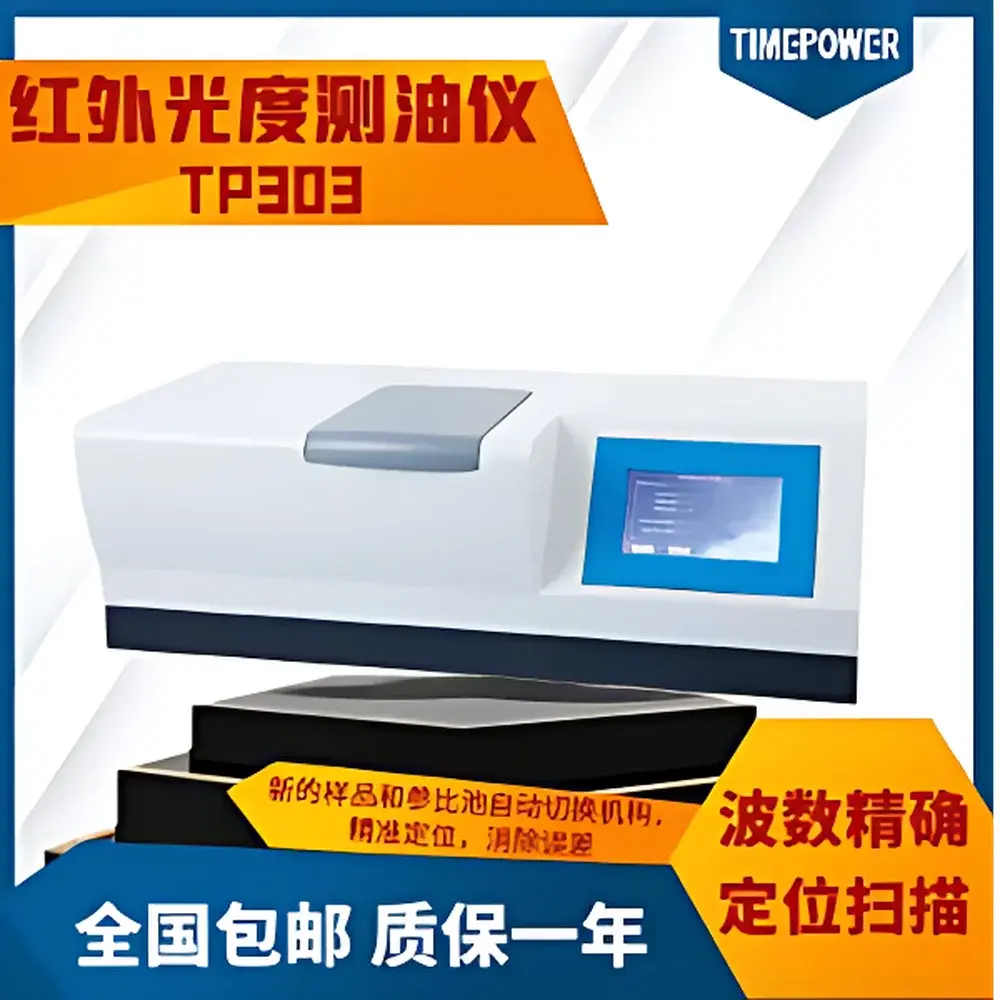
Timepower TP303 Infrared Oil Content Analyzer
| Brand | Timepower |
|---|---|
| Origin | Beijing, China |
| Manufacturer Type | Direct Manufacturer |
| Instrument Category | Domestic |
| Model | TP303 |
| Application | Laboratory Use |
| Measurement Principle | Infrared Spectrophotometry (Fourier-transform-free, fixed-wavelength dual-beam) |
| Measurement Range | 0.02–800 mg/L (in extractant, e.g., tetrachloroethylene) |
| Detection Limit | <0.2 mg/L |
| Accuracy | ±2% of reading |
| Resolution | 0.1 mg/L |
| Measurement Frequency | 7 analyses per minute |
| Compliance | HJ 637–2018 (China National Standard) |
Overview
The Timepower TP303 Infrared Oil Content Analyzer is a dedicated laboratory instrument engineered for quantitative determination of oil and grease in aqueous matrices using standardized infrared spectrophotometric methodology. It operates on the principle of absorbance measurement at three characteristic wavenumbers—2930 cm⁻¹ (aliphatic CH₂ stretch), 2960 cm⁻¹ (aliphatic CH₃ stretch), and 3030 cm⁻¹ (aromatic C–H stretch)—in tetrachloroethylene (C₂Cl₄) extracts. This tri-wavelength algorithm enables independent quantification of total extractable material (TEM), petroleum hydrocarbons (PHC), and non-petroleum hydrocarbons (e.g., animal and vegetable oils) via differential spectral subtraction, fully aligned with the technical requirements of HJ 637–2018, the official Chinese standard for petroleum hydrocarbon analysis in water. Unlike calibration-dependent photometric methods, the TP303 employs a reference-based correction coefficient approach—eliminating the need for daily standard curve preparation while maintaining traceability to certified reference materials and inter-laboratory validation protocols.
Key Features
- Fixed-optical-path, dual-beam infrared detection system optimized for stability under ambient laboratory conditions
- Integrated sample handling workflow: automated extraction interface compatibility (with external liquid-liquid extraction units), manual cell loading, and zero-point referencing routine
- Digital signal processing engine with real-time baseline correction and spectral drift compensation
- Robust optical design utilizing high-stability tungsten-halogen source and thermoelectrically stabilized PbSe detector
- Pre-programmed calculation modules for TEM, PHC, and AVOC (animal/vegetable oil content) according to HJ 637–2018 Annex A
- Non-volatile memory storage for up to 500 measurement records with timestamp, operator ID, and method version stamp
Sample Compatibility & Compliance
The TP303 is validated for use with water samples including municipal wastewater, industrial effluents (e.g., petrochemical, metallurgical, thermal power generation), food service exhaust condensates, and stormwater runoff. Sample preparation follows standardized liquid–liquid extraction using tetrachloroethylene as the solvent, followed by optional silica-magnesium adsorption for polar interference removal. The instrument conforms to the metrological and procedural specifications outlined in HJ 637–2018, including wavelength tolerance (±1 cm⁻¹), photometric linearity verification, and blank correction protocol. While not certified to ISO/IEC 17025 out-of-the-box, its operational parameters support full compliance when implemented within an accredited laboratory’s documented quality management system—including GLP-aligned audit trails, reagent lot tracking, and analyst authentication logs.
Software & Data Management
The embedded firmware supports USB 2.0 data export in CSV format, compatible with LIMS integration and statistical process control (SPC) platforms. All measurements retain metadata: date/time, operator code, sample ID, extraction batch number, and calibration status flag. Optional PC-based software (TP-OilSuite v2.1) provides extended functionality including trend charting, multi-sample comparison reports, outlier detection (Dixon Q-test), and PDF report generation compliant with internal QA/QC documentation standards. Audit trail features log all parameter changes, result edits, and firmware updates—supporting alignment with FDA 21 CFR Part 11 requirements when deployed in regulated environments with appropriate system validation.
Applications
- Regulatory monitoring by environmental protection agencies and municipal water authorities
- Effluent compliance testing for petroleum refineries, chemical plants, and metal finishing facilities
- Wastewater treatment plant influent/effluent characterization and process optimization
- Stack emission condensate analysis in food service and hospitality sector environmental audits
- Baseline and periodic surveillance in railway infrastructure maintenance depots and thermal power stations
- Research-grade hydrocarbon speciation in academic and government environmental laboratories
FAQ
Does the TP303 require daily calibration with standard solutions?
No—its measurement algorithm relies on pre-determined correction coefficients derived from NIST-traceable mineral oil standards; only periodic verification (e.g., weekly) using certified reference materials is required.
Is tetrachloroethylene the only acceptable extraction solvent?
Yes, per HJ 637–2018; alternative solvents such as CCl₄ or FC-40 are not permitted due to spectral interference and regulatory non-conformance.
Can the instrument distinguish between diesel-range and lubricating oil-range hydrocarbons?
No—the TP303 quantifies bulk aliphatic and aromatic hydrocarbon mass concentration; compound-specific identification requires GC-MS or FTIR with advanced chemometrics.
What maintenance is required beyond routine cleaning?
Annual optical path inspection and detector sensitivity verification are recommended; no consumable optical components are user-replaceable.
Is remote diagnostics supported?
Firmware-level diagnostic codes are accessible via serial port; full remote troubleshooting requires on-site service engineer deployment under warranty or service contract.
Related Products







