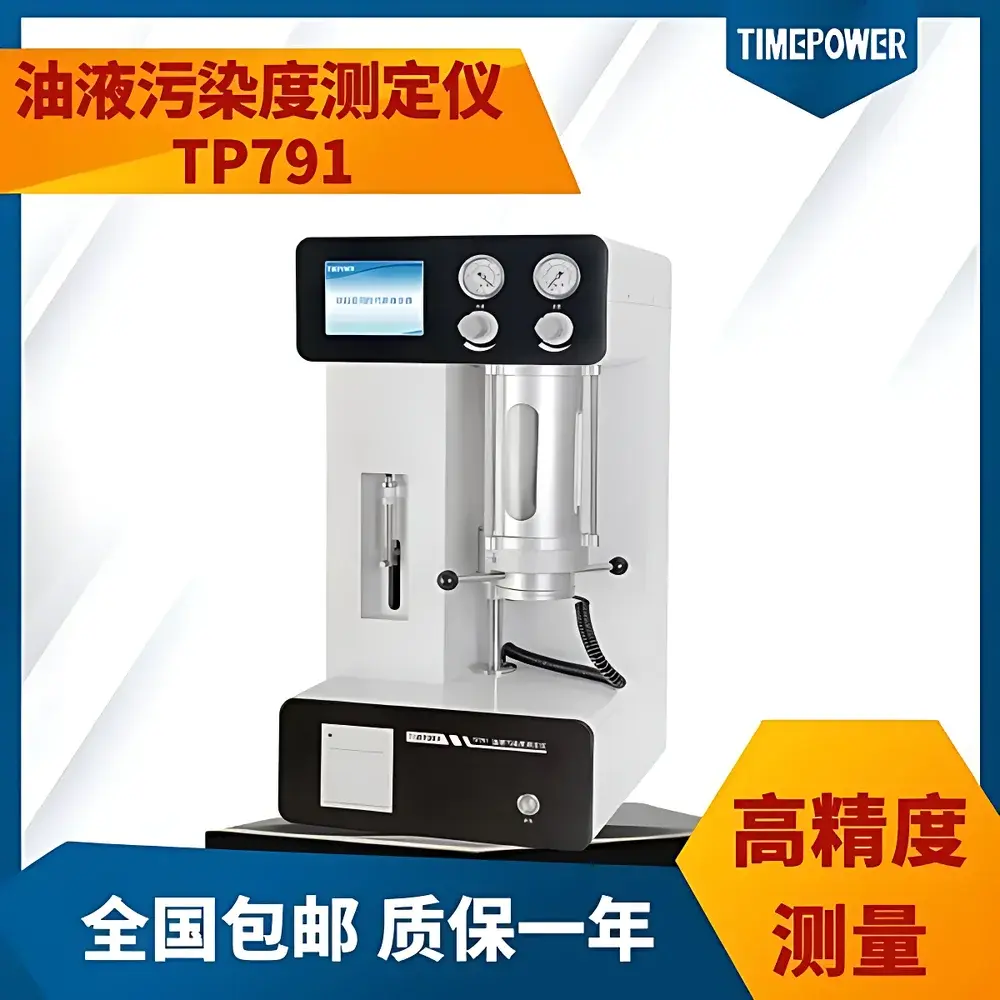
Timepower TP791 Oil Particle Contamination Analyzer
| Brand | Timepower |
|---|---|
| Model | TP791 |
| Origin | Beijing, China |
| Manufacturer | Timepower Co., Ltd. |
| Type | Domestic |
| Measurement Principle | Light Obscuration (LO) |
| Detection Range | 0.8 µm – 600 µm (sensor-dependent) |
| Accuracy | ±0.5% |
| Repeatability | RSD < 2% |
| Resolution | < 10% |
| Temperature Operating Range | 0–60 °C |
| Light Source | Semiconductor Laser |
| Number of Sizing Channels | 16 (user-definable within calibration curve range) |
| Sample Flow Rate | 5–80 mL/min |
| Coincidence Limit | 12,000–24,000 particles/mL (sensor-dependent) |
| Power Supply | AC 220 V ±10%, 50 Hz ±10% |
| Power Consumption | ≤200 W |
| Dimensions (Main Unit) | 360 × 370 × 700 mm |
| Dimensions (Air Pump) | 330 × 266 × 255 mm |
| Weight (Main Unit) | 30 kg |
| Weight (Air Pump) | 10 kg |
Overview
The Timepower TP791 Oil Particle Contamination Analyzer is a fully integrated, laboratory-grade instrument engineered for quantitative assessment of solid particulate contamination in liquid media—primarily hydraulic oils, lubricants, transformer (insulating) oils, turbine oils, gear oils, engine oils, aviation kerosene, water-glycol hydraulic fluids, and other organic liquids or polymer solutions. It operates on the internationally standardized light obscuration (LO) principle, as specified by the International Organization for Standardization (ISO 11171, ISO 4402, and ASTM D6786), and endorsed by the International Hydraulic Institute (IHI) and the National Fluid Power Association (NFPA). In this method, particles suspended in a fluid stream pass through a precisely defined sensing zone intersected by a collimated laser beam. Each particle obstructs a portion of the incident light proportional to its projected area, generating a voltage pulse whose amplitude correlates directly with particle size. Pulse counting and amplitude analysis across 16 user-configurable channels enable simultaneous quantification of particle concentration per size bin, supporting compliance-driven reporting against ISO 4406, NAS 1638, SAE AS4059, and GJB 420B standards.
Key Features
- High-stability semiconductor laser source with low-noise photodetector architecture ensures consistent signal-to-noise ratio and long-term measurement reproducibility.
- Precision syringe pump sampling system allows programmable sample volume selection (1–100 mL typical) and maintains constant flow rates from 5 to 80 mL/min—critical for viscosity-independent accuracy across diverse oil types.
- Combined positive- and negative-pressure sample introduction accommodates fluids ranging from low-viscosity aviation fuels (1000 cSt), minimizing aspiration artifacts and bubble entrapment.
- 16-channel digital pulse-height analyzer with user-defined bin boundaries enables granular sizing resolution within the calibrated detection range (0.8 µm to 600 µm, dependent on sensor configuration).
- Preloaded multi-point calibration curves traceable to NIST-traceable PSL and ISO MTD reference materials; supports import of custom calibration files for proprietary or industry-specific standards.
- Onboard data processing engine performs real-time ISO cleanliness code assignment per ISO 4406:2017 (e.g., 18/16/13), automatic alarm thresholds, and statistical summary reports including cumulative/differential histograms and trend tracking.
Sample Compatibility & Compliance
The TP791 is validated for use with mineral-based, synthetic, and bio-based oils—including phosphate ester fire-resistant fluids—as well as aqueous polymer solutions and non-aqueous solvents compatible with wetted materials (316 stainless steel, fused silica capillaries, fluoropolymer seals). Its design adheres to key regulatory and quality frameworks: ISO 17025-compliant operation when used within an accredited laboratory environment; full alignment with FDA 21 CFR Part 11 requirements for electronic records and signatures (audit trail, user authentication, data integrity controls); and suitability for GLP/GMP environments where documented traceability, calibration history, and version-controlled firmware are mandatory. Instrument validation documentation—including IQ/OQ protocols and performance qualification (PQ) test scripts—is available upon request.
Software & Data Management
The TP791 is operated via Timepower’s proprietary ContamiView™ software (Windows 10/11 compatible), which provides intuitive workflow navigation, method library management, and automated report generation in PDF, CSV, and XML formats. All raw pulse data, calibration logs, user actions, and result metadata are stored in an encrypted local database with configurable backup intervals and role-based access control. The software supports LIMS integration via ASTM E1384-compliant HL7 or direct SQL export, enabling seamless transfer of contamination grade results into enterprise quality systems. Audit trails record timestamped entries for every calibration, maintenance event, user login, and result modification—ensuring full data lineage per ALCOA+ principles.
Applications
- Condition monitoring of hydraulic systems in aerospace actuators and flight control surfaces per SAE AS4059 Class 5–10 specifications.
- Transformer oil acceptance testing in power generation substations aligned with IEC 60296 and IEEE C57.106 particle limits.
- In-service lubricant analysis for wind turbine gearboxes, marine propulsion systems, and rolling mill bearings to detect wear debris onset (e.g., >5 µm ferrous spikes).
- Final filtration verification for pharmaceutical-grade silicone oils and medical device manufacturing fluids under USP and ISO 8573-7.
- Research-grade particle stability assessment in nanofluids, lithium battery electrolyte suspensions, and functionalized polymer dispersions.
FAQ
What particle size standards does the TP791 support out-of-the-box?
The instrument ships with preloaded calibration curves traceable to ISO MTD (Medium Test Dust) and PSL (Polystyrene Latex) standards per ISO 11171:2010, covering ISO 4406, NAS 1638, SAE AS4059, and GJB 420B grading schemes.
Can the TP791 analyze opaque or highly colored oils?
Yes—the LO method is robust against moderate absorbance; however, samples exceeding OD 1.5 at 650 nm require dilution with matched base oil and correction for dilution factor. Optional UV-Vis spectrophotometric pre-screening module is available.
Is remote operation or network connectivity supported?
ContamiView™ supports TCP/IP-based remote desktop control and scheduled unattended runs via Windows Task Scheduler; no built-in Wi-Fi or cellular interface is provided to maintain electromagnetic compatibility in sensitive lab environments.
How often must the optical sensor be cleaned or recalibrated?
Routine cleaning is recommended after every 50 samples or when baseline noise exceeds 1.5 mV RMS; full recalibration using certified reference particles is required semiannually or after sensor replacement, per ISO/IEC 17025 Clause 6.5.
Does the system comply with FDA 21 CFR Part 11 for regulated pharmaceutical or biotech applications?
Yes—ContamiView™ implements electronic signature workflows, immutable audit trails, and role-based permissions meeting all technical and procedural requirements of 21 CFR Part 11 Subpart B, verified during third-party validation.
Related Products