
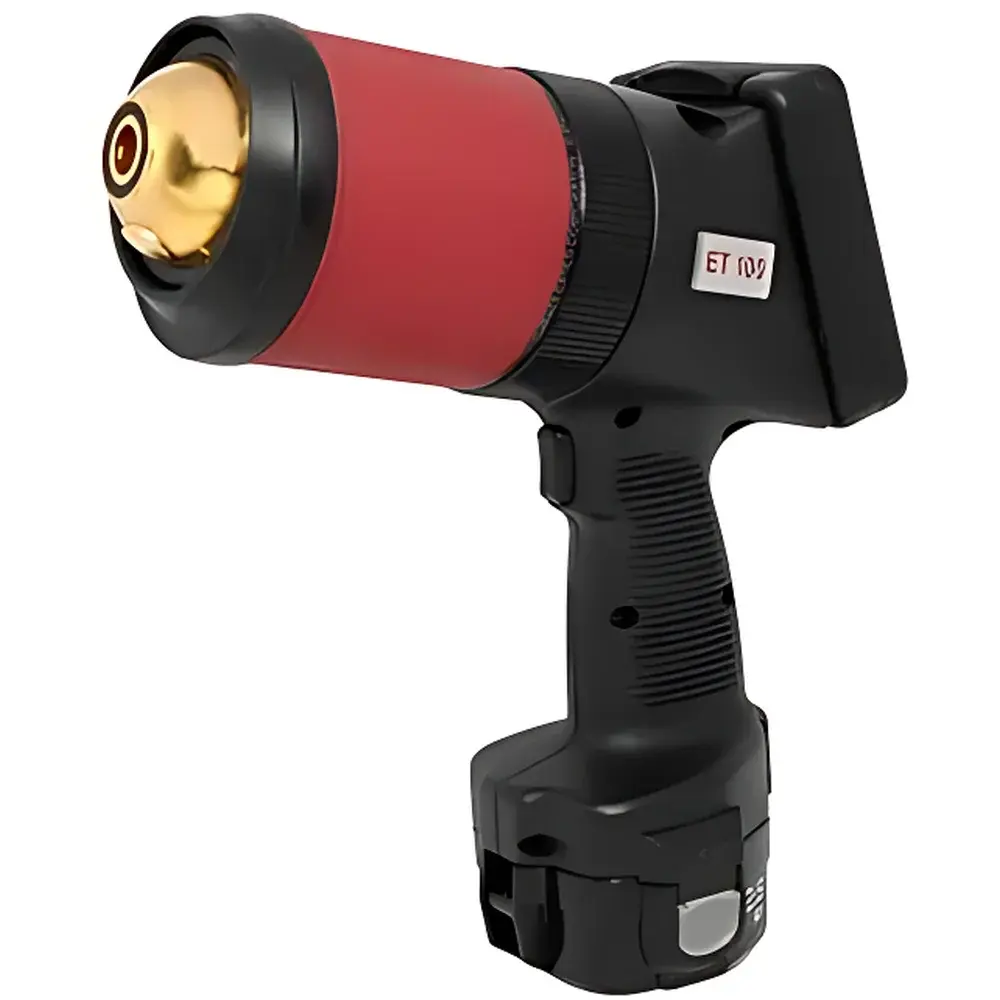
SurfaceOptics ET100 Field-Portable Infrared Spectral Emissometer
| Brand | SurfaceOptics (SOC) |
|---|---|
| Origin | USA |
| Model | ET100 |
| Spectral Range | 1.0–21 µm |
| Measurement Geometry | Bidirectional (20° & 60° incidence) |
| Spectral Bands | Six discrete bands (1.5–2.0, 2–3, 3–4, 4–5, 5–10, 10–21 µm) |
| Accuracy | ±1.5% |
| Measurement Time | ≤10 s per full-band acquisition |
| Warm-up Time | 90 s |
| Battery Life | 2 h (rechargeable NiMH) |
| Weight | 4.7 lbs (2.13 kg) |
| Operating Temperature | 0–40 °C (non-condensing) |
| Storage Temperature | −25–70 °C |
| Detector Type | Thermopile-based broadband IR sensor array |
| Calibration Traceability | NIST-traceable standards |
| Interface | Touchscreen PDA with graphical LCD |
| Data Storage | 265 MB CompactFlash |
| Output Formats | CSV, TXT, Excel-compatible |
Overview
The SurfaceOptics ET100 is a field-deployable, handheld infrared spectral emissometer engineered for quantitative, in-situ measurement of directional-hemispherical reflectance (DHR) and directional thermal emissivity across six discrete mid- to long-wave infrared (MWIR–LWIR) spectral bands—from 1.5–2.0 µm up to 10–21 µm. Unlike dispersive or Fourier-transform spectrometers, the ET100 employs a calibrated, multi-channel thermopile detection architecture coupled with a high-stability Cr–Al–Co alloy filament blackbody source operating at ~1000 °C. This design enables rapid, non-contact, absolute reflectance measurements under ambient daylight or low-light conditions without cryogenic cooling or vacuum enclosures. Its operational principle is grounded in bidirectional reflectance distribution function (BRDF) sampling at two fixed incidence angles (20° and 60° from surface normal), followed by hemispherical integration via empirical angular interpolation and Planckian spectral weighting—enabling derivation of both directional emissivity (εθ) and total hemispherical emissivity (εh). The instrument serves as a direct functional successor to legacy systems such as the Gier–Dunkle DB-100, offering enhanced repeatability, modular head interchangeability, and NIST-traceable calibration across all six bands.
Key Features
- Field-rugged, handheld form factor (11.54″ H × 9.04″ L × 3.72″ W; 2.13 kg with battery)
- Dual-angle measurement capability (20° and 60° incidence) compliant with ASTM E1933 and ISO 9277 for emissivity validation
- Six independently calibrated MWIR–LWIR spectral bands optimized for thermal signature characterization and material identification
- Integrated NIST-traceable reference source and on-board calibration verification routine
- Touchscreen PDA interface with real-time graphical display of raw reflectance, computed emissivity, and diagnostic status metrics
- Modular optical head design supporting future band expansion or application-specific configurations (e.g., extended LWIR or narrowband filtering)
- Battery-powered operation (rechargeable NiMH, 2 h runtime, 1 h recharge) enabling extended off-grid deployment
- Robust mechanical design accommodating curved surfaces—validated on convex radii down to 6 inches and concave radii up to 12 inches
Sample Compatibility & Compliance
The ET100 is designed for non-destructive, contactless evaluation of opaque and semi-opaque solid surfaces—including metallic alloys, ceramic coatings, polymer composites, thermal barrier materials, and oxidized or weathered substrates. It does not require sample preparation, vacuum, or temperature stabilization beyond ambient environmental limits (0–40 °C, non-condensing). All measurements adhere to fundamental radiometric principles defined in ASTM C1371 (Standard Test Method for Determination of Emittance of Materials Near Room Temperature Using Portable Emissometers) and support traceable reporting under ISO/IEC 17025-accredited quality management systems. Data integrity complies with ALCOA+ principles (Attributable, Legible, Contemporaneous, Original, Accurate), and audit trails—including operator ID, GPS metadata (optional external module), timestamp, ambient humidity/temperature logs, and calibration certificate IDs—are embedded in each stored record.
Software & Data Management
Data acquisition, visualization, and post-processing are managed through the proprietary ET100 Control Suite running on the integrated Windows Mobile–based PDA. Each measurement session captures synchronized values for all six bands, incidence angle, source stability index, detector signal-to-noise ratio, and internal thermal drift compensation flags. Export options include tab-delimited ASCII (.txt), comma-separated values (.csv), and native Excel (.xls) formats—ensuring seamless integration with MATLAB, Python (NumPy/Pandas), or enterprise LIMS platforms. The software enforces secure user authentication, configurable data retention policies, and optional 21 CFR Part 11–compliant electronic signatures when paired with validated IT infrastructure. Raw spectral reflectance data can be exported for third-party BRDF modeling or cross-referenced against HITRAN or MODTRAN atmospheric transmission libraries.
Applications
- Thermal signature validation for defense and aerospace platforms (aircraft skins, missile domes, UAV stealth coatings)
- In-field verification of high-emissivity thermal control coatings on spacecraft radiators and satellite bus components
- Quality assurance of selective solar absorbers and low-emissivity architectural glazing
- Corrosion monitoring via emissivity shift tracking on aged metal infrastructure (pipelines, storage tanks, naval hulls)
- Material degradation assessment in nuclear containment structures and fire-rated barriers
- Ground-truthing of airborne or satellite-based hyperspectral thermal imagery (e.g., AVIRIS-NG, HyTES)
- Calibration transfer between laboratory FTIR systems and field-deployed radiometric assets
FAQ
What spectral standards does the ET100 use for calibration?
The ET100 is calibrated using NIST-traceable blackbody references and spectral bandpass filters certified per ISO/IEC 17025 at SurfaceOptics’ A2LA-accredited calibration laboratory.
Can the ET100 measure transparent or semi-transparent materials?
No—it is designed exclusively for opaque or near-opaque surfaces where reflected radiant flux dominates over transmitted flux in the specified 1.0–21 µm range.
Is GPS geotagging supported natively?
GPS functionality is available via optional Bluetooth-connected external receivers; coordinates are embedded into metadata during export.
How is hemispherical emissivity calculated from directional measurements?
Using angular interpolation of measured DHR at 20° and 60°, combined with Planck-weighted integration over the six bands and standard ASTM E1933 hemispherical approximation algorithms.
Does the system support GLP/GMP-compliant audit trails?
Yes—when deployed with validated networked storage and configured user roles, the ET100 Control Suite maintains full electronic audit trails meeting FDA 21 CFR Part 11 and EU Annex 11 requirements.




