
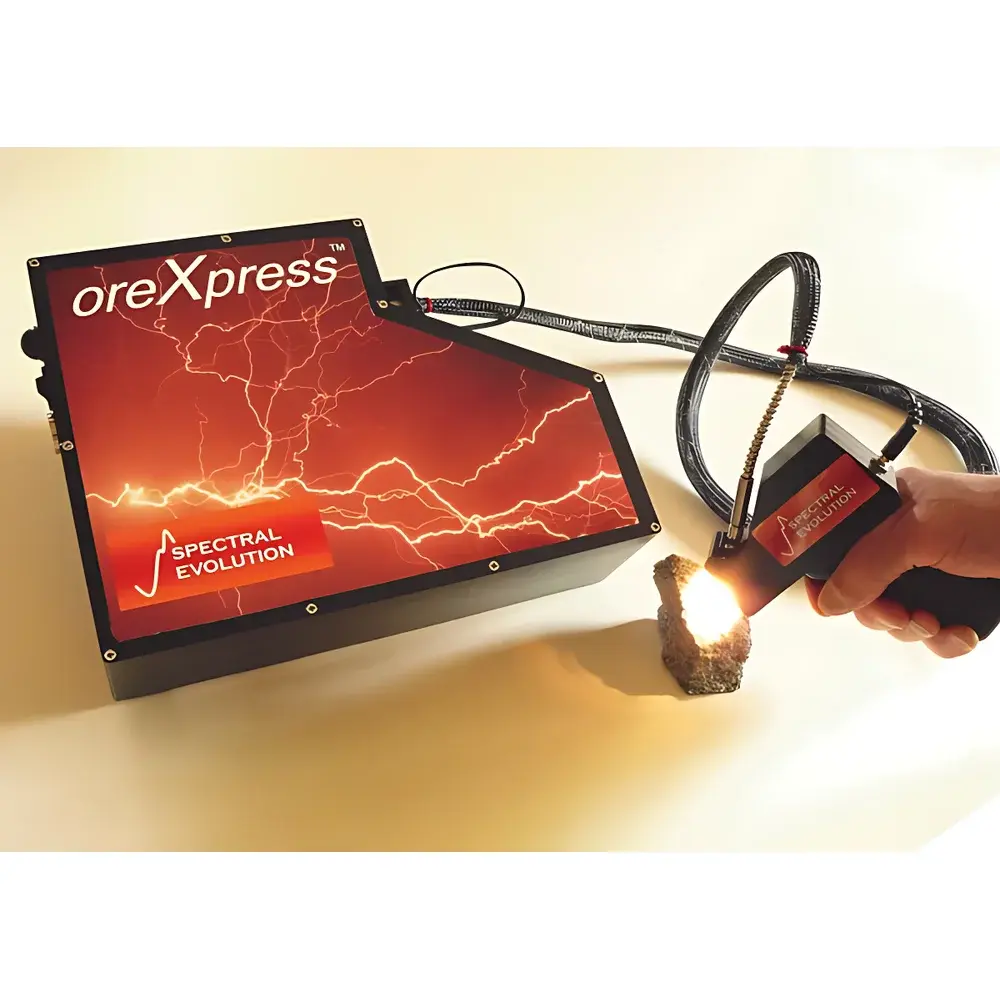
Spectral Evolution oreXpress Portable Near-Infrared Spectrometer
| Brand | Spectral Evolution |
|---|---|
| Origin | USA |
| Model | oreXpress |
| Instrument Type | Portable |
| Optical Principle | Fixed-grating array-detector (non-scanning) |
| Wavelength Range | 350–2500 nm |
| Sampling Interval | 1.5 nm (350–1000 nm), 3.8 nm @ 1500 nm, 2.5 nm @ 2100 nm |
| Measurement Mode | Diffuse Reflectance |
| Software | DARWin SP (data acquisition), EZ-ID (mineral identification), SpecMIN™, GRAMS®, TSG® |
| Detector Architecture | Dual silicon & InGaAs linear array |
| Battery | Removable high-capacity Li-ion |
| Integrated Field Terminal | GETAC PS336 with GPS, auto-focus camera, digital compass, altimeter, voice memo |
| Probe | Contact reflectance probe with pistol-grip handle, integrated 5W tungsten lamp, sapphire window |
Overview
The Spectral Evolution oreXpress Portable Near-Infrared Spectrometer is an engineered field-deployable instrument designed for rapid, non-destructive mineral identification and semi-quantitative analysis in geological exploration, mining operations, and core logging environments. Operating on a fixed-grating, dual-detector architecture—silicon (350–1000 nm) and extended-range InGaAs (1000–2500 nm)—the oreXpress captures full-spectrum diffuse reflectance data without mechanical scanning, ensuring spectral stability and measurement repeatability under variable ambient conditions. Its 350–2500 nm spectral coverage aligns precisely with diagnostic absorption features of hydroxyl-bearing minerals (e.g., clays, micas), carbonates, sulfates, iron oxides, and transition-metal-bearing phases critical to alteration mapping and deposit typology classification (e.g., porphyry Cu-Mo, kimberlite, skarn, shear-zone gold). Unlike scanning spectrometers, the array-based design eliminates moving parts, reducing thermal drift and enabling consistent radiometric calibration across temperature gradients typical of field deployments.
Key Features
- True portable architecture: Compact, ruggedized housing rated for IP54 environmental exposure; weighs < 3.2 kg with battery and probe
- Dual-array optical engine: Simultaneous acquisition across UV-Vis-NIR-SWIR bands with factory-calibrated wavelength registration and photometric linearity traceable to NIST standards
- Integrated GETAC PS336 field terminal: Embedded GPS (sub-meter accuracy), 8 MP auto-focus camera, digital compass, barometric altimeter, and voice annotation—synchronized metadata tagging for every spectrum
- Contact probe with ergonomic pistol grip, built-in 5W tungsten halogen source, and scratch-resistant sapphire window optimized for rock surface contact under dust or moisture
- Hot-swappable lithium-ion battery system supporting >6 hours continuous operation; field-replaceable without tooling
- Bluetooth 5.0 and USB-C connectivity for real-time data streaming and remote firmware updates
Sample Compatibility & Compliance
The oreXpress is validated for direct-contact diffuse reflectance measurements on unprepared geological materials including drill core segments, RC chip trays, blast-hole cuttings, outcrop surfaces, and hand specimens. Its optical geometry conforms to ASTM E1710 (Standard Practice for Determining Diffuse Reflectance of Solid Materials) and supports GLP-compliant workflows when paired with DARWin SP’s audit-trail-enabled acquisition logs. All spectral data files embed EXIF-style metadata (GPS coordinates, timestamp, operator ID, probe pressure status, ambient light flag) required for chain-of-custody documentation in exploration reporting. The instrument meets IEC 61326-1 for electromagnetic compatibility and operates within –10 °C to +50 °C ambient ranges—validated per MIL-STD-810G for shock, vibration, and humidity resistance.
Software & Data Management
Data acquisition is managed via DARWin SP software, which provides real-time spectral preview, dark/current reference capture, and automated SNR monitoring. Processed spectra are exported in ASTM E131-compliant JCAMP-DX format for interoperability. Mineral identification is performed using EZ-ID software, which implements constrained least-squares fitting, spectral angle mapper (SAM), and derivative-based feature matching against embedded USGS and SpecMIN™ spectral libraries. Users may curate project-specific libraries by importing validated reference spectra—each entry retains full metadata and uncertainty flags. All library operations comply with FDA 21 CFR Part 11 requirements when configured with electronic signature and audit trail modules. Third-party compatibility includes GRAMS AI for multivariate regression modeling (PLS, PCA) and TSG® for geological spectral database management and spatial rasterization.
Applications
- Rapid alteration zonation mapping via clay mineral assemblage discrimination (e.g., kaolinite vs. smectite vs. illite ratios)
- Core logging acceleration: Reduces traditional 6-hour visual/chemical logging cycles to ≤2 hours per 100 m interval
- Open-pit face characterization for selective mining unit delineation
- In-field validation of geochemical assay results through spectral proxy correlation (e.g., Al-OH band depth vs. Al₂O₃ content)
- Pre-screening of diamond indicator minerals (e.g., garnet, ilmenite, chromite) in glacial till or stream sediment samples
- Uranium and rare earth element (REE) host-phase identification via characteristic Ce³⁺/Nd³⁺ absorption features in the 750–900 nm region
FAQ
Is the oreXpress suitable for quantitative elemental analysis?
No—it performs mineralogical identification and semi-quantitative phase abundance estimation based on spectral absorption features, not elemental concentration. For quantitative assays, coupling with XRF or ICP-MS is recommended.
Can EZ-ID operate offline in remote field locations?
Yes—both USGS and SpecMIN™ libraries are fully embedded; no internet connection is required for spectral matching or custom library deployment.
What spectral resolution does the oreXpress achieve across its range?
Resolution is defined by sampling interval and detector pixel count—not a fixed FWHM value. At 350–1000 nm, effective resolution approximates 3–5 nm; at 2100 nm, it is ~8–10 nm—sufficient to resolve key mineral absorption minima (e.g., Al–OH at 2200 nm, Mg–OH at 2320 nm).
How is calibration maintained during extended field use?
The instrument uses internal white reference (Spectralon®) and dark current correction routines executed automatically before each measurement sequence. Annual factory recalibration is recommended for metrological traceability.
Does the system support integration with GIS platforms?
Yes—DARWin SP exports geotagged spectra in CSV and Shapefile-compatible formats; TSG® natively imports GPS-tagged spectra into ArcGIS and QGIS for raster-based mineral probability mapping.
Related Products





