
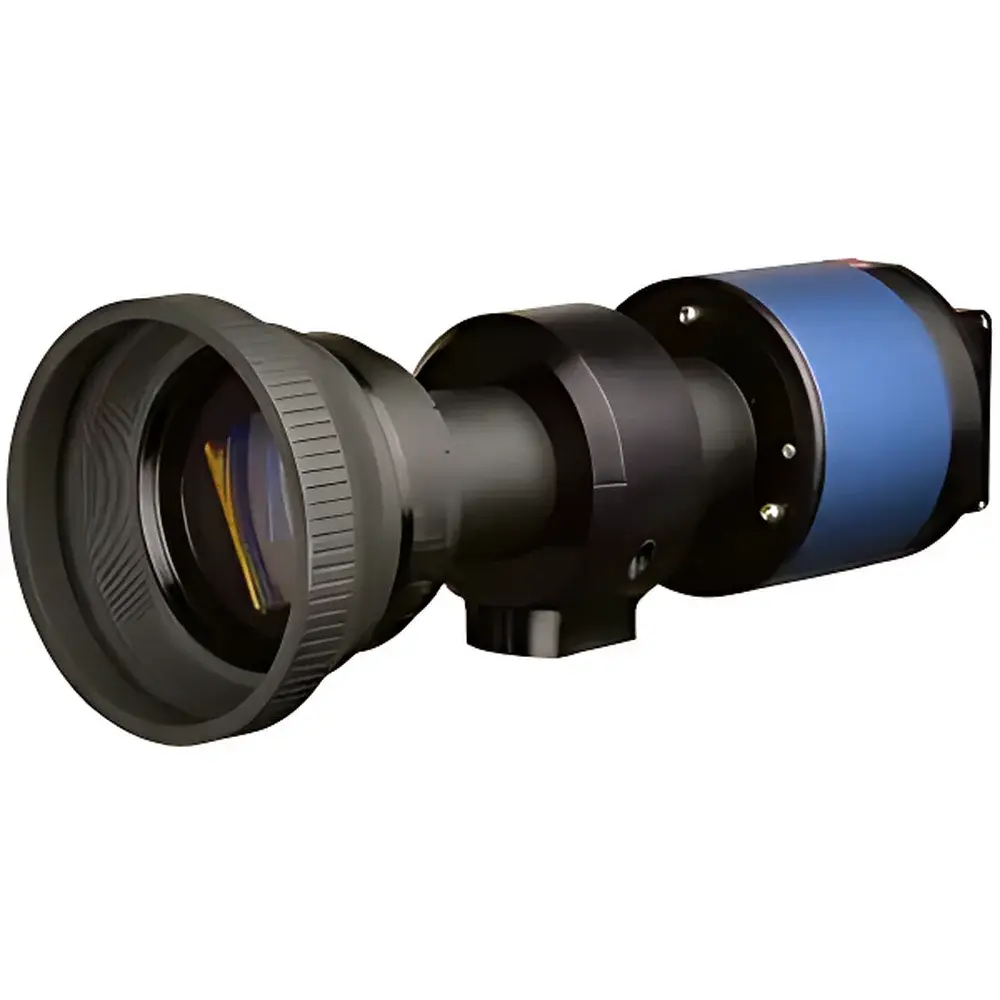
SOC SurfaceOptics SOC716 Full-Motion Video Hyperspectral Imaging Spectrometer
| Brand | SOC/SurfaceOptics |
|---|---|
| Origin | USA |
| Manufacturer Type | Authorized Distributor |
| Product Origin | Imported |
| Model | SOC716 |
| Price Range | USD 70,000–140,000 |
| Operating Principle | Filter-Based (Snapshot Multispectral Array) |
| Imaging Method | Snapshot Filter-Array FPA |
| Deployment Mode | Ground-Based |
| Spectral Range | 270–1700 nm (configurable UV/VNIR/SWIR variants) |
| Spectral Bands | 16 discrete channels |
| Spatial Resolution | 400K pixels (e.g., 640×540 for VNIR variant) |
| Field of View (TFOV) | Configurable per optical module |
| Frame Rate | ≥30 Hz (up to 60 Hz in VNIR mode) |
| Sensor Type | Back-Illuminated CMOS (UV/VNIR), Si-CCD (VNIR), InGaAs (SWIR) |
| Bit Depth | 10–12 bit |
| Power Consumption | 2–12 W @ 12 VDC |
| Dimensions | 10.75″×3.9″×3.9″ to 6.78″×4.5″×5.6″ |
| Weight | 1.9–3.55 kg |
Overview
The SOC SurfaceOptics SOC716 Full-Motion Video Hyperspectral Imaging Spectrometer is an engineered solution for real-time, motion-resilient spectral data acquisition in ground-based remote sensing and laboratory applications. Unlike conventional push-broom or scanning hyperspectral systems—whose reliance on platform motion or mechanical filter rotation introduces temporal misregistration and spectral smearing—the SOC716 employs a monolithic, snapshot-style focal plane array (FPA) architecture. This design integrates a custom patterned bandpass filter array directly onto the sensor surface, enabling simultaneous capture of all 16 spectral bands within a single integration period. As a result, the SOC716 delivers true video-rate spectral cubes (up to 60 Hz in VNIR configuration) without motion artifacts, preserving spatial-spectral fidelity for dynamic targets such as moving vehicles, conveyor-belt materials, or live biological specimens.
Key Features
- Snapshot spectral acquisition: No moving parts; eliminates mechanical latency, spectral拖尾 (smearing), and registration errors inherent in scanning or filter-wheel systems.
- Configurable spectral coverage across three optimized variants: SOC716-UV (270–550 nm), SOC716-VNIR (450–950 nm), and SOC716-SWIR (900–1700 nm), each with 16 precisely defined bandpass channels.
- High-speed data throughput: Real-time spectral cube generation at ≥30 Hz (up to 60 Hz in VNIR mode), compatible with standard machine vision timing protocols.
- Modular optical interface: Interchangeable telecentric achromatic objectives support variable working distances and field-of-view configurations (e.g., 12.3° TFOV with 85 mm f/2.8 lens in VNIR).
- Low-power embedded operation: Consumes 2–12 W depending on variant; supports battery-powered field deployment with stable 12 VDC input.
- Native integration with SOC MIDIS real-time processing engine: Enables on-device radiometric calibration, spectral band selection, anomaly detection, and NTSC-compliant analog video output—no host PC required.
Sample Compatibility & Compliance
The SOC716 is designed for non-contact, reflectance/transmission-mode analysis of solid, liquid, and semi-solid samples under ambient or controlled illumination. Its UV-VNIR-SWIR coverage supports identification of organic functional groups (C–H, O–H, N–H), mineral absorption features, pigment signatures, and moisture content indicators. The system complies with standard optical safety classifications (IEC 60825-1 Class 1 for UV/VNIR variants). While not certified for medical diagnostics or aerospace flight use, its hardware architecture and data output formats align with common laboratory interoperability requirements—including IEEE 1394/USB3 Vision compliance for frame synchronization and metadata embedding. Data provenance and processing integrity are maintained through timestamped frame headers and optional MIDIS audit logging, supporting GLP-aligned workflows where traceability of spectral acquisition parameters is required.
Software & Data Management
The SOC716 operates natively with the SOC MIDIS (Multispectral Image Data Interpretation System) embedded processor, which performs real-time radiometric correction, dark-current subtraction, flat-field normalization, and user-defined band ratioing or NDVI-like index computation. Raw data is output in standardized binary formats (e.g., BSQ/ENVI-compatible headers) via GigE Vision or Camera Link interfaces. Optional SDKs provide C/C++, Python, and MATLAB APIs for custom algorithm integration, including supervised classification (SVM, Random Forest) and spectral unmixing (NNLS, VCA). All firmware updates and configuration files adhere to SHA-256 signed package verification. While the SOC716 itself does not implement FDA 21 CFR Part 11 electronic signature controls, MIDIS-generated reports can be exported with embedded hash-verified metadata suitable for regulated QA/QC documentation when paired with external LIMS or ELN systems.
Applications
- Industrial sorting and quality control: Real-time detection of foreign material, bruising, or ripeness in agricultural produce; polymer identification on recycling lines.
- Defense and security: Covert surveillance of vehicle exhaust plumes, camouflage detection, and chemical residue screening under daylight or low-light conditions.
- Environmental monitoring: Vegetation stress assessment via red-edge and water-band indices; soil organic carbon estimation using SWIR absorption features.
- Pharmaceutical manufacturing: Tablet coating uniformity analysis, excipient distribution mapping, and counterfeit drug detection via spectral fingerprinting.
- Academic research: Time-resolved plant phenotyping, microfluidic reaction tracking, and cultural heritage pigment analysis with minimal sample exposure.
FAQ
Does the SOC716 require external illumination for operation?
Yes—ambient or calibrated broadband illumination (e.g., halogen, LED, or Xenon sources) is required for reflectance measurements. Optional integrated illumination modules are available for controlled lab environments.
Can spectral calibration be performed in-field?
Yes—MIDIS supports user-initiated white/dark reference acquisition sequences. Factory spectral response curves (with NIST-traceable lamp validation) are embedded and applied automatically during radiometric correction.
Is the SOC716 compatible with third-party hyperspectral analysis software?
Yes—raw data exports conform to ENVI, HDF5, and TIFF-based spectral cube standards. Metadata includes wavelength centers, FWHM values, sensor gain, and integration time per frame.
What is the maximum operating temperature range?
The SOC716-VNIR and SOC716-UV variants operate reliably from 0 °C to 40 °C; the SOC716-SWIR variant requires thermoelectric cooling stabilization and is rated for 15–30 °C ambient.
How is geometric distortion corrected?
Each optical module undergoes factory-based pin-cushion/barrel distortion mapping. MIDIS applies pixel-level polynomial correction using stored coefficients, with optional user-uploaded calibration grids for high-precision metrology applications.




