
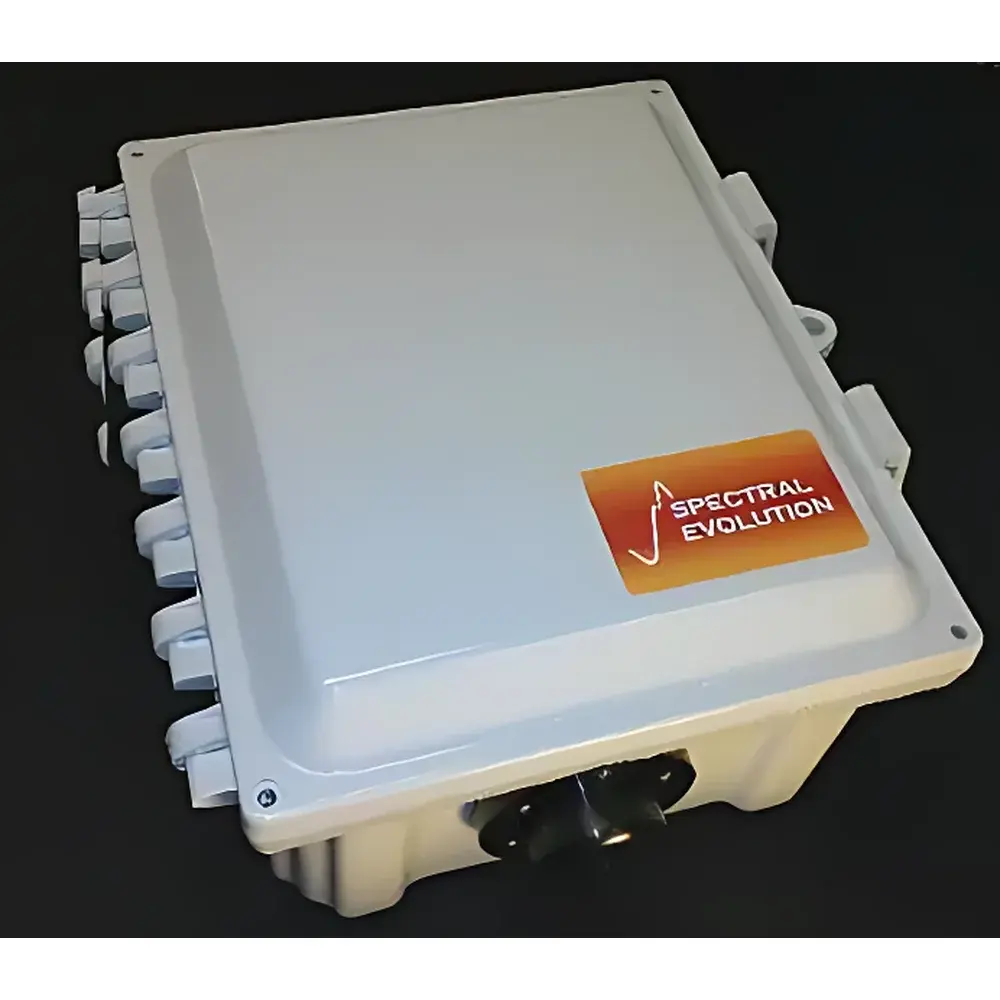
Spectral Evolution UDS-1100 Continuous Monitoring Near-Infrared Spectrometer
| Origin | USA |
|---|---|
| Manufacturer Type | Authorized Distributor |
| Origin Category | Imported |
| Model | UDS-1100 |
| Price Range | USD 21,000–28,000 |
| Instrument Type | Online/Field-Deployable |
| Operating Principle | Fixed-grating spectrometer with linear silicon photodiode array (non-scanning) |
| Wavelength Range | 320–1100 nm |
| Integration Time | 8–2000 ms |
| Spectral Sampling Interval | 1.5 nm |
| Spectral Resolution (FWHM) | 3.2 nm |
| Detector | 512-element Si photodiode array |
| A/D Conversion | 16-bit |
| Slit Width | 50 µm |
| Wavelength Accuracy | ±0.5 nm |
| Wavelength Repeatability | ±0.1 nm |
| Radiometric Noise (NEΔL) | 8.0×10⁻¹⁰ W/cm²/nm/sr @400 nm (1 s), 7.0×10⁻¹⁰ W/cm²/nm/sr @700 nm (1 s), 1.5×10⁻⁹ W/cm²/nm/sr @900 nm (1 s) |
| Maximum Radiance @700 nm | 1.5×10⁻⁴ W/cm²/nm/sr |
| Calibration | NIST-traceable factory radiometric calibration |
| Dark Current Compensation | Automatic per-scan |
| Auto-Exposure Control | Yes |
| Measurement Geometry | Diffuse Reflectance / Hemispherical Radiance |
| Software | DARWin SP v5.x (Spectral Evolution) |
Overview
The Spectral Evolution UDS-1100 Continuous Monitoring Near-Infrared Spectrometer is a field-deployable, non-scanning, fixed-grating spectroradiometer engineered for high-stability, long-term spectral monitoring in uncontrolled outdoor environments. Based on a robust optical architecture featuring a 512-element silicon photodiode array and a precision 50 µm entrance slit, the UDS-1100 operates across the 320–1100 nm range—spanning the UV-A, visible, and near-infrared (NIR) spectral regions—with a nominal FWHM resolution of 3.2 nm and 1.5 nm sampling interval. Its measurement principle relies on direct spectral dispersion via a ruled holographic grating onto the linear detector array, eliminating mechanical scanning components to ensure mechanical stability, thermal robustness, and high temporal reproducibility—critical for diurnal, seasonal, or multi-year environmental time-series studies. Designed for continuous radiometric operation under variable illumination and temperature conditions, the UDS-1100 delivers calibrated spectral radiance (W/cm²/nm/sr) and reflectance data traceable to NIST standards. It supports both upward-looking (sky radiance) and downward-looking (surface reflectance) configurations, enabling simultaneous characterization of atmospheric downwelling irradiance and surface bidirectional reflectance distribution function (BRDF)-informed responses.
Key Features
- Field-hardened enclosure with IP65-rated ingress protection, conformal coating, and wide operating temperature range (−20 °C to +50 °C)
- Integrated lithium-ion rechargeable battery pack supporting >12 hours of continuous operation at 100-ms integration time
- Onboard Bluetooth 5.0 module for wireless configuration, real-time telemetry, and remote firmware updates
- Automatic dark current subtraction and adaptive exposure control ensuring optimal signal-to-noise ratio across dynamic lighting conditions
- Factory-applied NIST-traceable radiometric calibration with certificate of calibration and uncertainty budget
- Modular mounting interface compatible with meteorological towers, vehicle roof rails, UAV gimbals, and portable tripods
- Optional handheld companion terminal with integrated GPS, geotagged imaging, SDXC storage (up to 512 GB), and touchscreen-based instrument control
Sample Compatibility & Compliance
The UDS-1100 is optimized for non-contact, non-destructive measurement of diffuse reflectance from heterogeneous natural surfaces—including vegetation canopies, bare soil, snowpack, algal blooms, coral reefs, and aquatic sediments—as well as hemispherical radiance from sky and cloud fields. Its optical design complies with ASTM E275, ISO 9050, and ISO 13406-2 for spectral radiance measurement integrity. The instrument’s radiometric calibration protocol adheres to NIST SP 250-95 guidelines for transfer standards and uncertainty propagation. Data acquisition workflows support GLP-compliant metadata tagging (timestamp, GPS coordinates, ambient temperature/humidity, viewing geometry) and are compatible with FDA 21 CFR Part 11 requirements when deployed within validated environmental monitoring networks. All firmware and DARWin SP software revisions undergo internal verification against ISO/IEC 17025:2017 clause 5.9 (method validation) and 7.7 (data integrity).
Software & Data Management
DARWin SP v5.x is a Windows-based spectral acquisition and processing suite developed exclusively for Spectral Evolution instruments. It provides real-time spectral preview, auto-exposure optimization, batch calibration application, and export to industry-standard formats (ENVI .hdr/.sli, CSV, NetCDF-4). The software implements spectral smoothing (Savitzky-Golay), dark/light correction, BRDF normalization using empirical models (e.g., Rahman-Pinty-Verstraete), and spectral index computation (NDVI, PRI, WI, MCARI, etc.). Audit trails record all user actions, parameter changes, and calibration events with timestamps and operator IDs. Raw data files include embedded EXIF-like metadata compliant with ISO 19115-2 for geospatial interoperability. Exported datasets are structured to meet FAIR principles (Findable, Accessible, Interoperable, Reusable) and integrate seamlessly into Python (spectral, scikit-learn), R (hyperSpec), and ENVI workflows.
Applications
- Long-term vegetation phenology monitoring across agricultural, forest, and tundra ecosystems
- Canopy structural parameter retrieval (LAI, fPAR, clumping index) using directional reflectance modeling
- Soil moisture and organic carbon estimation via NIR absorption features (760–900 nm)
- Ocean color validation and phytoplankton functional type discrimination in coastal and inland waters
- Atmospheric aerosol optical depth (AOD) and cloud optical thickness derivation from sky radiance spectra
- Climate feedback assessment through multi-decadal spectral time-series alignment with satellite sensors (e.g., Sentinel-2, Landsat OLI, MODIS)
- Calibration/validation campaigns for airborne and spaceborne hyperspectral missions requiring ground-truth reference spectra
FAQ
Is the UDS-1100 suitable for fully autonomous,无人值守 operation?
Yes—the instrument supports scheduled acquisition, watchdog timer reset, and low-power sleep modes. When paired with a solar-charging station and cellular/GNSS telemetry module, it functions as a node in distributed environmental sensor networks.
Does DARWin SP support chemometric model deployment (e.g., PLS regression) for real-time prediction?
DARWin SP enables offline model training and validation; however, real-time prediction requires external integration via its COM API or TCP/IP socket interface into third-party inference engines (e.g., MATLAB Runtime, Python Flask services).
Can the UDS-1100 be used underwater or in submerged applications?
No—the standard UDS-1100 is rated for terrestrial and aerial use only. Submersible variants require custom pressure housings and quartz window optics, available under OEM engineering collaboration.
What is the recommended recalibration interval for field-deployed units?
Spectral Evolution recommends annual radiometric recalibration for critical applications; biannual verification using onboard stable light sources (optional) is advised for routine environmental monitoring.
How is geometric uncertainty managed during mobile deployments (e.g., vehicle-mounted)?
The optional handheld terminal provides real-time pitch/yaw/roll compensation via integrated IMU, and DARWin SP allows post-acquisition correction using synchronized GNSS-RTK positioning and orientation data.



