
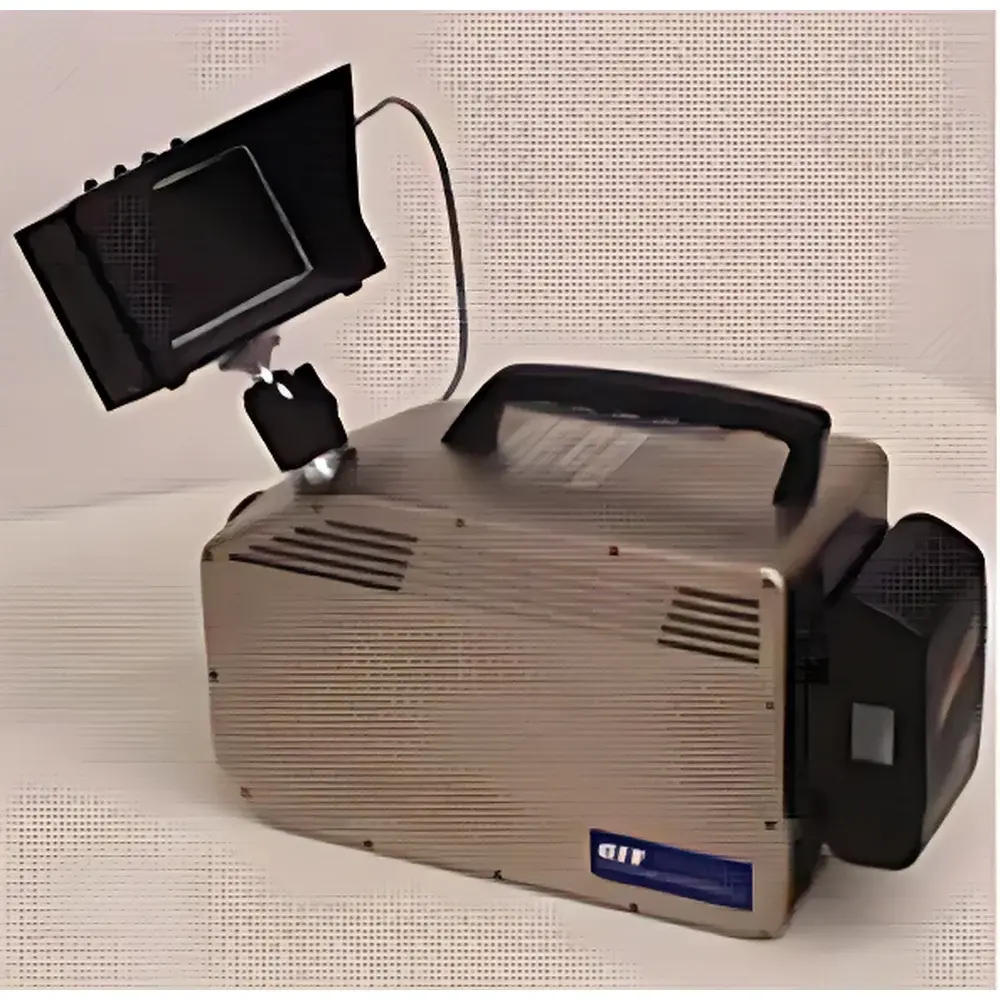
GIT Sherlock VOC Infrared Imaging Spectrometer
| Brand | GIT (Gas Imaging Technology) |
|---|---|
| Origin | USA |
| Manufacturer Type | Authorized Distributor |
| Product Origin | Imported |
| Model | Sherlock VOC |
| Price | Upon Request |
| Weight (without battery) | 6.8 kg (15 lbs) |
| Weight (with battery) | 8.6 kg (19 lbs) |
| Dimensions | 30.5 × 17.8 × 20.3 cm |
| Power Supply | 12 V rechargeable battery or AC adapter |
| Spectral Range | Pre-tuned to hydrocarbon absorption bands (MWIR, ~3 µm) |
| Aperture | f/2.5 at 3 µm |
| Focal Length | 75 mm at 3 µm |
| Instantaneous Field of View (IFOV) | 0.4 mrad |
| Total Field of View (FOV) | 7.3° × 5.5° |
| Spatial Resolution | 320 × 240 pixels |
| Minimum Detectable Leak Rate | 1 mL/min (≈1 g/hr for methane-equivalent VOCs) |
| Display | 640 × 480 LCD |
| Video Capture | Internal 14-bit frame grabber |
| Interfaces | Ethernet, RS-232, NTSC, S-Video, USB |
| Software | HyPAT™ for spectral analysis and quantitative gas mapping |
Overview
The GIT Sherlock VOC Infrared Imaging Spectrometer is a field-deployable, battery-operated optical gas imaging (OGI) system engineered for real-time visualization, localization, and semi-quantitative assessment of volatile organic compound (VOC) emissions. Based on patented Image Multi-Spectral Sensing (IMSS) technology—U.S. Patents 5,479,258; 5,867,264; and 6,680,778—the instrument employs cooled MWIR (mid-wave infrared) detection centered near 3 µm, where fundamental C–H vibrational absorption bands of hydrocarbons and numerous other VOCs exhibit strong, spectrally distinct signatures. Unlike broadband thermal cameras, the Sherlock VOC integrates spectral filtering and calibrated radiometric response to distinguish target gases from background thermal clutter and atmospheric interference. Its core measurement principle relies on differential absorption imaging: by comparing scene radiance in narrow spectral bands adjacent to and within a gas’s absorption feature, the system generates contrast-enhanced video sequences revealing plume morphology, directionality, and relative concentration gradients. Designed for compliance-driven industrial monitoring, it meets U.S. EPA Method 21–adjacent operational performance criteria and supports Tier II LDAR (Leak Detection and Repair) program objectives across regulated sectors.
Key Features
- Pre-aligned MWIR optical path with fixed f/2.5, 75 mm focal length lens—no lens swapping required for standard field deployment
- 7.3° × 5.5° wide-angle field of view optimized for rapid survey of valves, flanges, pumps, and process piping
- 320 × 240 pixel indium antimonide (InSb) focal plane array with 14-bit digitization for high dynamic range radiometric capture
- Integrated EasyRig ergonomic harness system with adjustable air-cushioned背 strap and balanced center-of-gravity design, enabling extended handheld or tripod-mounted operation
- Onboard 640 × 480 LCD display with real-time false-color plume overlay and intuitive single-hand control interface
- Built-in 14-bit digital video recorder eliminating dependency on external recording hardware
- Ruggedized aluminum chassis rated for IP54 environmental protection (dust and water splash resistant)
- Compliant with MIL-STD-810G for shock, vibration, and thermal cycling durability in industrial field conditions
Sample Compatibility & Compliance
The Sherlock VOC is validated for detection of over 100 VOCs—including methane, ethane, propane, butane, benzene, toluene, xylene, acetone, methanol, formaldehyde, ethylene oxide, hydrogen sulfide, and chlorinated solvents—based on their characteristic 2.7–3.5 µm absorption features. It satisfies functional requirements outlined in U.S. EPA OOOOa (40 CFR Part 60), ASTM D7907-22 (Standard Practice for Optical Gas Imaging), and ISO 16000-29 (Indoor air — Part 29: Determination of VOC emissions using optical remote sensing). While not a certified reference method per se, its output supports documented LDAR work practices under 40 CFR Part 63 Subpart VV and Subpart HH, and provides auditable visual evidence admissible in regulatory reporting. The system operates within GLP-compliant data integrity frameworks when paired with HyPAT™ software’s audit-trail-enabled workflows and timestamped metadata embedding.
Software & Data Management
HyPAT™ (Hyper-spectral Pattern Analysis Toolkit) is the proprietary desktop application supplied with the Sherlock VOC. It enables post-acquisition processing of recorded 14-bit spectral video sequences to generate calibrated gas concentration maps, plume mass flow estimates, and time-resolved leak rate profiles. The software implements NIST-traceable radiometric calibration routines, atmospheric transmission correction (using MODTRAN-based modeling), and spectral library matching against a curated database of >120 VOC reference spectra. All processed datasets retain full traceability: each exported report includes embedded EXIF metadata (GPS coordinates, ambient temperature/humidity, operator ID, instrument serial number, acquisition time), digital signature, and version-controlled processing parameters. HyPAT™ complies with FDA 21 CFR Part 11 requirements for electronic records and signatures when configured with user authentication, role-based access controls, and immutable audit logs.
Applications
- LDAR program execution across upstream oil & gas facilities, refineries, petrochemical plants, and LNG terminals
- Pre-commissioning and post-maintenance verification of seal integrity in compressors, pumps, agitators, and pressure relief devices
- Environmental compliance auditing for fugitive emission inventories under state and federal regulatory mandates
- Emergency response triage during chemical release incidents to identify source location and plume dispersion trends
- Process optimization studies—e.g., quantifying vent stack emissions, evaluating flare efficiency, or mapping fugitive sources in pulp & paper mills
- Research applications in atmospheric chemistry, landfill gas migration modeling, and biogas facility monitoring
FAQ
Is the Sherlock VOC certified by the U.S. EPA for regulatory use?
The Sherlock VOC is EPA-recognized as a compliant optical gas imaging tool under Method 21 supplemental guidance and referenced in EPA OOOOa implementation documents. It is not a “certified” instrument in the sense of being listed on EPA’s Compendium of Methods, but its performance specifications meet or exceed EPA-recommended minimum detectability thresholds (≤1 g/hr for methane) and are accepted by regional EPA offices for LDAR program execution.
Can it quantify absolute gas concentration in ppm-m or kg/hr?
The system provides semi-quantitative relative concentration mapping and plume-integrated mass flux estimates derived from calibrated radiometric models. Absolute quantification requires site-specific validation using tracer gas injection or concurrent point-sensor correlation; HyPAT™ supports such calibration workflows but does not replace certified reference analyzers for legally binding emission reporting.
What maintenance is required for long-term field reliability?
Annual factory recalibration of the detector’s non-uniformity correction (NUC) table and spectral response function is recommended. The cooled InSb detector requires no consumables; battery health monitoring and firmware updates via Ethernet are performed in-field using HyPAT™’s built-in diagnostics suite.
Does it operate in low-light or nighttime conditions?
Yes—being an active infrared imager, the Sherlock VOC is fully functional in total darkness, fog, or smoke, as it detects emitted thermal radiation rather than reflected visible light. Its sensitivity is unaffected by ambient illumination levels.
Is training included with purchase?
Yes—GIT provides on-site or virtual instructor-led training covering instrument operation, regulatory context, video interpretation, HyPAT™ data processing, and report generation. Training materials include ASTM D7907-compliant competency assessments and certificate issuance upon completion.






