
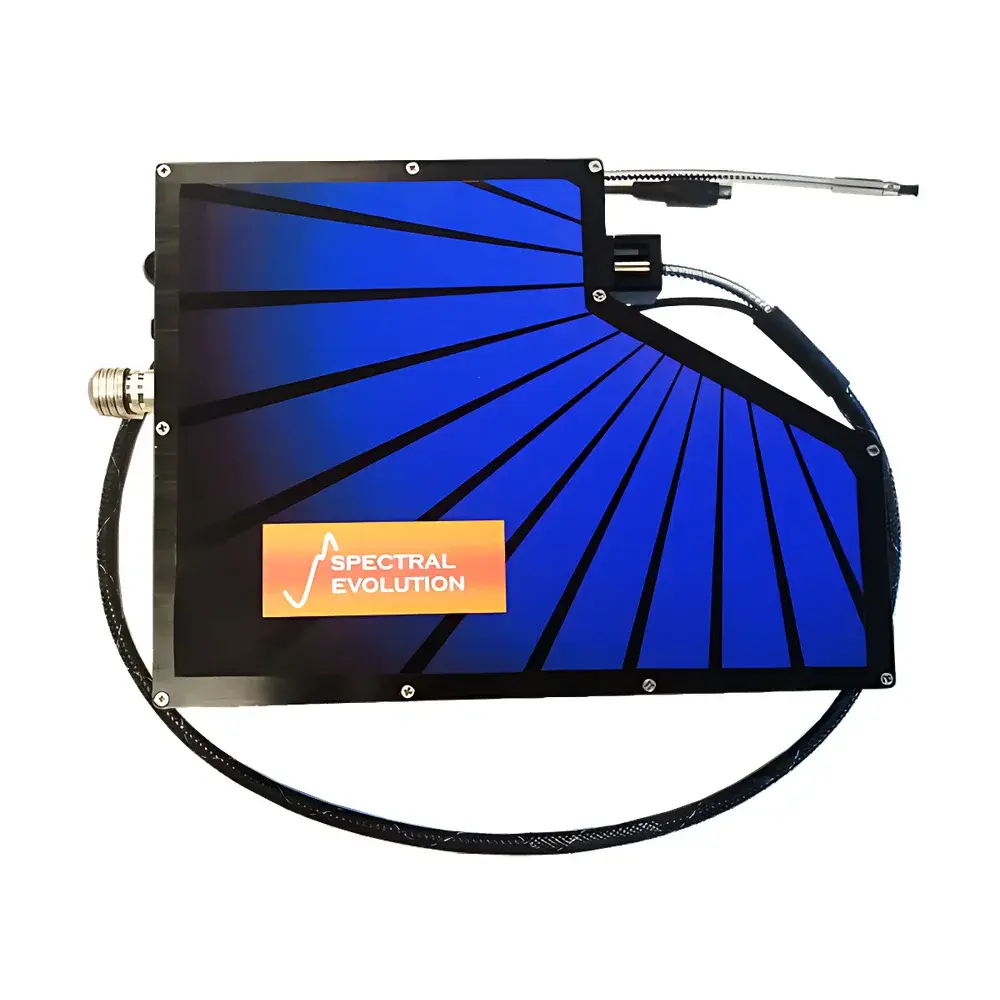
Spectral Evolution oreXpress EZ-ID Portable Hyperspectral Mineral Analyzer
| Brand | Spectral Evolution |
|---|---|
| Model | oreXpress EZ-ID |
| Type | Filter-Based Hyperspectral Imaging Spectrometer |
| Spectral Range | 350–2500 nm |
| Spectral Resolution | 3 nm @ 700 nm, 8 nm @ 1500 nm, 6 nm @ 2100 nm |
| Detector Configuration | 512-pixel Si array (350–1000 nm) + dual 256-pixel TE-cooled InGaAs arrays (970–2500 nm) |
| Fiber Optic | 1.2 m armored fiber (custom lengths available) |
| Stray Light | <0.10% |
| Minimum Integration Time | 100 ms |
| Wavelength Repeatability | ±0.1 nm |
| Wavelength Accuracy | ±0.5 nm FWHM |
| Dimensions | 21.6 × 30.5 × 8.9 cm |
| Weight | 3.3 kg |
| Power | 7.4 V rechargeable Li-ion battery |
| Interfaces | USB 2.0, Bluetooth 4.2 |
| Measurement Modes | Handheld PDA-controlled, external trigger, unattended autonomous, UAV-integrated survey |
Overview
The Spectral Evolution oreXpress EZ-ID is a field-deployable, filter-based hyperspectral imaging spectrometer engineered for rapid, non-destructive mineral identification and spectral characterization across the full solar-reflective range (350–2500 nm). Unlike dispersive or Fourier-transform systems, the oreXpress employs a precision optical filter wheel architecture coupled with dual optimized detector arrays — a 512-element silicon CCD for the visible–NIR (350–1000 nm) and two thermoelectrically cooled 256-element InGaAs arrays for the SWIR (970–2500 nm) — enabling high-fidelity, radiometrically stable measurements under variable ambient conditions. Its core measurement principle relies on reflectance spectroscopy: incident solar or calibrated lamp illumination interacts with surface mineralogy, producing diagnostic absorption features tied to electronic transitions (e.g., Fe²⁺/Fe³⁺, OH⁻, CO₃²⁻) and vibrational overtones (e.g., Al–OH, Mg–OH, Si–O stretching/bending), which are resolved at defined spectral sampling intervals. Designed explicitly for geological exploration workflows, the oreXpress delivers laboratory-grade spectral fidelity in a ruggedized, portable form factor suitable for ground-based core logging, outcrop scanning, and UAV-mounted wide-area surveys.
Key Features
- Full-range spectral coverage from 350 nm to 2500 nm with wavelength-specific resolution: 3 nm at 700 nm (VIS–NIR), 8 nm at 1500 nm, and 6 nm at 2100 nm (SWIR), optimized for key mineralogical absorption features
- Dual-detector architecture: 512-pixel Si array (350–1000 nm) and two TE-cooled 256-pixel InGaAs arrays (970–2500 nm) ensure low-noise, high-dynamic-range data acquisition across atmospheric windows
- Integrated contact probe with ergonomic handle, built-in 5 W tungsten-halogen source, and sapphire window for consistent illumination and mechanical durability in abrasive field environments
- Wireless operation via Bluetooth 4.2 and USB 2.0; supports real-time telemetry and remote configuration from Android/iOS PDA units equipped with GPS, digital imaging, voice annotation, and georeferenced metadata tagging
- Modular battery system: hot-swappable 7.4 V lithium-ion pack rated for >4 hours continuous operation under typical integration settings (100–500 ms)
- UAV-ready mechanical interface and low-mass design (3.3 kg) enable seamless integration with multirotor platforms for automated, GPS-georeferenced hyperspectral grid mapping
Sample Compatibility & Compliance
The oreXpress EZ-ID is validated for direct reflectance measurement of unprepared geological materials including drill core segments, RC chip trays, outcrop surfaces, soil profiles, and hand specimens. Its contact probe ensures reproducible geometry (fixed 0° incidence / 0° collection) per ASTM E2758–21 (Standard Practice for Reflectance Spectroscopy of Geologic Materials). The instrument’s spectral calibration traceability aligns with NIST-traceable standards, and raw data output conforms to ENVI-compatible BIL/BIP formats for interoperability with third-party processing pipelines. All firmware and software modules comply with ISO/IEC 17025:2017 requirements for analytical instrumentation validation, and data integrity safeguards—including timestamped audit logs, user authentication, and immutable spectral header metadata—support GLP/GMP-aligned field documentation protocols.
Software & Data Management
The oreXpress ships with DARWin SP v5.x for instrument control, real-time preview, and raw spectral export, and EZ-ID v3.2 for mineral identification and library management. EZ-ID implements multiple matching algorithms—including spectral angle mapper (SAM), continuum-removed correlation (CRC), and derivative-based feature weighting—to quantify similarity between unknown spectra and reference libraries. It natively integrates the USGS Digital Spectral Library (Version 7, 470 spectra across 314 minerals), SpecMIN™ (1528 spectra, 494 minerals), and optional GeoSpec HR (688 high-resolution spectra, 239 minerals). Users may construct project-specific libraries via batch import, manual peak annotation, or field-acquired reference spectra—each entry preserving full metadata (GPS coordinates, lighting conditions, probe pressure, integration time). All spectral datasets are stored in HDF5 format with embedded SHA-256 checksums to ensure long-term data integrity and regulatory compliance with FDA 21 CFR Part 11 for electronic records.
Applications
- Rapid lithological and alteration zoning: mapping kaolinite, illite, chlorite, smectite, and alunite distributions in hydrothermal systems to delineate porphyry Cu–Mo or epithermal Au–Ag vectors
- Drill core spectral logging: reducing traditional 6-hour visual–microscopic core description workflows to ≤2 hours per 100 m, with quantitative band-depth analysis for hematite/goethite ratios and clay crystallinity indices
- Open-pit face characterization: identifying sulfide-bearing zones, carbonate replacement bodies, or uranium-enriched calcretes in near-real time during mine planning cycles
- UAV-based regional reconnaissance: executing 10 km² surveys at 1–5 m GSD with sub-pixel spectral unmixing to detect cryptic mineral assemblages associated with kimberlite pipes or shear-hosted gold systems
- Geochemical targeting support: correlating spectral absorption depths (e.g., 2200 nm Al–OH feature) with lab-derived assays for pathfinder elements (e.g., As, Sb, Tl) to refine exploration models
FAQ
Is the oreXpress compatible with third-party spectral libraries beyond USGS and SpecMIN?
Yes — EZ-ID supports import of custom spectral libraries in ASCII, CSV, or ENVI SPC formats, provided wavelength vectors are linearly spaced and calibrated to NIST-traceable references.
What is the recommended calibration frequency for field deployments?
A white reference (Spectralon® 99% reflectance panel) measurement is required before each session; dark current correction is performed automatically prior to every scan. Annual factory recalibration is advised for traceable radiometric accuracy.
Can the oreXpress perform quantitative mineral abundance estimation?
While primarily designed for identification and relative band-depth assessment, linear spectral unmixing (LSU) and partial least squares regression (PLSR) models can be trained in external tools (e.g., Python scikit-learn, MATLAB) using oreXpress-collected endmember spectra.
Does the system meet environmental ingress protection standards for field use?
The main unit meets IP54 rating (dust-protected, splash-resistant); the contact probe and PDA are rated IP65. Optional ruggedized enclosures extend suitability for desert, arctic, or high-humidity operations.
How is data security handled during UAV missions where real-time telemetry is unavailable?
All spectral acquisitions are stored redundantly on both the onboard SD card (encrypted FAT32) and the PDA’s internal eMMC, with SHA-256 hash verification performed post-flight during synchronization.





