
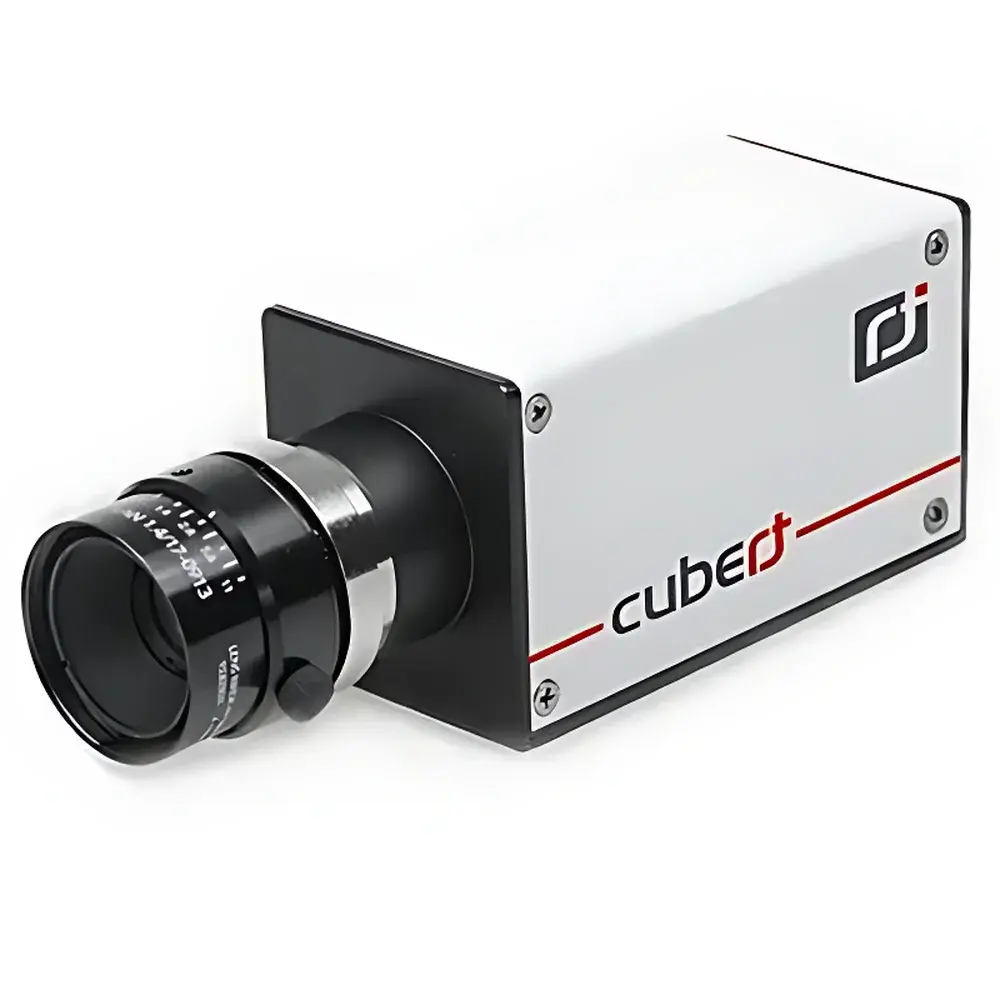
Cubert S118 Snapshot Multispectral Imaging Spectrometer
| Brand | Cubert |
|---|---|
| Origin | Germany |
| Model | S118 |
| Spectral Range | 520–950 nm |
| Spectral Channels | TM2/TM3/TM4 (3-band snapshot acquisition) |
| Spatial Resolution | 1.0 mrad (IFOV) |
| Field of View (TFOV) | 16.5° (with 25 mm lens, typical) |
| Image Resolution | 1728 × 1152 pixels (3.2 MP) |
| Frame Rate | 3 fps |
| Detector | Si CMOS, 10-bit or 8-bit digitization |
| Integration Time | < 100 µs |
| Interface | GigE Vision + Hardware Trigger |
| Lens Mount | Standard C-mount |
| Storage | Internal SD card (user-replaceable) |
| Power | DC 5 V, 15 W |
| Operating Temperature | 0–40 °C |
| Weight | 380 g |
| Certifications | CE compliant |
| Compliance | Designed for GLP-aligned field data acquisition |
Overview
The Cubert S118 is a snapshot-based multispectral imaging spectrometer engineered for high-fidelity, motion-robust spectral data acquisition in dynamic field environments. Unlike scanning or push-broom hyperspectral systems, the S118 employs a monolithic, single-lens optical architecture with an integrated filter array and high-speed CMOS detector to simultaneously capture three discrete spectral bands—TM2 (550–570 nm), TM3 (640–670 nm), and TM4 (770–810 nm)—within a single exposure. This snapshot principle eliminates temporal misregistration between bands, ensuring pixel-perfect co-location without post-acquisition geometric correction. Its 3.2-megapixel sensor delivers spatially registered radiometric data at native resolution, enabling direct computation of vegetation indices—including NDVI and SAVI—without interpolation or band alignment. The instrument operates across the visible-to-near-infrared (VNIR) range (520–950 nm), making it suitable for both ground-based surveys and UAV-integrated remote sensing platforms where weight, power efficiency, and real-time operational autonomy are critical.
Key Features
- Snapshot multispectral acquisition: Simultaneous capture of TM2, TM3, and TM4 bands in one frame—no moving parts, no temporal offset.
- C-mount lens compatibility: Supports interchangeable lenses (e.g., 16 mm, 25 mm, 35 mm) for scalable ground sampling distance (GSD) optimization.
- Embedded intelligent control panel: Standalone operation without host PC; intuitive interface for exposure control, trigger configuration, and on-device preview.
- GigE Vision-compliant interface: Enables seamless integration into industrial machine vision frameworks and automated flight control systems (e.g., PX4, ArduPilot).
- Onboard SD card storage: Raw radiometric frames stored in lossless 10-bit format; metadata embedded per frame (timestamp, exposure, lens ID, GPS sync pulse if externally triggered).
- Low-power, lightweight design: 380 g mass and 5 V DC input support extended battery life on small UAS platforms (e.g., DJI M300 RTK, Autel EVO II Dual).
Sample Compatibility & Compliance
The S118 is optimized for reflectance-based surface characterization of vegetative canopies, soil surfaces, water bodies, and man-made materials under natural illumination. It does not require active illumination sources and is calibrated for solar-illuminated outdoor use. Radiometric calibration is performed using NIST-traceable reference panels (e.g., Spectralon® 99% white standard), and factory calibration certificates include spectral response curves per channel. The system complies with CE marking requirements for electromagnetic compatibility (EN 61326-1) and safety (EN 61010-1). While not a medical or pharmaceutical device, its data output supports ISO 17025-compliant laboratory workflows when used within documented measurement procedures and controlled environmental conditions. For regulatory-grade agricultural monitoring, the S118 meets foundational requirements for spatial consistency and spectral fidelity outlined in ASTM E2936 (Standard Practice for Remote Sensing of Vegetation Indices).
Software & Data Management
Data acquisition is managed via Cubert’s proprietary CubeSuite software (Windows/macOS), which supports batch processing, radiometric correction, geotagging (when synchronized with GNSS timestamps), and VI map generation. Export formats include GeoTIFF (with embedded projection metadata), ENVI-compatible BIP/BIL, and CSV time-series logs. The SDK provides C++ and Python APIs for custom pipeline integration, including compatibility with OpenCV, GDAL, and scikit-image. All acquired frames include embedded EXIF-like metadata—exposure time, gain setting, lens focal length, and hardware trigger status—enabling full auditability. While the S118 itself does not implement FDA 21 CFR Part 11 electronic signature controls, its raw data structure and timestamped logging support GxP-aligned validation when deployed within a documented QA/QC framework.
Applications
- Precision agriculture: In-field monitoring of crop health, nitrogen status, and irrigation stress via NDVI, NDRE, and SAVI time-series analysis.
- Ecological surveying: Species-level discrimination in mixed vegetation stands using spectral signature clustering (e.g., PCA, SVM classification).
- Environmental compliance: Detection of algal blooms, sediment plumes, and oil sheens in inland and coastal waters through differential band ratio analysis.
- Forestry management: Canopy density estimation, deforestation tracking, and post-fire regeneration assessment.
- UAS-based infrastructure inspection: Corrosion mapping on metallic surfaces, thermal anomaly screening (when fused with complementary IR sensors), and pavement condition assessment.
FAQ
Does the S118 require external lighting or calibration before each flight?
No—calibration is factory-performed and stable over temperature; however, a pre-flight dark-frame and white-reference capture are recommended for optimal radiometric accuracy.
Can the S118 be synchronized with GNSS/IMU units for georeferenced mapping?
Yes—hardware trigger input accepts TTL pulses from compatible GNSS loggers (e.g., u-blox ZED-F9P) to embed precise timestamps; georeferencing is applied during post-processing using bundle adjustment tools.
Is the 3 fps frame rate adjustable?
Yes—frame rate is configurable between 1–3 fps depending on exposure time and onboard buffer capacity; lower rates enable longer integration times for low-light scenarios.
What spectral indices are computed onboard?
None—the S118 outputs raw band-aligned radiance data; NDVI, SAVI, and other indices are generated in post-processing using standardized reflectance conversion pipelines.
Is firmware upgradable in the field?
Yes—firmware updates are delivered via SD card and applied during boot; version history and changelogs are maintained in accordance with IEC 62304 software lifecycle standards.
Related Products





