
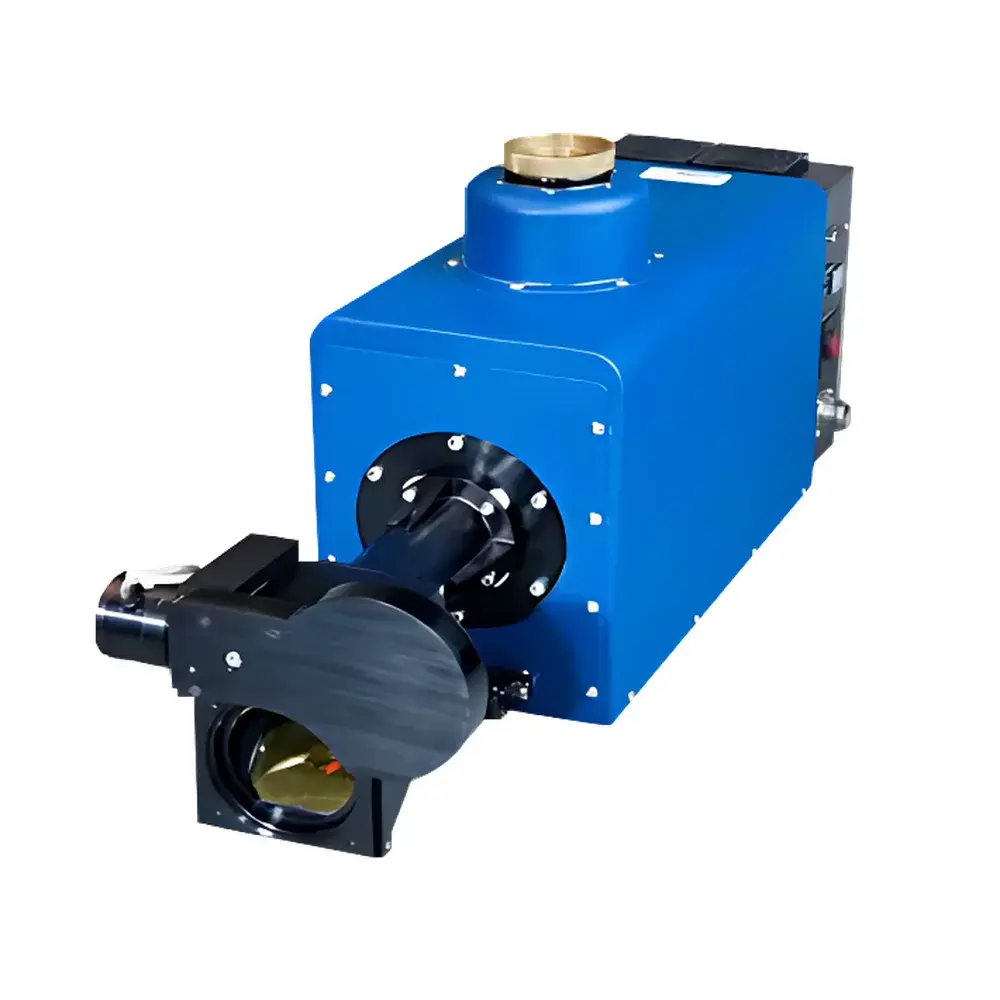
SurfaceOptics SOC750MW Mid-Wave Infrared Hyperspectral Imaging Spectrometer
| Brand | SurfaceOptics |
|---|---|
| Origin | USA |
| Model | SOC750MW |
| Operating Principle | Push-broom |
| Imaging Mode | 3D (hyperspectral data cube) |
| Platform | Ground-based |
| Spectral Range | 2–5 µm |
| Spectral Resolution | 48–73 nm |
| Instantaneous Field of View (IFOV) | 256 × 240 pixels |
| Frame Rate | 27 cubes/s |
| Detector Type | HgCdTe (MCT) or InSb focal plane array |
| Software | HSAnalysis3 (real-time processing, GUI-based calibration & analysis) |
Overview
The SurfaceOptics SOC750MW is a high-speed, ground-deployable mid-wave infrared (MWIR) push-broom hyperspectral imaging spectrometer engineered for real-time spectral-spatial data acquisition across the 2–5 µm atmospheric transmission window. It operates on the principle of spatial scanning combined with dispersive spectroscopy, where incoming radiation is collimated, spectrally dispersed via a high-efficiency grating or prism-based spectrometer, and imaged onto a cooled HgCdTe (MCT) or InSb focal plane array (FPA). Each acquired frame constitutes a full hyperspectral data cube (x, y, λ), enabling pixel-wise spectral signature extraction with calibrated radiometric fidelity. The system is designed for laboratory, field-portable, and fixed-site operational environments—supporting applications requiring rapid detection, identification, and quantification of materials based on their intrinsic MWIR absorption/emission features.
Key Features
- Real-time acquisition at up to 27 hyperspectral cubes per second (256 × 240 spatial pixels × 42–64 spectral bands), enabling dynamic process monitoring and time-resolved spectral analysis.
- Cooled InSb or MCT detector architecture with 256 × 240 native resolution, optimized for high quantum efficiency and low noise in the MWIR band.
- Integrated real-time hyperspectral processor and proprietary HSAnalysis3 software suite, delivering on-the-fly radiometric calibration, spectral unmixing, endmember extraction, and spectral library matching.
- Modular optical design compatible with interchangeable fore-optics (e.g., 50 mm f/2.0 lens), supporting variable ground sampling distances and IFOV configurations.
- Full radiometric calibration traceable to NIST-traceable blackbody sources; supports both reflectance and emissivity-mode measurements under controlled or ambient thermal conditions.
- Export-ready data format (e.g., ENVI-compatible .hdr/.dat, HDF5) ensuring seamless interoperability with third-party analytical platforms including MATLAB, Python (scikit-learn, spectral), and commercial chemometric software.
Sample Compatibility & Compliance
The SOC750MW is optimized for non-contact, standoff analysis of solid, liquid, and gaseous samples exhibiting diagnostic vibrational-rotational absorption features in the MWIR region—including hydrocarbons, polymers, pharmaceutical actives, explosives precursors, and biological tissues. Its ground-based configuration meets ASTM E1985 (Standard Practice for Calibration of Infrared Spectrometers) and ISO 18563-1 (Non-destructive testing — Ultrasonic and electromagnetic testing — Part 1: General requirements) foundational metrology expectations. While not inherently FDA 21 CFR Part 11-compliant as a standalone instrument, HSAnalysis3 supports audit trail logging, user access controls, and electronic signature capability when deployed within validated GxP environments. System documentation includes full traceable calibration certificates, uncertainty budgets per spectral band, and detector linearity reports aligned with ISO/IEC 17025 principles for testing laboratories.
Software & Data Management
HSAnalysis3 provides a Windows-native graphical interface for instrument control, real-time visualization, and post-acquisition analysis. Core modules include: (1) automated dark/current/bias correction; (2) spectral response normalization using reference white/black standards; (3) geometric correction for scan-line distortion; (4) PCA, MNF, and vertex component analysis for dimensionality reduction; (5) spectral angle mapper (SAM), matched filter, and binary encoding for target detection; and (6) export of ROI-averaged spectra, classification maps, and quantitative concentration estimates (when calibrated against reference standards). All processing steps are scriptable via COM/ActiveX interfaces, facilitating integration into automated QA/QC workflows compliant with GLP and ISO 9001 quality management systems.
Applications
- Precision Agriculture: Crop stress assessment, water content mapping, and nutrient deficiency detection via C–H, O–H, and N–H bond absorption features.
- Pharmaceutical Manufacturing: Real-time blend uniformity verification, coating thickness quantification, and counterfeit drug screening using spectral fingerprint libraries.
- Defense & Security: Standoff detection of explosive residues, chemical warfare agents, and illicit narcotics through characteristic MWIR spectral signatures.
- Materials Science: Polymer degradation analysis, composite delamination identification, and thermal barrier coating integrity evaluation.
- Environmental Monitoring: Volatile organic compound (VOC) plume tracking, landfill gas composition analysis, and wildfire smoke characterization.
- Biomedical Research: Label-free tissue histopathology, lipid/protein distribution mapping, and metabolic activity profiling in ex vivo specimens.
FAQ
What cooling method is used for the detector?
The InSb or MCT FPA is cooled to ~77 K using a compact, closed-cycle Stirling cooler integrated into the sensor head—ensuring stable dark current and optimal signal-to-noise ratio during extended acquisitions.
Is external triggering supported?
Yes—TTL-compatible trigger input/output ports enable synchronization with external motion stages, laser sources, or process control systems for gated or event-driven acquisition.
Can the system operate in reflective or emissive mode?
Both modes are supported: reflectance measurements require an external broadband MWIR source and calibrated reference panel; emissive mode uses inherent sample thermal radiation and is suitable for elevated-temperature targets (up to 1250 °C).
What is the typical calibration interval?
Annual radiometric recalibration is recommended; however, onboard non-uniformity correction (NUC) and drift-compensated dark frame subtraction allow for stable operation between formal calibrations.
Does the system support custom spectral binning or region-of-interest readout?
Yes—HSAnalysis3 allows user-defined spectral sub-bands and spatial ROI masking to increase effective frame rate or reduce data volume without hardware modification.




