
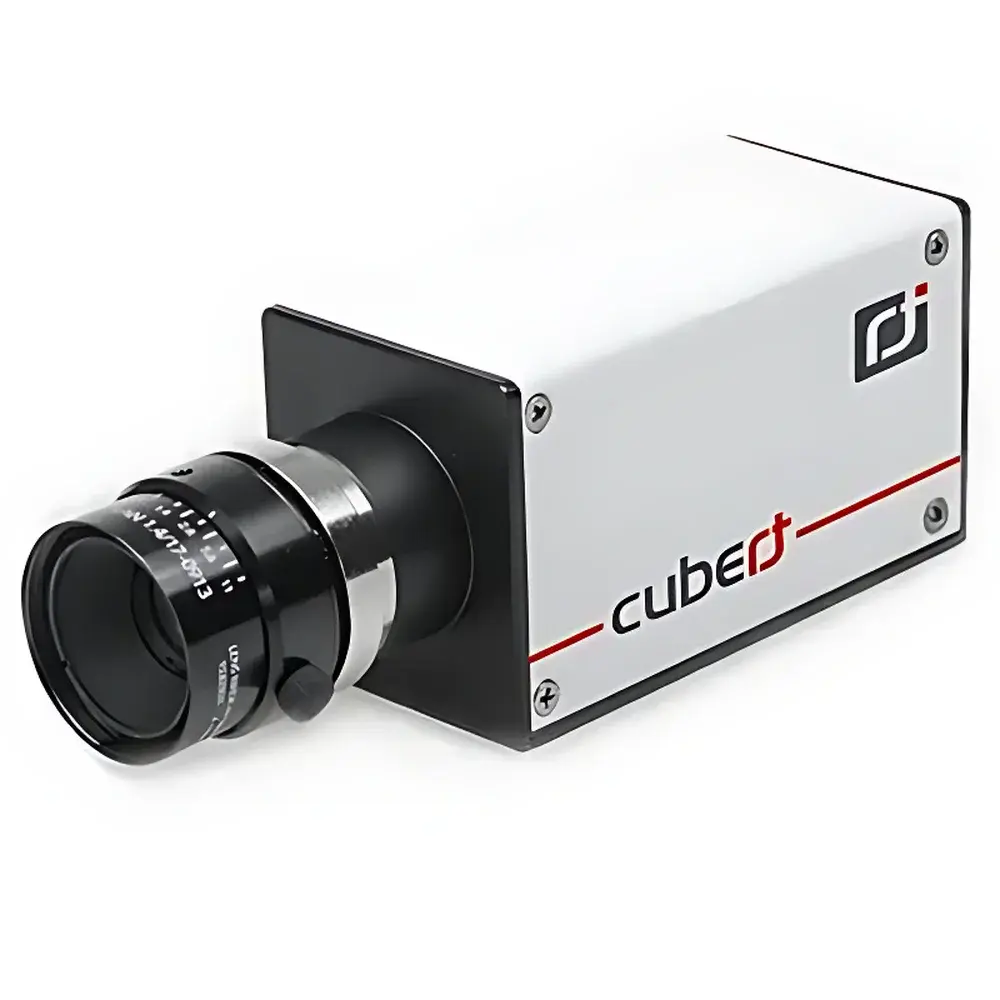
Cubert S199 High-Speed Hyperspectral Imaging Spectrometer
| Brand | Cubert |
|---|---|
| Origin | Germany |
| Model | S199 |
| Operating Principle | Push-broom |
| Imaging Method | Linear Variable Filter (LVF) |
| Deployment | Ground-based & Airborne |
| Spectral Range | 470–900 nm |
| Spectral Resolution | 5–10 nm |
| Spatial Resolution (IFOV) | 9 cm @ 180 m altitude |
| Image Resolution | 2048 × 1088 pixels |
| Field of View (TFOV) | Configurable |
| Frame Rate | 30 hyperspectral cubes per second |
| Detector | Si CMOS |
| Bit Depth | 8/10-bit |
| Shutter Type | Global shutter |
| Exposure Time | < 100 µs |
| Interface | USB, GigE, Trigger, Power |
| Lens Mount | C-mount |
| Weight | 350 g |
| Operating Temperature | 0–40 °C (non-condensing) |
| Power Supply | DC 9–24 V, 15 W |
| Onboard Processing | ARM7 core |
| Storage | SD card, PC, or SSD |
Overview
The Cubert S199 is a compact, high-speed push-broom hyperspectral imaging spectrometer engineered for precision remote sensing applications where simultaneous high spatial and spectral fidelity are critical. Unlike conventional scanning or snapshot systems, the S199 employs a proprietary linear variable filter (LVF) architecture integrated directly with a high-sensitivity Si CMOS sensor—eliminating mechanical moving parts and optical misalignment risks. This design enables true simultaneous acquisition of 160 spectral bands across the visible to near-infrared (VNIR) range (470–900 nm), with spectral sampling at 5–10 nm resolution and pixel-level spatial registration. Its lightweight form factor (350 g) and low power consumption (15 W, DC 9–24 V) make it uniquely suited for integration onto small UAV platforms without compromising radiometric stability or geometric accuracy. The system operates on a global shutter principle, ensuring artifact-free imaging even during dynamic motion—critical for airborne deployments where vibration and platform instability would otherwise introduce spatial-spectral misregistration.
Key Features
- Push-broom acquisition with linear variable filter (LVF) technology—no moving parts, zero motion-induced spectral smearing
- Real-time onboard processing via ARM7 embedded core for metadata tagging, basic calibration, and trigger-synchronized capture
- Native GigE and USB 3.0 interfaces supporting synchronized multi-sensor integration and deterministic frame timing
- Configurable field-of-view via interchangeable C-mount lenses; calibrated ground sampling distance (GSD) of 9 cm at 180 m altitude
- Full-frame spatial resolution of 2048 × 1088 pixels per hyperspectral cube, acquired at up to 30 cubes per second
- Robust thermal management for stable operation in ambient temperatures from 0 °C to 40 °C (non-condensing environment)
- On-device storage support (microSD, SSD, or direct PC streaming) with dual-bit-depth output (8-bit or 10-bit)
Sample Compatibility & Compliance
The S199 is designed for non-contact, passive reflectance-based spectroscopic analysis of natural and engineered surfaces under ambient illumination or controlled illumination conditions. It complies with standard optical safety classifications (IEC 60825-1 Class 1) and meets CE marking requirements for electromagnetic compatibility (EMC Directive 2014/30/EU) and low-voltage operation (LVD Directive 2014/35/EU). While not a regulated medical or pharmaceutical device, its data output structure adheres to common geospatial and spectral metadata conventions—including ENVI header compatibility, GeoTIFF embedding support, and adherence to ISO 19115-2 for georeferenced dataset description. For GLP/GMP-aligned workflows, raw cube files retain full traceability of acquisition parameters (exposure time, gain, temperature, GPS timestamp, IMU attitude), enabling audit-ready documentation when paired with third-party logging middleware.
Software & Data Management
Data acquisition is managed through Cubert’s cross-platform SDK (C++/Python APIs) and GUI-based Capture Studio software, supporting real-time preview, region-of-interest (ROI) selection, and hardware-triggered acquisition sequences. Post-processing leverages VITO’s open-source HySpex-compatible toolchain and integrates seamlessly with commercial platforms including ENVI, PCI Geomatica, and QGIS via GDAL drivers. All raw cubes are stored in standardized BIL (Band Interleaved by Line) format with embedded radiometric calibration coefficients. The optional cloud-based processing service provides automated orthorectification, atmospheric correction (using MODTRAN-based modeling), spectral unmixing (via constrained least squares), and large-area mosaic generation with sub-pixel co-registration accuracy. Cloud API endpoints support RESTful ingestion into enterprise data lakes and interoperability with FAIR-compliant metadata schemas.
Applications
- Precision agriculture: Quantitative mapping of chlorophyll content, nitrogen status, water stress, and early-stage disease indicators (e.g., fungal infection before visual symptom onset)
- Environmental monitoring: Detection of algal blooms, soil contamination (heavy metals, hydrocarbons), wetland delineation, and post-fire vegetation recovery assessment
- Forestry inventory: Species classification, canopy density estimation, and detection of invasive flora using spectral signature libraries (e.g., USGS Spectral Library v7)
- Geological surveying: Mineral identification (e.g., clays, carbonates, iron oxides) via diagnostic absorption features in the VNIR domain
- Urban infrastructure inspection: Roof material classification, solar panel degradation analysis, and pavement condition assessment
- Ecological research: Habitat mapping, biodiversity indexing, and phenological stage tracking across seasonal time series
FAQ
Does the S199 require external calibration sources for routine operation?
No—factory-applied radiometric and spectral calibration coefficients are embedded in each cube file. Optional field recalibration can be performed using certified reflectance panels (e.g., Labsphere Spectralon) with included calibration workflow scripts.
Is the system compatible with RTK-GNSS and IMU for georeferenced mapping?
Yes—the GigE interface supports synchronized PPS-triggered acquisition aligned with external GNSS/IMU timestamps. Integration with NovAtel SPAN or u-blox ZED-F9P modules is validated and documented.
Can spectral libraries be customized and deployed onboard?
Yes—user-defined spectral endmembers can be loaded into the embedded ARM7 runtime for real-time spectral angle mapper (SAM) classification during flight, subject to memory constraints (max 512 endmembers).
What level of spectral data compression is applied, if any?
Raw cubes are stored losslessly. Optional on-the-fly lossless compression (PNG-based) or visually lossless JPEG2000 (with user-defined PSNR thresholds) is configurable via SDK.
Is FDA 21 CFR Part 11 compliance supported for regulated environments?
While the instrument itself is not a Part 11–certified system, audit trails, electronic signatures, and role-based access control can be implemented at the enterprise software layer (e.g., via LabVantage or Thermo Fisher SampleManager integrations) using the S199’s immutable metadata schema.




