
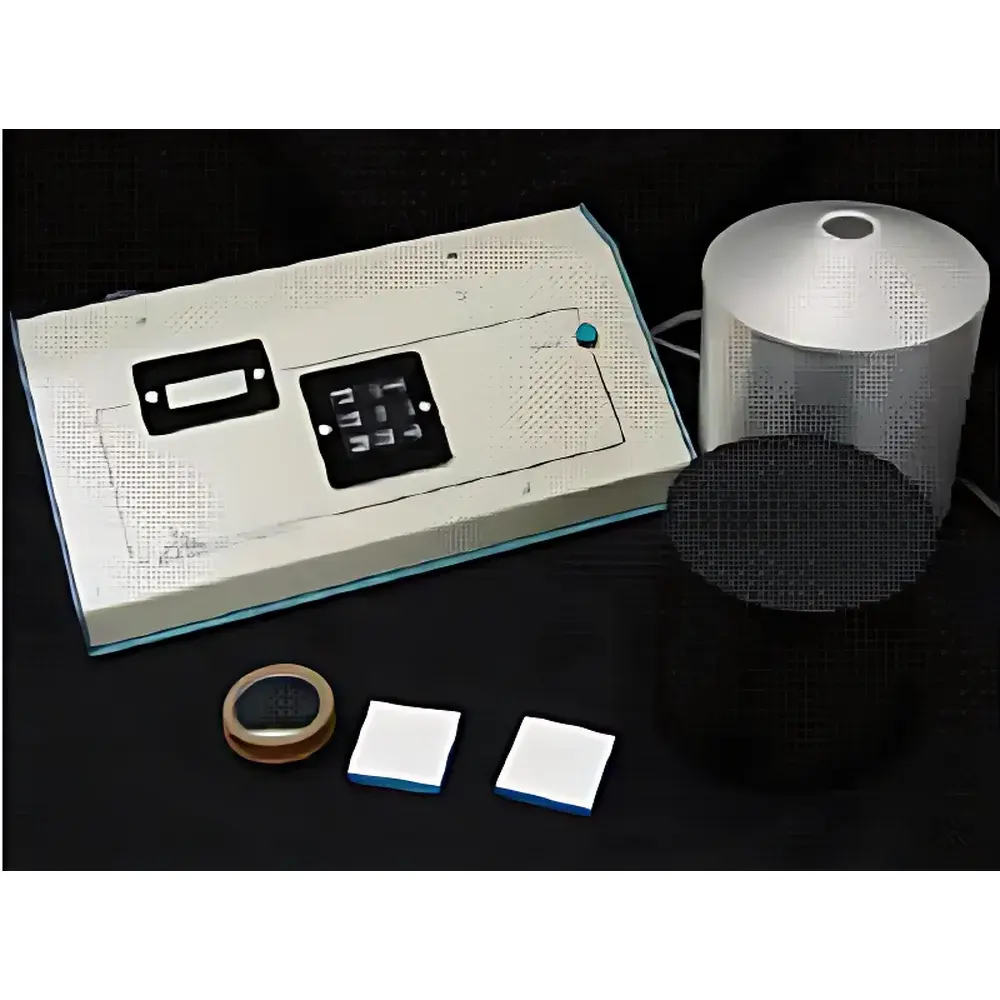
D&S SSR-ER Solar Spectral Reflectometer
| Brand | D&S |
|---|---|
| Origin | USA |
| Manufacturer Type | Authorized Distributor |
| Origin Category | Imported |
| Model | SSR-ER |
| Price | USD 115,000 (FOB USA) |
| Power Supply | 100–240 VAC, 50/60 Hz |
| Portable Option | 12 V DC battery pack (5 h continuous operation) |
| Measurement Port Diameter | 25.4 mm (1 in) |
| Minimum Sample Diameter | 27.9 mm (1.1 in) |
| Sample Thickness Minimum | 6.4 mm |
| Spectral Coverage | UV–Vis–NIR (via 4 primary + 2 auxiliary photodetectors) |
| Incident Angle | 20° from normal |
| Repeatability | ±0.003 |
| Accuracy | ±0.002 |
| Resolution (LCD) | 0.001 for solar reflectance, absorptance, and transmittance |
| Drift | < ±1% per hour or ±0.003 after 5 min warm-up |
| Operating Temperature | Electronics ≤ 60°C, Measurement Head ≤ 50°C |
| Relative Humidity | ≤ 80% non-condensing |
| Calibration Standards | NIST-traceable diffuse and specular reflectance standards (ceramic white, mirror, black body) |
| Optional Accessory | SSR-T Transmittance Attachment (adjustable 0°–60° incidence, diffuser-illuminated) |
Overview
The D&S SSR-ER Solar Spectral Reflectometer is a precision-engineered optical instrument designed for quantitative measurement of solar-weighted spectral reflectance, absorptance, and (with optional SSR-T attachment) transmittance of solid materials under standardized CIE solar irradiance conditions. It operates on the principle of filtered broadband photometry—utilizing six calibrated photodetectors with spectrally selective interference filters to emulate the solar spectral power distribution across ultraviolet (UV), visible (VIS), and near-infrared (NIR) bands. Unlike full-spectrum spectroradiometers, the SSR-ER delivers rapid, repeatable, and traceable solar reflectance values (ρsolar) by integrating detector responses weighted against the ASTM E891-22 reference solar spectral irradiance curve. Its 20° near-normal incident geometry conforms to ISO 9050:2003 and ASTM C1549-21 for architectural glazing and thermal control surface characterization. The system employs a replaceable tungsten-halogen lamp as a stable, low-color-temperature source, supplemented by two auxiliary detectors optimized for red/NIR signal fidelity at reduced filament temperatures—ensuring robust performance across diverse coating emissivities and substrate thermal states.
Key Features
- High-reproducibility solar reflectance measurement with ±0.003 repeatability and ±0.002 absolute accuracy, validated against NIST-traceable standards
- Dual-mode display: real-time switching between reflectance (ρ), absorptance (α), and transmittance (τ) values—all resolved to 0.001 on integrated LCD
- Modular architecture: SSR-E electronics module interfaces seamlessly with SSR-R reflectance head and optional SSR-T transmittance accessory
- Field-deployable design: includes ergonomic handle, 12 V DC battery pack (5 h runtime), rugged transport case, and 1.5 m (extendable to 10 m) shielded signal cable
- Customizable measurement geometry: standard flat-sample port (25.4 mm diameter); optional curved-surface probe available for cylindrical samples down to 13 mm diameter
- Thermal stability management: 5-minute warm-up period ensures drift < ±0.003 or ±1% per hour; electronic module rated to 60°C ambient, measurement head to 50°C
Sample Compatibility & Compliance
The SSR-ER accommodates rigid planar or gently curved specimens ≥6.4 mm thick and ≥27.9 mm in diameter. Its 20° fixed-angle illumination enables consistent evaluation of thermally critical surfaces—including aerospace thermal control coatings, solar selective absorbers, dielectric mirror stacks, and low-emissivity architectural films. All calibration standards (diffuse white ceramic, specular mirror, and black body) are certified by the National Institute of Standards and Technology (NIST), ensuring metrological traceability compliant with ISO/IEC 17025 requirements. Instrument validation protocols align with ASTM E903-22 (solar absorptance), ASTM C1549-21 (solar reflectance of roofing materials), and MIL-STD-810G for environmental robustness. Data output meets GLP audit requirements when used with external logging systems supporting time-stamped metadata and operator ID tagging.
Software & Data Management
While the SSR-ER operates autonomously via front-panel controls and onboard LCD, it supports RS-232 serial output for integration into laboratory data acquisition environments. Raw detector voltages, computed ρsolar/αsolar/τsolar, measurement timestamps, and system diagnostics are exportable in ASCII CSV format. When deployed in regulated settings (e.g., aerospace QA or solar thermal certification labs), users may pair the instrument with validated third-party software that provides 21 CFR Part 11-compliant electronic signatures, audit trails, and user access controls. Firmware updates are delivered via secure USB interface, preserving calibration integrity through cryptographic checksum verification.
Applications
- Aerospace thermal management: qualification of spacecraft thermal control coatings (TCCs), radiator finishes, and MLI outer layer reflectivity
- Solar energy: performance grading of concentrated solar power (CSP) mirror reflectivity, photothermal absorber selectivity, and PV module anti-reflective coating efficacy
- Architectural science: compliance testing of cool roof materials per ENERGY STAR® and CRRC rating programs
- Optical thin-film R&D: rapid screening of sputtered, evaporated, or sol-gel deposited multilayer stacks for solar spectrum modulation
- Defense & camouflage: evaluation of multispectral signature suppression across UV–Vis–NIR bands under daylight illumination conditions
FAQ
What spectral bands does the SSR-ER measure?
It uses four primary detectors covering UV, blue, red, and IR ranges—plus two auxiliary detectors optimized for red/NIR response under low-color-temperature illumination—to reconstruct solar-weighted reflectance per ASTM E891-22.
Can the SSR-ER measure curved surfaces?
Yes—standard configuration supports flat samples, but custom probe heads are available for cylindrical geometries down to 13 mm diameter.
Is NIST traceability documented for each unit?
Each shipped system includes calibration certificates referencing NIST Standard Reference Materials (SRMs) 990c (diffuse reflectance) and 2020 (specular reflectance), with full uncertainty budgets.
How is drift corrected during extended measurements?
Automatic dark-offset compensation occurs every 8-second cycle: 6 s lamp-off baseline capture followed by 2 s lamp-on measurement, eliminating thermal drift effects.
Does the SSR-T transmittance accessory require recalibration when attached?
No—the SSR-T mounts mechanically and electrically to the SSR-R head without altering detector gain or spectral weighting; only geometric alignment verification is required.




