
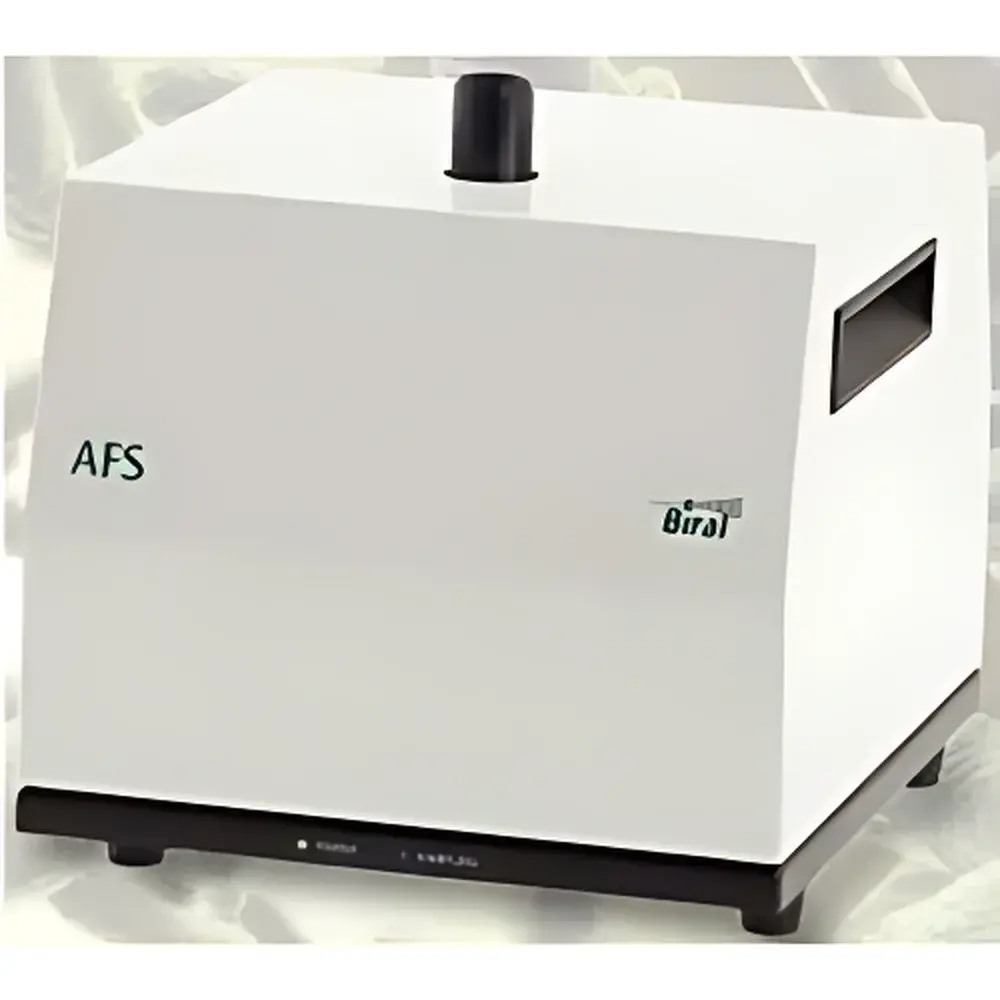
CMI AFS Bioaerosol Fluorescence Monitor
| Brand | CMI (California Measurements, Inc.) |
|---|---|
| Origin | United Kingdom |
| Manufacturer Type | Authorized Distributor |
| Origin Category | Imported |
| Model | AFS |
| Pricing | Available Upon Request |
| UV Excitation Source | 280 ±20/−40 nm |
| Fluorescence Channel 1 (UV) | 330–650 nm |
| Fluorescence Channel 2 (Visible) | 420–650 nm |
| Sample Volume per Measurement | 2.5 cm³ |
| Dimensions (L×W×H) | 30 × 28 × 24 cm |
| Weight | 5.3 kg (11.3 lbs) |
| Power Supply | 90–260 VAC, 47–63 Hz |
| Operating Temperature | +5 to +30 °C |
| Relative Humidity Range | 0–95 % RH |
Overview
The CMI AFS Bioaerosol Fluorescence Monitor is a real-time, continuous-duty instrument engineered for the detection and classification of airborne biological particles using Ultra-Violet Light Induced Fluorescence (UV-LIF) spectroscopy. It operates on the principle that endogenous fluorophores—primarily tryptophan, tyrosine, and NAD(P)H—exhibit intrinsic fluorescence when excited by ultraviolet light near 280 nm. This optical signature enables discrimination between viable or metabolically active biological aerosols (e.g., bacteria, fungal spores, pollen, and bioengineered agents) and non-biological particulates such as mineral dust, soot, or industrial polymers. The AFS does not identify species taxonomically but provides rapid, label-free classification based on multichannel fluorescence intensity ratios and spectral response kinetics—making it suitable for early-warning surveillance in critical infrastructure, biosafety laboratories, and defense-related air monitoring applications.
Key Features
- High-sensitivity dual-channel fluorescence detection with spectrally resolved collection in UV (330–650 nm) and visible (420–650 nm) bands to enhance discriminability between biological classes.
- Stable, narrow-band UV excitation source centered at 280 nm (±20/−40 nm tolerance), optimized for tryptophan absorption peak and minimizing photobleaching during continuous operation.
- Compact benchtop architecture (30 × 28 × 24 cm; 5.3 kg) designed for integration into HVAC ducts, cleanroom monitoring networks, or mobile deployment platforms.
- Robust environmental operating envelope: functional across 5–30 °C ambient temperature and 0–95 % RH without condensation—validated for unattended field use in variable climatic conditions.
- Compliant with IEC 61000-6-3 (EMC emission standards) and IEC 61000-6-2 (immunity), supporting deployment in electromagnetically noisy environments including hospitals and industrial facilities.
- Configurable alarm thresholds and event logging aligned with ISO 14644-1 particle counting conventions and ASTM E2994-15 guidance for bioaerosol detection system performance evaluation.
Sample Compatibility & Compliance
The AFS monitors ambient or ducted air streams without sample preparation, filtration, or culturing. It accepts aerosol size distributions typical of respirable bioaerosols (0.5–10 µm aerodynamic diameter), with optimal sensitivity in the 1–5 µm range where bacterial cells and fungal conidia predominate. While not a diagnostic tool, its fluorescence response correlates with biological load and metabolic activity—supporting compliance with occupational health frameworks including OSHA Technical Manual Section III: Chapter 2 (Bioaerosols) and EU Directive 2000/54/EC on biological agents. Data outputs are structured to support GLP-compliant audit trails when integrated with validated data acquisition systems meeting FDA 21 CFR Part 11 requirements for electronic records and signatures.
Software & Data Management
The AFS interfaces via RS-232 or optional Ethernet to host software capable of time-series visualization, multi-parameter correlation (e.g., fluorescence intensity vs. coincident PM2.5 or CO2 data), and automated event flagging. Raw spectral histograms and per-pulse fluorescence decay profiles are exportable in CSV and HDF5 formats for post-acquisition multivariate analysis (e.g., PCA, LDA). Firmware supports configurable sampling intervals (1–300 s), internal clock synchronization via NTP, and secure TLS-encrypted remote access when deployed behind enterprise firewalls. Audit logs record all configuration changes, calibration events, and user-initiated actions—ensuring traceability under ISO/IEC 17025 and GxP-aligned quality systems.
Applications
- Real-time biothreat monitoring in government facilities, transportation hubs, and military command centers.
- Process air quality assurance in pharmaceutical manufacturing suites and aseptic filling lines.
- Indoor environmental quality (IEQ) assessment in hospitals, schools, and office buildings to correlate bioaerosol dynamics with HVAC performance.
- Field validation of air disinfection technologies (e.g., UV-C, bipolar ionization) through pre- and post-treatment fluorescence signal attenuation.
- Research-grade characterization of bioaerosol emissions from agricultural operations, wastewater treatment plants, and composting facilities.
FAQ
Does the AFS identify specific microorganisms (e.g., Bacillus anthracis)?
No. It classifies particles as “biological” or “non-biological” based on intrinsic fluorescence signatures—not genomic or antigenic markers. Confirmatory identification requires downstream culture or molecular analysis.
Can the AFS operate outdoors or in high-humidity environments?
It is rated for indoor and sheltered outdoor use within its specified temperature (5–30 °C) and humidity (0–95 % RH, non-condensing) limits. Extended outdoor deployment requires climate-controlled enclosures.
Is routine calibration required?
Yes. Annual factory recalibration is recommended; field verification using NIST-traceable fluorescent microspheres (e.g., polystyrene beads doped with fluorescein) is supported via built-in diagnostic routines.
How is data integrity ensured for regulatory reporting?
When paired with compliant data acquisition software, the system maintains timestamped, immutable logs with user authentication, change tracking, and electronic signature capability—meeting foundational requirements of 21 CFR Part 11 and ISO 17025 Clause 7.9.
What maintenance is required?
Routine cleaning of the inlet nozzle and optical window every 30–90 days (depending on particulate loading); annual inspection of pump flow rate and laser diode output stability.







