
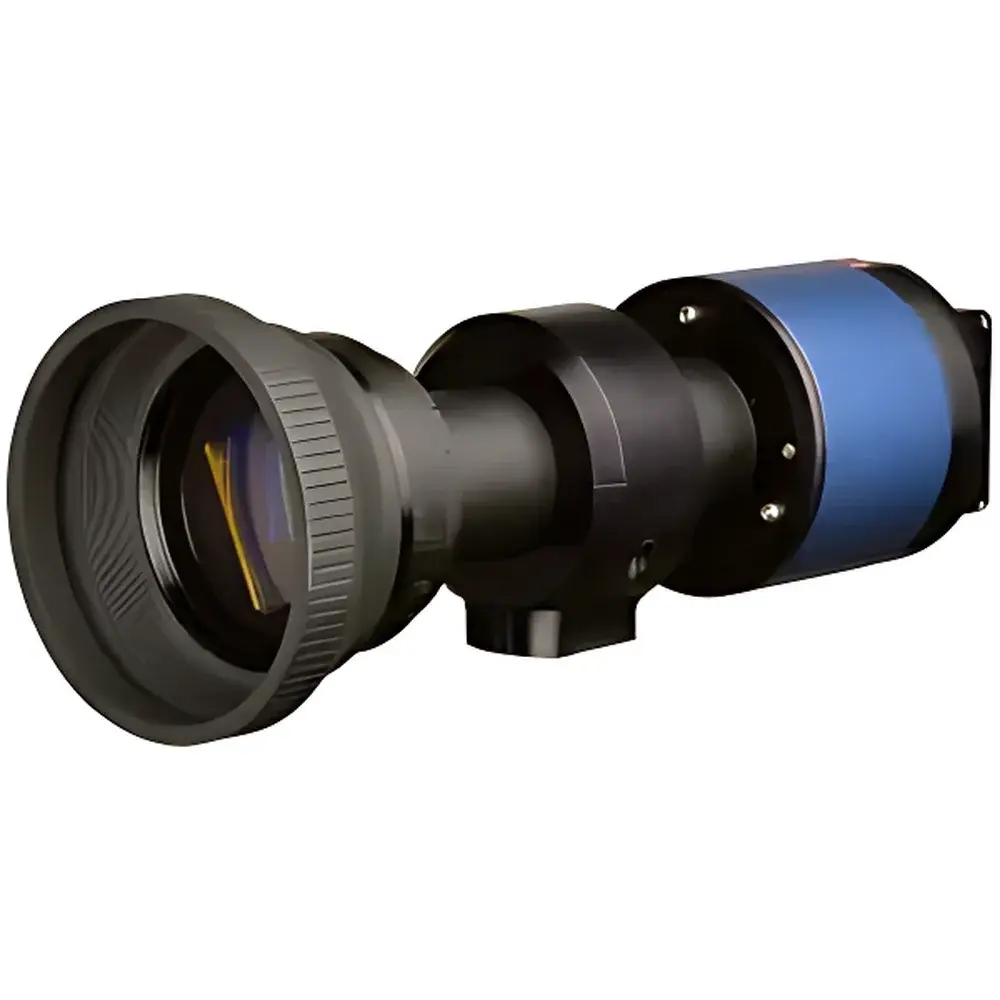
SOC716 FMV-SI Video-Grade Hyperspectral Imaging Spectrometer
| Brand | SOC/SurfaceOptics |
|---|---|
| Origin | USA |
| Manufacturer Type | Authorized Distributor |
| Import Status | Imported |
| Model | SOC716FMV-SI |
| Price Range | USD 70,000–140,000 |
| Operating Principle | Filter-Based (Tunable Bandpass Filter Array) |
| Imaging Modality | 3D Spatio-Spectral Data Cube Acquisition |
| Deployment Mode | Ground-Based |
| Spectral Range | 270–1700 nm |
| Spectral Resolution | Configurable (Typical FWHM: 5–20 nm per band) |
| Spatial Resolution | 1280 × 1024 pixels |
| Total Field of View (TFOV) | Selectable (e.g., 11.0°–12.3° depending on lens module) |
| Instantaneous Field of View (IFOV) | Configurable via focal length and pixel pitch |
| Frame Rate | Up to 30 fps (full-frame) |
Overview
The SOC716 FMV-SI is a video-grade, filter-based hyperspectral imaging spectrometer engineered for real-time, motion-tolerant spectral data acquisition in ground-based operational environments. Unlike conventional push-broom or whisk-broom systems that rely on mechanical scanning—introducing spatial-spectral misregistration and motion-induced spectral smearing—the SOC716 FMV-SI employs a monolithic, single-focal-plane architecture integrating a custom-designed mosaic bandpass filter array directly onto the sensor surface. This solid-state design eliminates moving parts, enabling simultaneous capture of spatial and spectral information across all bands within each frame. The instrument acquires full 3D spatio-spectral data cubes (x, y, λ) at native video rates—up to 30 full-resolution frames per second—and achieves effective cube generation rates of up to 60 Hz when paired with the optional MIDIS real-time processing engine. Its broad spectral coverage spans ultraviolet (270–550 nm), visible-near-infrared (450–950 nm), and short-wave infrared (900–1700 nm) domains, supporting multi-regime material characterization without hardware reconfiguration.
Key Features
- Solid-state, no-moving-parts optical architecture based on monolithic focal-plane filter mosaic—ensures high temporal stability and immunity to vibration-induced spectral drift.
- Real-time data cube acquisition: 1280 × 1024 spatial resolution with configurable spectral sampling (typically 16 discrete bands per module, scalable via firmware).
- Modular spectral configuration: Interchangeable optical modules (SOC716-UV, SOC716-VNIR, SOC716-SWIR) support application-specific spectral range selection and optimized optical throughput.
- Integrated far-corrected telecentric achromatic lenses with fixed focal lengths (84 mm, 85 mm, or 125 mm) and calibrated TFOV (11.0°–12.3°), ensuring consistent geometric fidelity across spectral bands.
- Low-power operation: 2–3.8 W DC power consumption (12 VDC), compatible with field-deployable battery packs and UAV-integrated platforms.
- NTSC-compliant analog video output and GigE Vision digital interface enable seamless integration into existing surveillance, industrial inspection, or laboratory imaging infrastructure.
Sample Compatibility & Compliance
The SOC716 FMV-SI is designed for non-contact, standoff analysis of heterogeneous surfaces including vegetation canopies, painted coatings, pharmaceutical tablets, food products, mineral specimens, and forensic evidence. Its ground-based deployment mode supports tripod mounting, vehicle integration, or fixed-site installation. The system complies with IEC 61000-6-3 (EMC emission standards) and meets RoHS Directive 2011/65/EU requirements. While not certified as medical or safety-critical equipment, its optical design adheres to ANSI Z87.1-2020 guidelines for UV-blocking performance in UV-capable configurations. Data integrity workflows align with GLP principles; metadata embedding (wavelength calibration, exposure time, lens ID, temperature) supports traceable spectral recordkeeping per ISO/IEC 17025:2017 Annex A.2.
Software & Data Management
The SOC716 FMV-SI operates natively with SurfaceOptics’ MIDIS (Multi-band Imaging Data Interpretation System) real-time processor—a standalone FPGA-based unit that performs on-the-fly radiometric calibration, spectral band selection, noise reduction, and spectral library matching without host PC dependency. MIDIS outputs processed NTSC video with overlaid spectral indices (e.g., NDVI, NDWI) or classification masks. For post-acquisition analysis, SOC’s HyperView software suite provides ENVI-compatible .hdr/.dat export, spectral unmixing (VCA, N-FINDR), endmember extraction, and batch processing compliant with ASTM E131-22 (Standard Terminology Relating to Molecular Spectroscopy). All raw and processed datasets include embedded EXIF-style metadata conforming to ISO 12234-2 (JPEG2000 for spectral imagery), facilitating audit-ready archiving under FDA 21 CFR Part 11–compliant environments when deployed with validated IT infrastructure.
Applications
- Agricultural monitoring: Real-time detection of plant stress, nutrient deficiency, and disease onset via spectral reflectance dynamics in VNIR-SWIR domains.
- Industrial quality control: In-line verification of coating uniformity, pigment dispersion, and counterfeit detection in pharmaceuticals and electronics manufacturing.
- Environmental remote sensing: Standoff identification of hydrocarbon spills, soil contamination, and invasive species mapping using spectral signature libraries.
- Defense & security: Concealed object detection (e.g., explosives residues, camouflaged materials) through SWIR spectral contrast analysis.
- Academic research: Time-resolved hyperspectral videography of chemical reactions, combustion processes, and biological tissue response under controlled illumination.
FAQ
Does the SOC716 FMV-SI require external calibration sources for routine operation?
No—each module includes factory-applied radiometric and spectral calibration coefficients stored in onboard EEPROM. Field validation may be performed using NIST-traceable reflectance standards (e.g., Spectralon® panels) per ASTM E275-21.
Can multiple spectral modules (UV/VNIR/SWIR) be operated simultaneously?
No—modules are physically interchangeable; spectral range selection requires manual lens/filter assembly replacement. However, co-registration across modules is supported via shared mechanical mounting interfaces and common coordinate transformation matrices.
Is the system compatible with third-party machine vision software?
Yes—GigE Vision compliance enables native integration with HALCON, OpenCV, and Common Vision Blox via GenICam protocol. SDKs (C/C++, Python) are provided for custom pipeline development.
What is the maximum sustainable data throughput during continuous acquisition?
At full resolution (1280 × 1024 × 16 bands × 12-bit), sustained throughput is 2.4 Gbps via GigE; onboard buffering supports 8-second burst capture at 30 fps before streaming saturation.
Does the SOC716 FMV-SI support synchronized triggering with external sensors?
Yes—TTL-compatible trigger input/output ports support hardware synchronization with LiDAR, thermal cameras, or motion stages per IEEE 1588 PTP timestamp alignment.







