
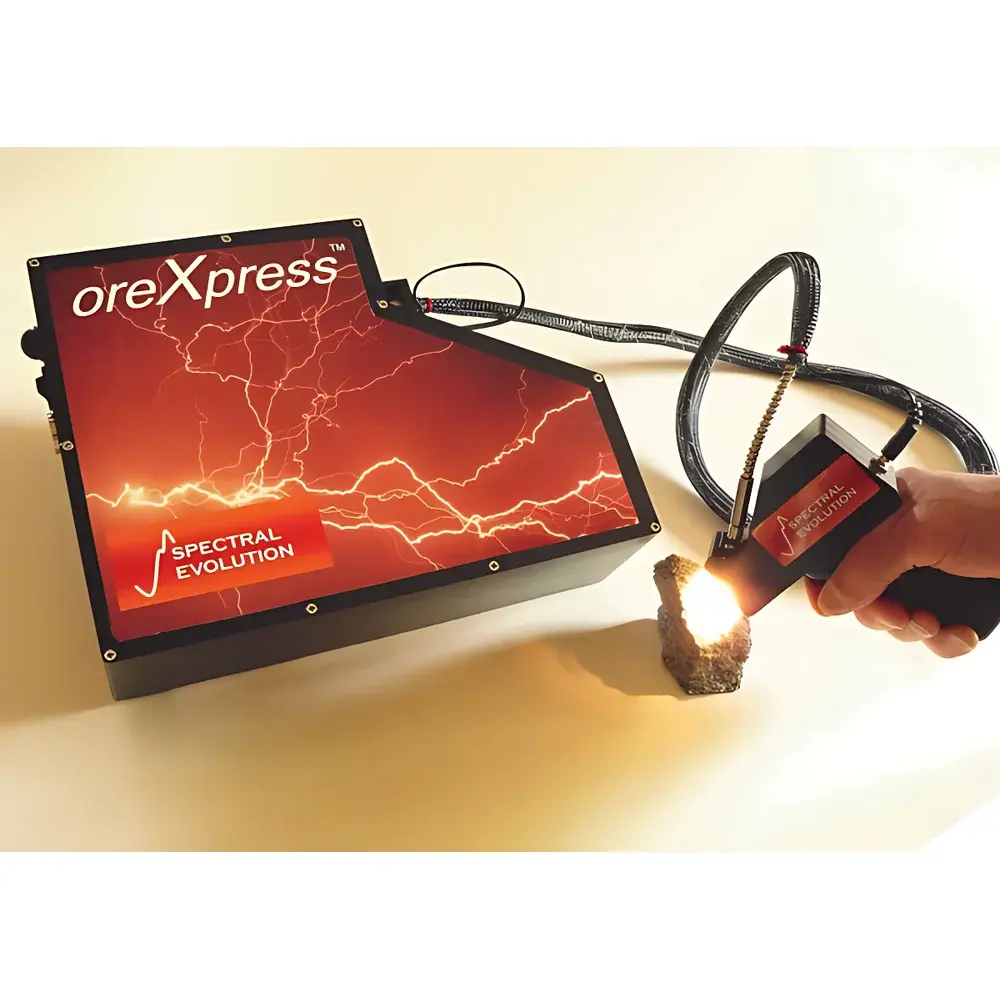
Spectral Evolution Platinum Portable Near-Infrared Spectrometer
| Brand | Spectral Evolution |
|---|---|
| Origin | USA |
| Model | Platinum |
| Instrument Type | Portable |
| Optical Principle | Fixed-grating array detector (non-scanning) |
| Wavelength Range | 350–2500 nm |
| Data Sampling Interval | 1 nm |
| Measurement Mode | Diffuse Reflectance |
| Chemometrics Software | DARWin SP |
| Mineral Identification Software | EZ-ID |
| Integrated Hardware | GETAC PS336 rugged handheld (GPS, auto-focus camera, digital compass, altimeter, voice memo), replaceable Li-ion battery, pistol-grip contact probe with 5 W tungsten halogen source and sapphire window |
| Spectral Libraries | USGS, SpecMIN™, customizable user libraries |
Overview
The Spectral Evolution Platinum Portable Near-Infrared Spectrometer is a field-deployable, high-fidelity spectroscopic instrument engineered for rapid, non-destructive mineral identification and spectral characterization across the ultraviolet–visible–near-infrared (UV-VNIR-SWIR) range. Operating on a fixed-grating, array-detector architecture—eliminating mechanical scanning components—the Platinum delivers stable, reproducible reflectance spectra from 350 to 2500 nm at 1 nm data sampling resolution. Its optical design leverages robust radiometric calibration traceable to NIST standards, ensuring measurement consistency under variable ambient conditions typical of geological fieldwork. Unlike benchtop scanning spectrometers, the non-scanning configuration enables sub-second spectral acquisition, facilitating real-time decision-making during core logging, outcrop mapping, or drill-site evaluation. The system is purpose-built for geoscientists requiring quantitative spectral fidelity without laboratory infrastructure, supporting both qualitative mineral phase discrimination and semi-quantitative compositional inference when paired with validated chemometric models.
Key Features
- Full-spectrum coverage from 350 to 2500 nm in a single acquisition—encompassing diagnostic absorption features for hydroxyl-bearing minerals (e.g., clays, micas), carbonates, sulfates, iron oxides, and transition-metal-bearing silicates.
- High signal-to-noise ratio (>10,000:1 at 1000 nm, 1s integration) optimized for low-light field environments and low-reflectance geological materials.
- Integrated pistol-grip contact probe with stabilized 5 W tungsten-halogen illumination and scratch-resistant sapphire window—designed for consistent illumination geometry and minimal sample disturbance during core, chip, or outcrop measurements.
- Ruggedized GETAC PS336 handheld terminal with integrated GPS, 8 MP auto-focus camera, digital compass, barometric altimeter, and voice annotation—enabling spatially referenced spectral metadata capture synchronized with each measurement.
- Hot-swappable, high-capacity lithium-ion battery pack rated for ≥8 hours continuous operation in temperatures ranging from –10 °C to 50 °C.
- Bluetooth 5.0 wireless interface compliant with RFCOMM and SPP profiles for secure, low-latency data streaming to field tablets or cloud-based repositories.
Sample Compatibility & Compliance
The Platinum spectrometer supports diffuse reflectance measurements on unprepared solid samples including drill core segments, RC chips, trench wall exposures, soil horizons, and hand specimens. Its probe geometry conforms to ASTM E275–21 (Standard Practices for Describing and Measuring Performance of UV-Vis-NIR Spectrophotometers) for geometric consistency in reflectance mode. While not certified for GLP or GMP environments per se, its data provenance framework—including embedded timestamp, GPS coordinates, operator ID, and hardware calibration checksums—supports audit-ready documentation required under ISO/IEC 17025:2017 for testing laboratories. All spectral data files are stored in vendor-neutral ENVI-compatible BIL format with embedded metadata headers, enabling interoperability with third-party analytical platforms used in regulatory reporting workflows.
Software & Data Management
DARWin SP serves as the primary acquisition and preprocessing engine—supporting real-time dark/current reference correction, spectral averaging, and configurable smoothing filters (Savitzky-Golay, median). EZ-ID mineral identification software implements spectral angle mapper (SAM), continuum-removed spectral matching (CRSM), and Euclidean distance algorithms against embedded USGS and SpecMIN™ spectral libraries. Users may define custom spectral regions of interest (e.g., Al–OH at 2200 nm, Fe–OH at 2300 nm) and generate match scores normalized between 0 and 1. Library management tools allow creation, versioning, and export of proprietary spectral databases compatible with GRAMS/AI and TSG™ for advanced multivariate regression (PLS-R), cluster analysis (PCA), or spectral unmixing. All software modules comply with FDA 21 CFR Part 11 requirements for electronic records and signatures when deployed with appropriate system validation protocols.
Applications
- Alteration zonation mapping in porphyry copper and epithermal gold systems via clay mineralogy (kaolinite, smectite, illite) and sulfate detection.
- Rapid lithological discrimination in open-pit faces and exploration trenches using diagnostic absorption features of feldspars, quartz polymorphs, and volcanic glass.
- Core logging acceleration—reducing traditional visual-log + XRD turnaround from 6+ hours per 10 m to ≤2 hours with full spectral archive generation.
- In-field identification of indicator minerals associated with diamondiferous kimberlites (e.g., garnet chemistry proxies), rare earth element (REE) deposits (e.g., monazite, xenotime), and unconformity-related uranium systems.
- Integration with GIS platforms (ArcGIS Pro, QGIS) for spatial interpolation of spectral indices (e.g., NIR/SWIR ratios) to model mineral abundance gradients.
FAQ
Is the Platinum spectrometer suitable for quantitative mineralogical analysis?
Yes—when calibrated against reference standards and coupled with validated partial least squares (PLS) or support vector regression (SVR) models, it supports semi-quantitative estimation of mineral abundances (e.g., % kaolinite in weathered granite). Absolute quantification requires matrix-matched standards.
Can EZ-ID operate offline in remote field locations?
Yes—both USGS and SpecMIN™ libraries are preloaded; no internet connection is required for spectral matching or custom library queries.
What spectral resolution does the Platinum achieve across its range?
Optical resolution varies by wavelength: ~3 nm FWHM at 700 nm, ~10 nm at 2500 nm—sufficient to resolve key mineral absorption features per ISO 18562-3:2021 guidelines for geological spectroscopy.
Does the system support compliance with mining industry QA/QC protocols?
Yes—DARWin SP generates immutable audit trails (including calibration history, operator logs, and environmental sensor data), meeting AS/NZS 4360:2004 risk documentation requirements for exploration-stage resource estimation.
How is spectral data backed up and archived?
All spectra are saved locally on the GETAC PS336 microSD card in .BIL + .HDR format; optional automated sync to encrypted network drives or AWS S3 buckets via configurable FTP/SFTP scripts.
Related Products






