
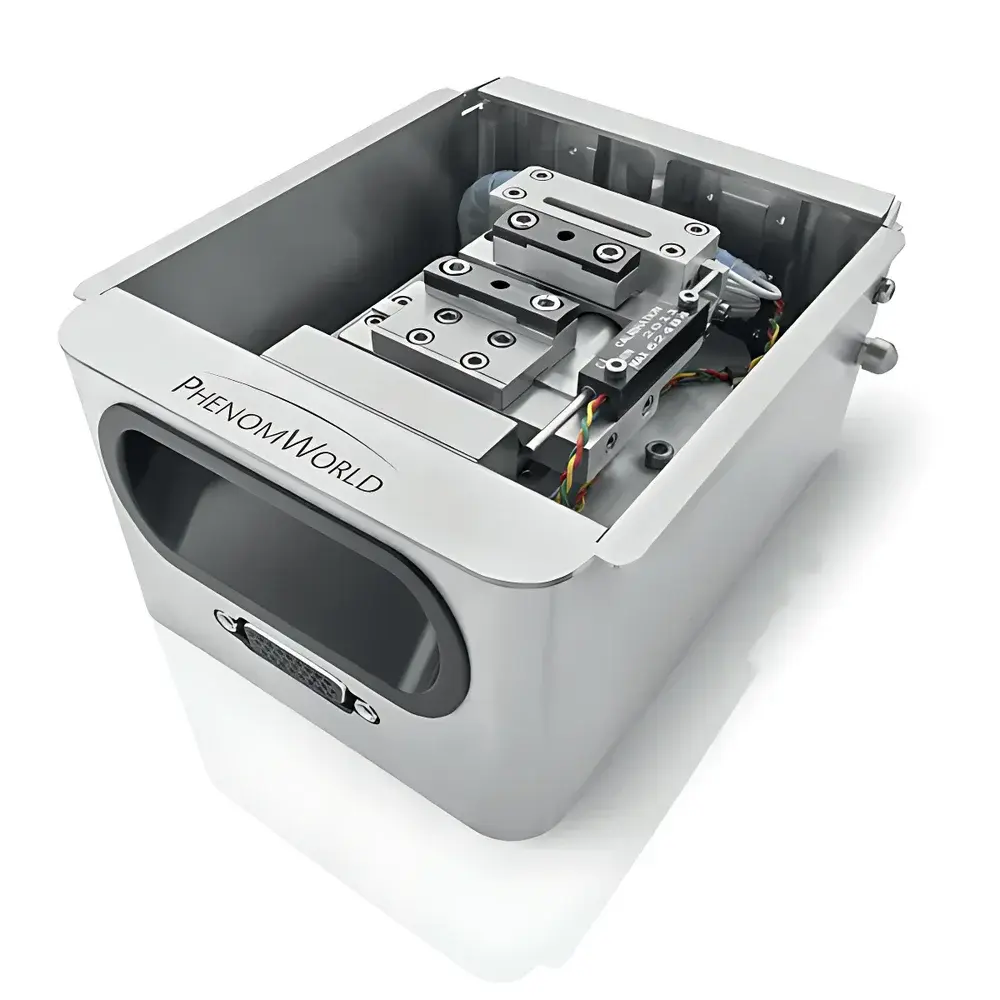
Phenom Tensile Sample Holder for In-Situ SEM Mechanical Testing
| Brand | Phenom |
|---|---|
| Origin | Netherlands |
| Manufacturer Type | Original Equipment Manufacturer (OEM) |
| Product Origin | Imported |
| Model | Tensile Sample Holder |
| Pricing | Available Upon Request |
Overview
The Phenom Tensile Sample Holder is an engineered in-situ mechanical testing module designed exclusively for integration with the Phenom XL desktop scanning electron microscope (SEM). It enables real-time, high-resolution observation of material deformation and failure mechanisms under controlled uniaxial tensile or compressive loading—directly within the SEM chamber. Unlike conventional ex-situ mechanical testers, this holder eliminates post-test handling artifacts and preserves spatial correlation between microstructural evolution (e.g., crack nucleation, void coalescence, grain boundary sliding) and applied stress states. The system operates on a precision piezoelectric or motor-driven actuation principle, delivering stable, programmable force profiles while maintaining vacuum compatibility and minimal electromagnetic interference. Its modular architecture supports two interchangeable load cells—150 N and 1000 N—each calibrated to ISO/IEC 17025-accredited standards, enabling quantitative stress–strain data acquisition synchronized with secondary electron (SE) and backscattered electron (BSE) imaging.
Key Features
- Full in-situ compatibility with Phenom XL SEM: No sample transfer required; maintains high-vacuum integrity (<1×10⁻³ mbar) during operation
- Dual-load-cell configuration: Selectable 150 N (range: 1.5–150 N) or 1000 N (range: 10–1000 N) modules, optimized for soft polymers, thin films, biological tissues, or high-strength metals and composites
- Bidirectional mechanical actuation: Supports tension, compression, and cyclic loading protocols (e.g., fatigue, creep-recovery) with programmable displacement resolution down to 100 nm
- Integrated force and displacement feedback: Real-time analog output signals compatible with external DAQ systems for synchronized SEM imaging and mechanical data logging
- Low-profile, compact design: Fits standard Phenom XL sample stage without obstructing detector line-of-sight or limiting tilt capability (±30°)
- Vacuum-compatible materials: All structural components manufactured from non-magnetic, low-outgassing stainless steel and ceramic insulators
Sample Compatibility & Compliance
The Tensile Sample Holder accommodates specimens up to 20 mm in length and 5 mm in width, with standardized dog-bone or rectangular geometries. It is routinely deployed for fiber bundles (e.g., carbon, silk), polymer thin films (PET, PI), metallic foils (Al, Cu), semiconductor wafers, plant cuticles, and keratin-based biomaterials (e.g., human hair, avian feathers). All mechanical test procedures align with ASTM E8/E8M (tension testing of metallic materials), ASTM D638 (plastics), and ISO 527 (determination of tensile properties). Force calibration certificates are traceable to national metrology institutes (NMI), and the system supports GLP-compliant audit trails when paired with Phenom’s Thermo Scientific™ SmartSEM software (v2.5+), including timestamped metadata embedding per image frame.
Software & Data Management
Control and synchronization are managed via Phenom’s native SmartSEM software suite, which provides intuitive graphical interfaces for defining load ramps, dwell times, and cycle counts. Force-displacement curves are exported in CSV and HDF5 formats for post-processing in MATLAB, Python (NumPy/Pandas), or commercial FEA tools. Image sequences are tagged with concurrent mechanical parameters—including instantaneous load, displacement, and strain rate—enabling pixel-level correlation analysis. Optional integration with third-party LabVIEW or Python APIs permits custom automation of multi-step experiments, including conditional triggering (e.g., initiate high-magnification imaging upon detection of crack initiation). All raw data and metadata comply with FAIR principles (Findable, Accessible, Interoperable, Reusable) and support 21 CFR Part 11-compliant electronic signatures when deployed in regulated QC environments.
Applications
- Microstructure–property linkage studies: Correlating dislocation activity, phase transformation, or interfacial debonding with macroscopic yield points
- Process validation: Assessing thermal annealing, laser sintering, or electrospinning effects on mechanical robustness at submicron scale
- Failure analysis: Capturing dynamic fracture propagation in brittle ceramics or delamination in multilayer coatings
- Biomaterial characterization: Quantifying tensile modulus and rupture strain of collagen scaffolds or vascular grafts under physiological humidity conditions
- Quality assurance: Batch-to-batch consistency verification for medical device components (e.g., stent struts, suture threads)
- Standards development: Supporting ISO/TC 201 and ASTM E2921 working groups on in-situ SEM mechanical testing protocols
FAQ
Is the Tensile Sample Holder compatible with SEMs other than Phenom XL?
No—it is mechanically and electronically optimized for the Phenom XL platform only. Mounting interfaces, signal pinouts, and vacuum feedthroughs are proprietary and not cross-compatible with other SEM brands or Phenom desktop models (e.g., Pure, Pro).
Can I perform compression tests on bulk samples?
Yes—the holder supports axial compression on specimens ≤3 mm thick using flat-ended tungsten carbide platens. Maximum compressive force equals the selected load cell rating (150 N or 1000 N), with displacement control accuracy ±0.5 µm.
Does the system provide strain measurement?
Strain is derived computationally from high-contrast fiducial markers (e.g., sputter-deposited Pt dots) tracked across image sequences using digital image correlation (DIC) algorithms. Direct extensometry is not embedded but can be added via optional external video extensometers.
What vacuum level is required for stable operation?
The holder functions reliably at operating pressures ≤1×10⁻³ mbar. For beam-sensitive biological samples, optional low-vacuum mode (10–100 Pa) may be used with reduced force fidelity due to increased damping effects.
Are calibration certificates included?
Yes—each load cell ships with a factory calibration certificate traceable to EUROMET and NIST standards, valid for 12 months. Recalibration services are available through Phenom’s authorized service centers in EMEA, APAC, and North America.




