
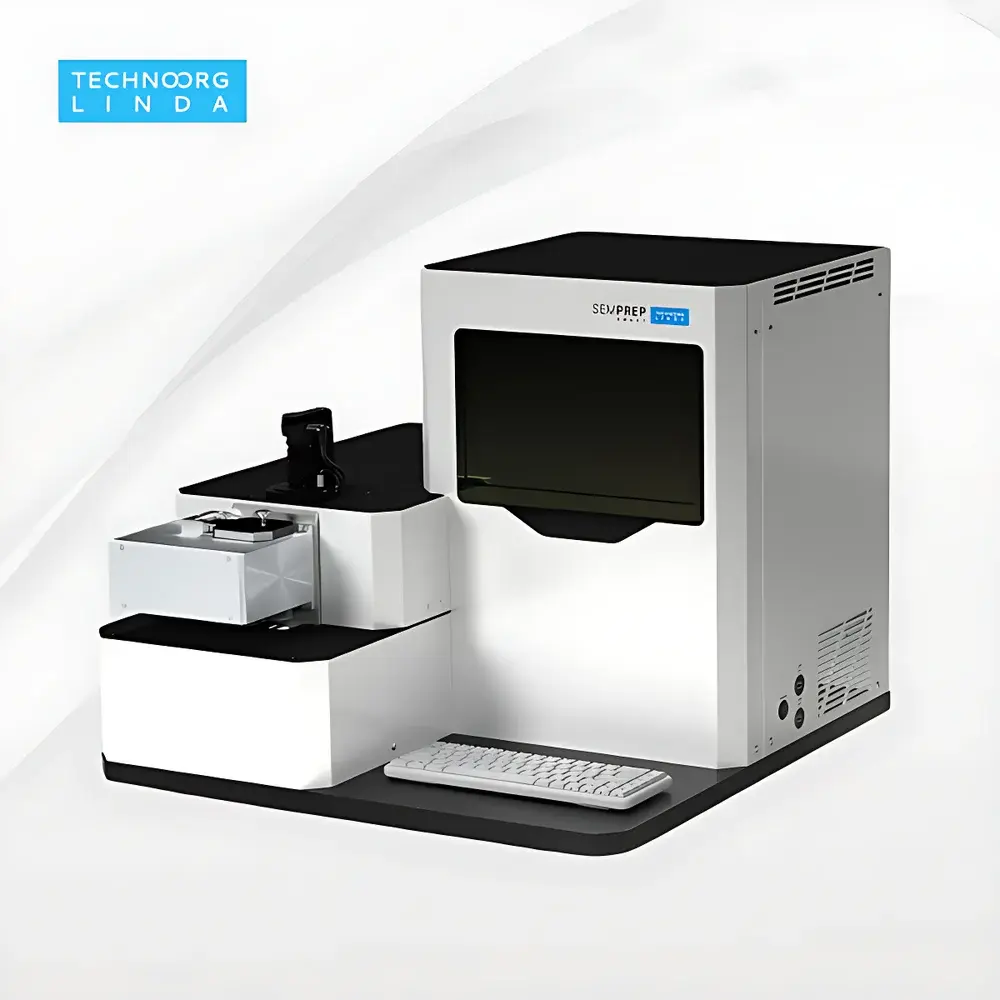

Technoorg Linda SEMPREPSMART Ion Milling System for Semiconductor Failure Analysis
| Brand | Technoorg Linda |
|---|---|
| Origin | Hungary |
| Model | SEMPREPSMART |
| Ion Gun Energy | Up to 16 keV |
| Sample Stage Options | 30° cross-section, 90° cross-section, and EBSD-compatible planar stages (flat-head: Ø50 mm × 4 mm |
| standard | Ø32 mm × 15 mm |
| hollow | Ø25 mm × 23 mm) |
| Tilt Range | 0–30° (0.1° incremental adjustment) |
| Rotation | 360° continuous variable-speed |
| Swing Angle | ±10° to ±120° (5° increments) |
| Vacuum System | Oil-free diaphragm pump + HiPace 80 Neo turbomolecular pump |
| Gas Supply | Ultra-high-purity argon (99.999%), precision needle-valve flow control |
| Optional Features | Low-Energy Gun (LEG), LN₂ or Peltier cooling, Vacuum Transfer Unit (VTU), Independent alignment stage for 90° sectioning |
| Imaging | 5 MP CMOS camera with on-image measurement capability |
| Control | Graphical user interface with automated ion beam positioning, stage calibration, and process scripting |
Overview
The Technoorg Linda SEMPREPSMART Ion Milling System is a high-precision, ultra-low-damage sample preparation instrument engineered specifically for failure analysis in semiconductor devices and advanced materials science. Operating on the principle of broad-beam argon ion sputtering, the system removes material via physical bombardment at controlled kinetic energies—enabling artifact-free cross-sectional and surface polishing essential for high-resolution scanning electron microscopy (SEM), electron backscatter diffraction (EBSD), and transmission electron microscopy (TEM) specimen preparation. Unlike mechanical polishing—which introduces subsurface deformation, smearing, or preferential etching—the SEMPREPSMART delivers atomically smooth, crystallographically undisturbed surfaces critical for quantitative microstructural characterization. Its dual-energy architecture (standard high-energy gun up to 16 keV + optional Low-Energy Gun) allows optimization across diverse material systems: from hard silicon nitride passivation layers to soft polymer electrolytes in solid-state batteries.
Key Features
- High-energy ion gun (up to 16 keV) with independently selectable low-energy gun (LEG) option for minimizing ion-induced damage in beam-sensitive materials such as Li-ion battery separators, organic semiconductors, or metal-organic frameworks.
- Modular, vacuum-integrated sample stage system supporting three distinct configurations: 30° cross-section stage (max 16.4 × 16 × 3.1 mm), 90° orthogonal sectioning stage (max 18.6 × 16 × 6 mm), and EBSD-optimized planar stages with flat-head (Ø50 mm × 4 mm), standard (Ø32 mm × 15 mm), and hollow (Ø25 mm × 23 mm) geometries.
- Precision motion control: continuous 0.1° tilt adjustment (0–30°), 360° infinitely variable-speed rotation, and programmable swing oscillation (±10° to ±120° in 5° steps) to ensure uniform milling and eliminate shadowing effects.
- Advanced vacuum architecture featuring an oil-free diaphragm roughing pump paired with a HiPace 80 Neo turbomolecular pump, achieving base pressures <5 × 10⁻⁷ mbar—critical for stable ion beam operation and contamination-free surface finishing.
- Integrated 5-megapixel CMOS imaging system with real-time on-screen measurement tools, enabling precise beam alignment, endpoint detection, and post-milling verification without breaking vacuum.
- Intuitive graphical software platform supporting script-based automation, multi-step process sequencing, and full audit trail logging compliant with GLP/GMP documentation requirements.
Sample Compatibility & Compliance
The SEMPREPSMART accommodates a wide range of technologically relevant specimens—including Si/SiO₂/SiN stacks, Cu/low-k interconnects, GaN HEMTs, perovskite photovoltaic layers, and ceramic-coated battery separators—without inducing thermal stress, phase transformation, or amorphization. Its optional LN₂ or Peltier cooling modules maintain sample temperatures below −120 °C during milling, suppressing radiation-enhanced diffusion and preserving metastable phases. All vacuum and gas-handling components meet ISO 8573-1 Class 1 purity standards for inert gas supply. The system’s control firmware supports 21 CFR Part 11-compliant electronic signatures and audit trails when configured with networked authentication and role-based access—making it suitable for regulated environments including semiconductor foundry QA labs and battery R&D centers operating under IATF 16949 or ISO/IEC 17025 frameworks.
Software & Data Management
The SEMPREPSMART is operated via a Windows-based GUI that integrates hardware control, image acquisition, and process documentation into a single workflow environment. Users define milling parameters—including beam energy, incidence angle, dwell time, and oscillation profile—through intuitive drag-and-drop templates or custom Python scripting. All operational events (e.g., valve actuation, pressure readings, stage position logs) are timestamped and stored in encrypted SQLite databases. Export options include CSV for statistical process control (SPC) integration and TIFF/PNG with embedded metadata (EXIF) for direct import into FEI/Thermo Fisher Avizo or Oxford AZtec platforms. Remote monitoring and diagnostics are supported via secure TLS-encrypted VNC sessions, facilitating multi-site lab coordination without compromising data integrity.
Applications
- Semiconductor failure root-cause analysis: revealing delamination at Cu/Ta interfaces, void formation in tungsten plugs, or gate oxide breakdown sites via artifact-free cross-sectioning.
- EBSD-ready surface preparation: generating strain-free, deformation-free surfaces on Ni-based superalloys or additively manufactured Ti-6Al-4V for reliable crystallographic orientation mapping.
- Energy materials characterization: exposing layered cathode structures (e.g., NMC811) or SEI morphology in cycled lithium-metal anodes without carbon redeposition or beam-induced decomposition.
- MEMS and packaging inspection: sectioning stacked die, underfill interfaces, or wafer-level CSPs while preserving solder joint metallurgy and intermetallic compound distribution.
- Geological and metallurgical research: preparing polished sections of zircon crystals or duplex stainless steels for trace-element LA-ICP-MS correlation with microstructural context.
FAQ
What vacuum level is required for stable ion beam operation?
The system achieves and maintains a base pressure of ≤5 × 10⁻⁷ mbar using the integrated HiPace 80 Neo turbomolecular pump—ensuring minimal gas-phase scattering and consistent sputter yield across extended runs.
Can the SEMPREPSMART prepare TEM lamellae directly?
While optimized for SEM/EBSD cross-sectioning and surface polishing, the instrument is not designed for site-specific lift-out or FIB-compatible thinning; it serves as a complementary pre-thinning tool prior to focused ion beam (FIB) final thinning.
Is the software compatible with laboratory information management systems (LIMS)?
Yes—process logs and image metadata export in standardized formats (CSV, TIFF-EXIF) support seamless ingestion into LIMS platforms via configurable API hooks or scheduled file transfer protocols (SFTP/FTPS).
How does the optional Vacuum Transfer Unit (VTU) improve workflow efficiency?
The VTU enables air-free transfer of milled samples to adjacent analytical instruments (e.g., XPS, AES, or cryo-SEM stages), eliminating oxidation of reactive surfaces such as freshly exposed Li-metal or reduced transition metal oxides.
Does the system support automated endpoint detection?
Real-time endpoint assessment is enabled through integrated CMOS imaging with contrast thresholding algorithms; users may define region-of-interest (ROI) intensity profiles to trigger process termination upon layer exposure or interface breakthrough.





