
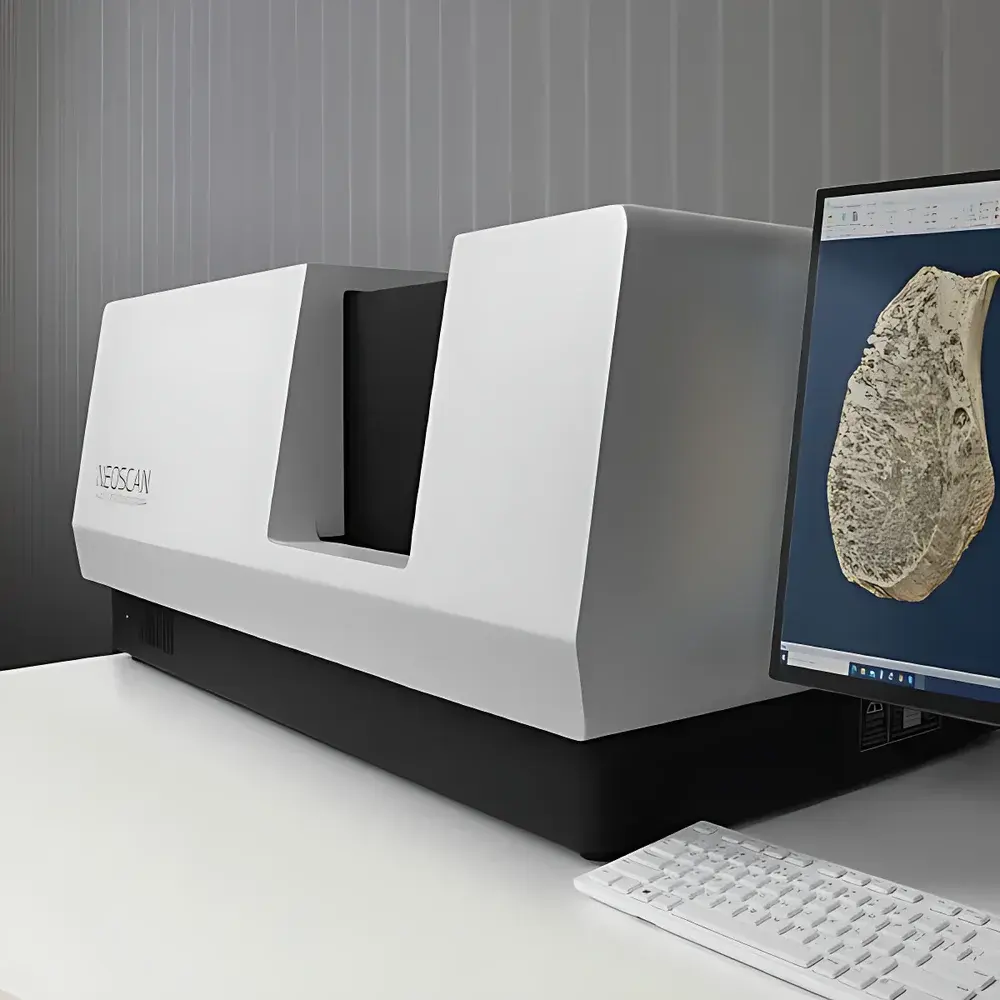
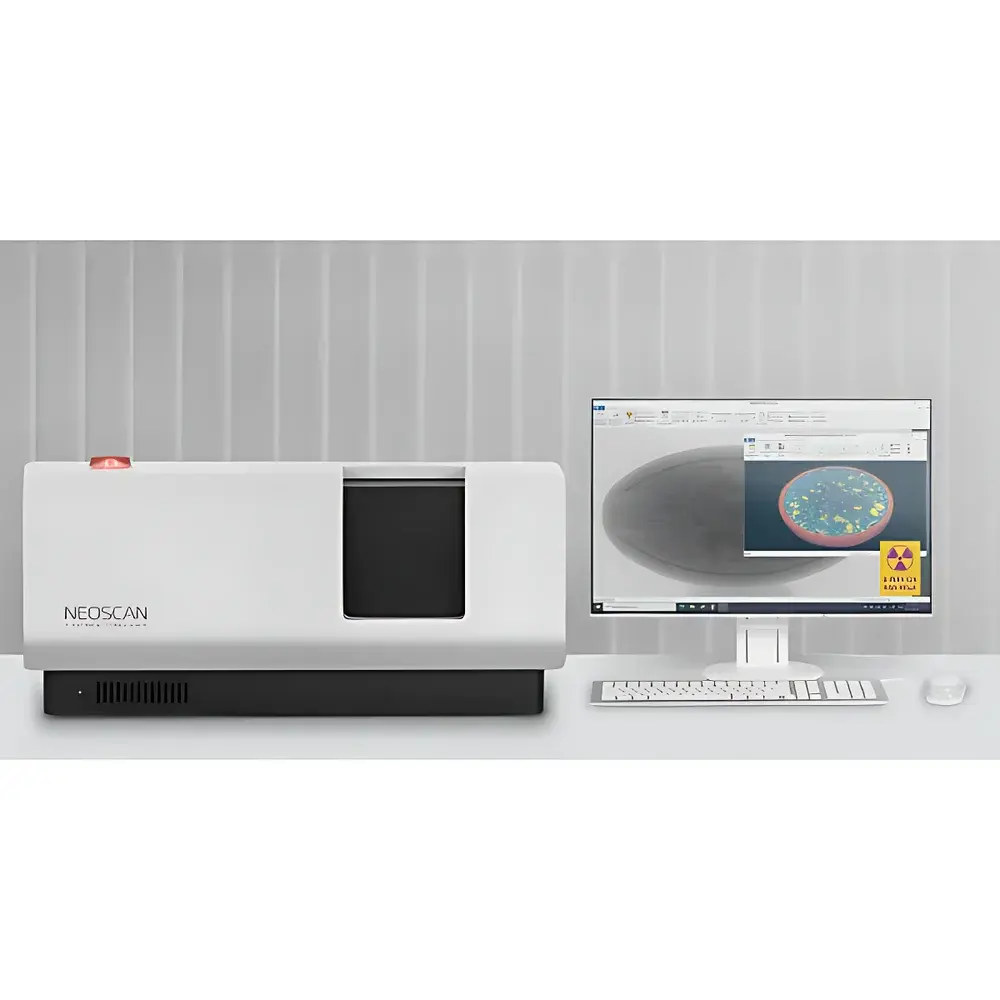
Neoscan N70 Benchtop Industrial Micro-CT System
| Brand | Neoscan |
|---|---|
| Origin | Belgium |
| Model | N70 |
| Detector Type | Flat-Panel Detector |
| Scan Mode | Rotation-Only (RO) |
| Spatial Resolution | 4 µm |
| X-ray Energy | 100 kV |
| Maximum Sample Dimensions | 100 mm × 120 mm (diameter × height) |
| Max Sample Weight | 20 kg |
| System Dimensions | 1050 mm × 607 mm × 463 mm |
| Accuracy | Micron-Level |
Overview
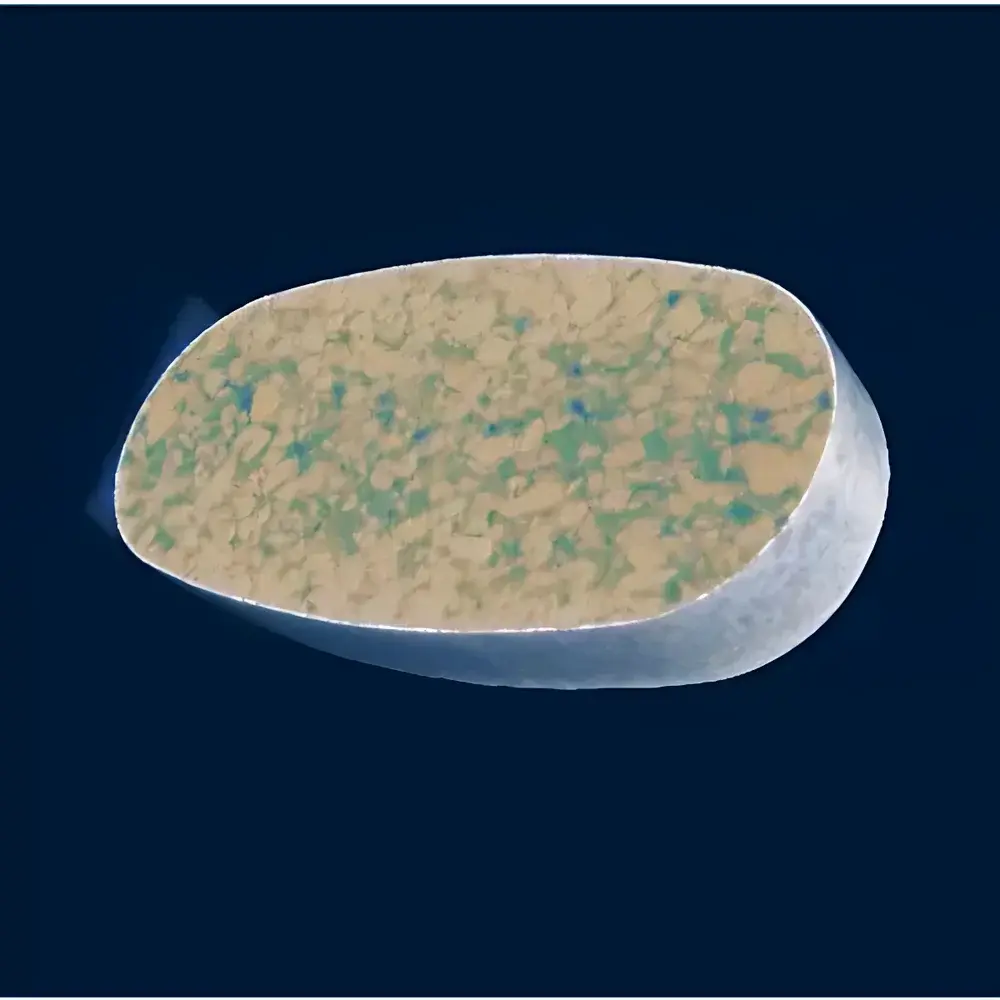
The Neoscan N70 Benchtop Industrial Micro-CT System is a high-performance, non-destructive 3D X-ray imaging platform engineered for precision internal structure characterization across research and industrial quality control environments. Based on cone-beam computed tomography (CBCT) principles, the N70 acquires hundreds of projection images as the sample rotates through 360° under a fixed microfocus X-ray source and flat-panel detector—enabling full volumetric reconstruction without mechanical translation or complex motion sequences. Its rotation-only (RO) scanning architecture ensures mechanical stability, repeatability, and minimal vibration-induced artifacts—critical for micron-level spatial resolution and quantitative density fidelity. Designed and manufactured in Belgium, the system integrates a 100 kV microfocus X-ray source with a high-dynamic-range 7-megapixel flat-panel detector to deliver isotropic voxel datasets with <4 µm effective spatial resolution, supporting both qualitative morphological inspection and rigorous quantitative analysis of density gradients, porosity distribution, and structural integrity.
Key Features
- High-Resolution Imaging Engine: Optimized 100 kV microfocus X-ray source coupled with a low-noise, large-area flat-panel detector enables high-contrast, low-artifact projection acquisition—even for dense or heterogeneous samples such as metal composites, sintered ceramics, or reinforced polymers.
- Large Sample Chamber: Accommodates specimens up to 100 mm in diameter and 120 mm in height (with optional extended-height configurations), supporting oversized components including battery cells, printed circuit board assemblies, geological core segments, and orthopedic implants—without requiring sectioning or destructive preparation.
- Micron-Level Metrological Accuracy: Engineered mechanical rigidity, thermally stable gantry design, and sub-pixel image registration algorithms ensure reproducible dimensional measurements traceable to ISO 12798 and ASTM E1441 standards for micro-CT metrology.
- Benchtop Footprint & Operational Efficiency: Compact dimensions (1050 × 607 × 463 mm) allow integration into standard laboratory spaces; rapid scan protocols reduce typical acquisition time to under 20 minutes for full-volume reconstructions at 8 µm voxel size—enhancing throughput for iterative QA/QC workflows.
- Robust Mechanical Load Capacity: Precision air-bearing rotation stage supports up to 20 kg payload while maintaining angular accuracy <0.01°, ensuring geometric fidelity for heavy industrial parts and composite laminates.
Sample Compatibility & Compliance
The N70 accepts a broad spectrum of sample types—including rigid solids (metals, ceramics, concrete), semi-rigid biological tissues (bone, teeth, plant stems), porous media (foams, filters, soils), and electronic assemblies—without chemical fixation or conductive coating. Its non-destructive nature complies with GLP and GMP-aligned documentation requirements for repeatable longitudinal studies. The system meets IEC 61000-6-3 (EMC) and IEC 61000-6-4 emission standards; radiation shielding conforms to EU Directive 2013/59/Euratom for Class IIb equipment. Data integrity protocols support audit trails compliant with FDA 21 CFR Part 11 when paired with validated software modules.
Software & Data Management
The integrated Neoscan CT Suite provides end-to-end workflow management—from parameter-driven scan planning and real-time projection monitoring to GPU-accelerated Feldkamp-Davis-Kress (FDK) reconstruction, multi-threshold segmentation, and quantitative morphometry. All software modules are included at no additional cost and receive regular feature updates aligned with ISO/IEC 17025-compliant validation frameworks. Export formats include DICOM, TIFF stacks, STL (for simulation-ready mesh generation), and HDF5 (for AI/ML training pipelines). Batch processing, scripting via Python API, and DICOM-RT export enable seamless integration into digital twin and predictive maintenance platforms.
Applications
- Materials Science: Quantification of void content, crack propagation paths, and interfacial debonding in additively manufactured alloys; pore network modeling in lithium-ion battery electrodes and solid-state electrolytes.
- Life Sciences: In vivo–compatible small-animal skeletal phenotyping; dental implant osseointegration assessment; 3D histomorphometry of trabecular bone architecture per ASBMR guidelines.
- Electronics & Automotive: Detection of solder voids (<50 µm) in BGA packages; analysis of thermal interface material delamination; porosity mapping in aluminum die-cast engine blocks per ASTM E155.
- Geosciences & Energy: Pore-throat connectivity analysis in reservoir rock analogs; grain-size distribution and cementation index derivation from sandstone cores.
- Pharmaceutical Development: Tablet tensile strength correlation with internal pore morphology; capsule shell thickness uniformity mapping; dissolution rate modeling from 3D porosity gradients.
- Archaeology & Paleontology: Virtual extraction of fossilized structures embedded in matrix; non-invasive stratigraphic layer analysis of cultural artifacts.
FAQ
What is the minimum detectable feature size under standard operating conditions?
The N70 achieves an effective spatial resolution of ≤4 µm under optimized acquisition parameters (e.g., magnification mode, exposure time, and binning). Minimum resolvable features depend on contrast-to-noise ratio and sample attenuation properties; typical practical detection limit for high-contrast interfaces is ~2–3 µm.
Can the system perform dimensional metrology certified to ISO 15530-3?
Yes—the N70’s mechanical stability, calibrated geometry model, and traceable reconstruction pipeline support compliance with ISO 15530-3 for CT-based coordinate measurement, provided user-performed system verification using certified reference objects (e.g., NIST SRM 2089a) is documented.
Is dual-energy scanning supported?
No—the N70 operates with a single fixed 100 kV X-ray source. Material decomposition applications require post-reconstruction spectral analysis using multi-threshold segmentation or machine-learning-based classification trained on known reference materials.
Does the software support automated defect recognition (ADR) workflows?
The CT Suite includes rule-based defect detection tools (e.g., void clustering, wall thickness deviation maps); integration with third-party ADR engines (e.g., NVIDIA Clara, Siemens Teamcenter Insights) is enabled via DICOM and Python API.
What maintenance schedule is recommended for long-term stability?
Annual preventive maintenance by Neoscan-certified engineers is advised—including X-ray tube performance calibration, detector gain correction, and mechanical alignment verification—to sustain micron-level geometric accuracy and dose consistency over >5 years of operation.



