
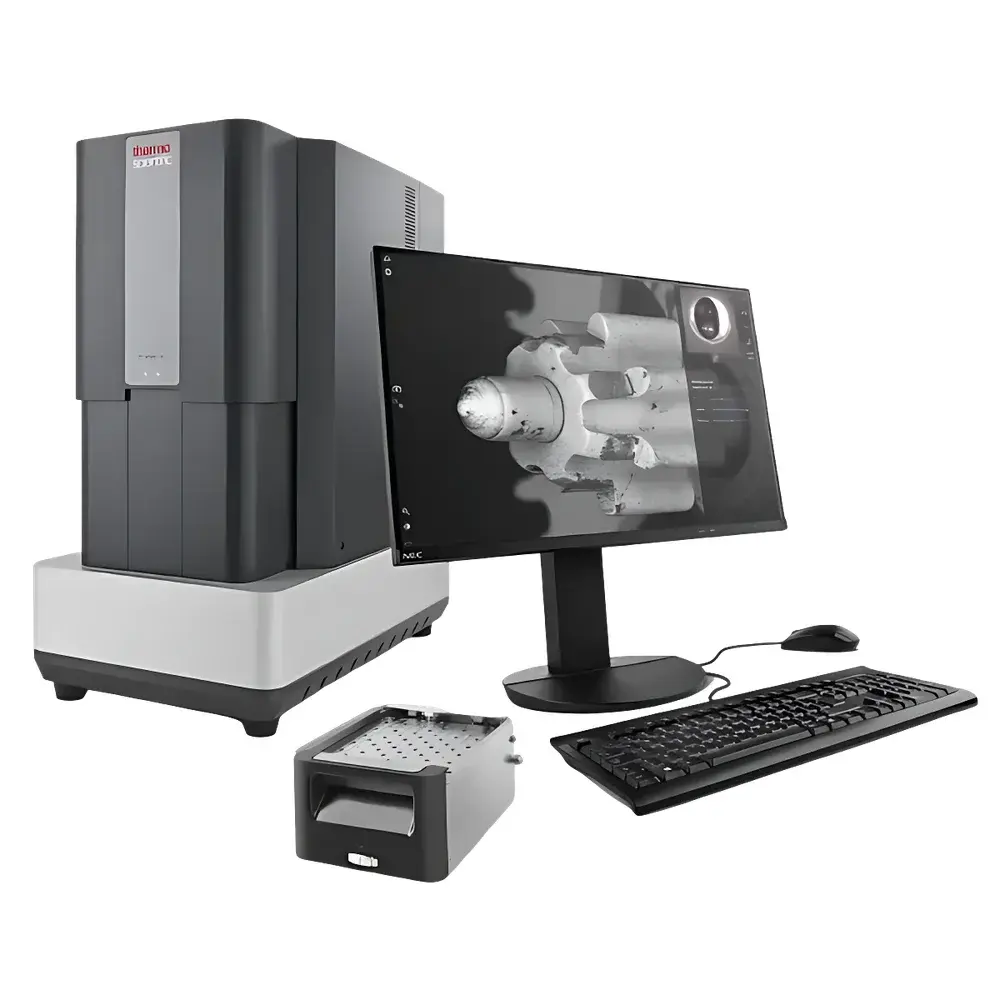
Phenom Desktop Scanning Electron Microscope (Domestic Production Model)
| Brand | Phenom |
|---|---|
| Origin | Netherlands (Manufactured in Guangzhou, China) |
| Type | Benchtop SEM |
| Electron Source | Cerium Hexaboride (CeB6) |
| SEM Class | Entry-level Field Emission / Tungsten-Filament Hybrid Architecture |
| Secondary Electron Resolution | 8 nm @ 20 kV |
| Backscattered Electron Resolution | 8 nm @ 20 kV |
| Magnification Range | 20× – 200,000× |
| Accelerating Voltage | 4.8 – 20.5 kV |
| Vacuum Pumping Time | ≤15 s |
Overview
The Phenom Desktop Scanning Electron Microscope (Domestic Production Model) is a benchtop SEM engineered for precision, reliability, and operational accessibility in academic laboratories, quality control environments, and industrial R&D settings. Built upon the established Phenom platform architecture and co-developed under Thermo Fisher Scientific’s global technology transfer framework, this model retains full alignment with the original Dutch-designed optical and vacuum specifications—while being manufactured at Thermo Fisher’s integrated R&D and production facility in Huangpu District, Guangzhou, China. Its imaging principle relies on scanning a focused electron beam across conductive or metallized samples, detecting secondary electrons (SE) and backscattered electrons (BSE) to generate high-fidelity topographic and compositional contrast images. The CeB6 thermionic electron source delivers stable emission current and superior brightness compared to conventional tungsten filaments—enabling consistent 8 nm resolution at 20 kV without requiring ultra-high vacuum or cryogenic cooling. This architecture bridges performance expectations of entry-level field-emission systems with the robustness and cost-efficiency of thermionic platforms.
Key Features
- Stable cerium hexaboride (CeB6) electron source with typical operational lifetime exceeding 1,500 hours—reducing filament replacement frequency and minimizing downtime.
- Benchtop form factor with integrated vibration-damping mechanical design and active magnetic shielding—eliminating the need for external anti-vibration tables or Faraday cages; suitable for placement on standard lab benches, office floors, or near production lines.
- Ultra-rapid vacuum cycle: chamber reaches operational pressure (<10⁻³ mbar) in ≤15 seconds via turbomolecular pumping—enabling rapid sample turnover and high-throughput workflows.
- Unified hardware-software integration: SEM imaging and optional energy-dispersive X-ray spectroscopy (EDS) modules share a single control interface and data acquisition engine—ensuring synchronized spatial registration and quantitative correlation.
- Native bilingual support: fully localized Chinese graphical user interface (GUI), context-sensitive help system, and comprehensive technical documentation—including ASTM E1558-compliant operating procedures and ISO/IEC 17025 traceability guidance.
Sample Compatibility & Compliance
The Phenom Domestic Production Model accommodates a broad range of solid specimens up to 100 mm in diameter and 50 mm in height—including metals, ceramics, polymers, geological sections, biological tissues (after conductive coating), and electronic components. Sample loading is facilitated by a motorized airlock stage with XYZ translation and tilt capability (±30°). All vacuum, electrical safety, and electromagnetic compatibility (EMC) subsystems comply with CE marking requirements per Directive 2014/30/EU and IEC 61000-6-3:2017. Manufacturing quality management adheres to ISO 9001:2015 standards, and factory calibration protocols are aligned with NIST-traceable reference materials. For regulated environments, the system supports audit-ready logging (per FDA 21 CFR Part 11 Annex 11 principles) when paired with validated software configurations.
Software & Data Management
Acquisition and analysis are performed using Phenom ProSuite v6.x—a modular, Windows-based application supporting real-time image acquisition, automated particle analysis, roughness quantification (ISO 25178-2), and EDS spectral processing (including peak deconvolution and matrix correction). All raw data (SEM images, EDS spectra, stage coordinates, vacuum logs) are stored in vendor-neutral HDF5 format with embedded metadata (EXIF-like structure), ensuring long-term archival integrity and third-party interoperability. Export options include TIFF, PNG, CSV, and Bruker ESPRIT-compatible .eds files. Remote monitoring and multi-user access are enabled via secure HTTPS API endpoints—compatible with institutional LIMS and ELN platforms.
Applications
This SEM serves as a primary characterization tool across diverse domains: failure analysis of PCB solder joints and semiconductor interconnects; morphology assessment of battery cathode/anode powders (e.g., NMC, SiOx); contamination identification in pharmaceutical excipients (per USP ); wear-track evaluation in tribology studies; and microstructural validation of additively manufactured metal parts (ASTM F3122-18). Its rapid turnaround and intuitive workflow make it especially suited for teaching labs, routine QC inspection, and cross-functional engineering teams requiring immediate microscale insight without dedicated microscopy staff.
FAQ
Is this instrument fully equivalent to the Netherlands-assembled Phenom models in performance?
Yes—the domestic production model meets identical specification thresholds for resolution, accelerating voltage stability, vacuum integrity, and detector quantum efficiency, verified through factory acceptance testing against master reference units.
Does the CeB6 source require special handling or training?
No—it operates at atmospheric pressure during loading and features automatic filament conditioning; no manual alignment or high-voltage tuning is required.
Can the system be upgraded with EDS post-purchase?
Yes—hardware预留 (pre-wired) ports and mechanical mounts support field installation of certified EDS detectors, with seamless firmware integration via ProSuite update.
What regulatory documentation is provided for GMP/GLP environments?
A complete validation package—including IQ/OQ protocols, calibration certificates, and electronic audit trail configuration guides—is available upon request and conforms to ISO/IEC 17025 and FDA 21 CFR Part 11 requirements.
Is remote diagnostics supported?
Yes—Thermo Fisher’s SecureConnect service enables encrypted remote assistance with customer-consented session initiation and full activity logging.



