
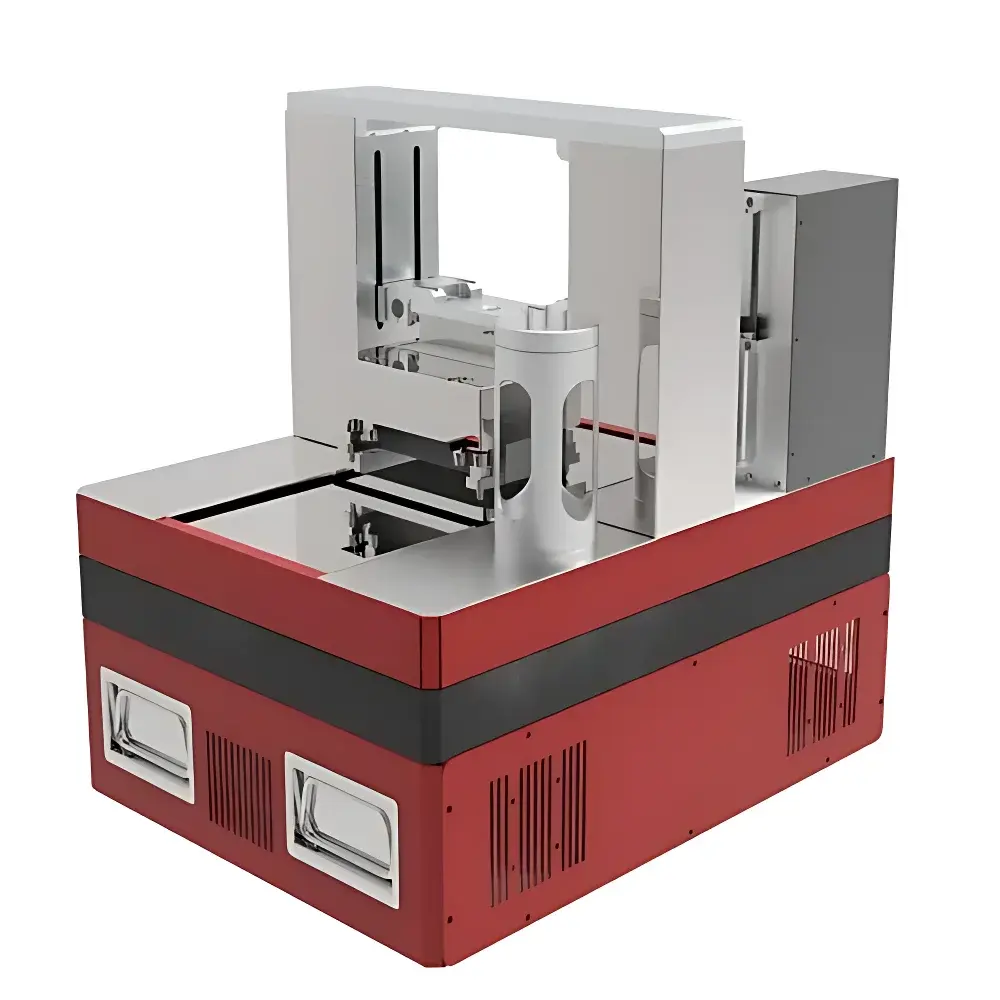
DT-2030 Slot Die Coater for Precision Thin-Film Deposition in Perovskite and Organic Photovoltaics
| Origin | Jiangsu, China |
|---|---|
| Manufacturer Type | Authorized Distributor |
| Origin Category | Domestic (China) |
| Model | DT-2030 |
| Pricing | Upon Request |
| Effective Coating Width | 200 mm |
| Wet Film Thickness Range | 10–200 µm |
| Dry Film Thickness Range | 0.5–10 µm |
| Solid Content | 10–50% w/w |
| Viscosity Range | 1–20,000 cP |
| Coating Speed | 0–100 mm/s |
| Dispense Flow Rate | 0.1–60 mL/min |
| Reservoir Capacity | 50 mL |
| Z-Axis Fine Adjustment Range | 0–10 mm (0.001 mm resolution) |
| Z-Axis Coarse Adjustment Range | 0–50 mm |
| Slot Nozzle Gap Options | 0.05 / 0.08 / 0.1 mm (via precision shims) |
| Substrate Platform Area | 220 × 220 mm |
| Active Coating Area | 200 × 200 mm |
| Stage Flatness | ±1.5 µm |
| Nozzle Levelness | ±2 µm |
| Optional Heated Stage | Up to 200 °C (±2 °C stability) |
| Power Supply | AC 220 V, 50 Hz |
Overview
The DT-2030 Slot Die Coater is an engineered solution for controlled, scalable thin-film deposition via precision slot die coating—a non-contact, pre-metered fluid delivery method grounded in laminar flow dynamics and meniscus-controlled wetting. Unlike spin coating or blade coating, slot die operates under steady-state hydrodynamic conditions where fluid extrusion through a narrow rectangular slit (defined by machined upper/lower dies and calibrated shim thickness) is synchronized with substrate translation. This enables deterministic film thickness calculation based on volumetric flow rate (Q), substrate velocity (v), and effective slot width (w): t = Q / (v × w). The system supports both R&D-scale formulation screening and pilot-line process transfer for functional layers in emerging optoelectronic devices—particularly perovskite photovoltaic (PVK) absorber layers, organic photovoltaic (OPV) active stacks, charge transport layers (HTL/ETL), and encapsulation barriers. Its modular architecture integrates fluid handling, motion control, environmental conditioning, and real-time parameter logging—designed for reproducibility, traceability, and alignment with GLP-compliant laboratory workflows.
Key Features
- Precision-engineered stainless-steel slot die head with interchangeable shims (0.05 / 0.08 / 0.1 mm) ensuring consistent gap geometry and chemical resistance to common PV solvents (e.g., DMF, DMSO, chlorobenzene, toluene).
- High-resolution Z-axis actuation (0.001 mm fine adjustment) coupled with dynamic height compensation to maintain constant die-to-substrate clearance during coating—critical for edge uniformity and defect minimization.
- Dual-stage motion control: independent programmable acceleration/deceleration profiles for X-axis die translation, enabling repeatable start/stop transitions without streaking or tailing artifacts.
- Integrated syringe pump system with pulseless flow delivery, inline filtration (0.2 µm PTFE), and real-time pressure monitoring to prevent clogging and ensure metering fidelity across viscosity ranges (1–20,000 cP).
- Heated substrate platform (optional, up to 200 °C, ±2 °C stability) with vacuum chucking for thermal management during solvent evaporation and crystallization kinetics studies.
- Modular add-ons include nitrogen purge nozzles, in-situ optical alignment aids (digital theodolite-compatible), dual-pump parallel dispensing, and edge-detection feedback loops for closed-loop thickness control.
Sample Compatibility & Compliance
The DT-2030 accommodates rigid and flexible substrates—including soda-lime glass, ITO/PEDOT:PSS-coated PET, stainless steel foils, and silicon wafers—within a 220 × 220 mm platform. Its low-fill-volume die design (<1.5 mL dead volume) reduces material waste and facilitates rapid formulation iteration. All wetted components comply with USP Class VI biocompatibility standards and resist corrosion from halogenated, polar aprotic, and protic solvents. The system supports documentation protocols aligned with ISO/IEC 17025 calibration traceability and meets hardware prerequisites for FDA 21 CFR Part 11–compliant data integrity when paired with validated third-party SCADA software. Process parameters—including flow rate, speed, temperature, and Z-gap—are timestamped and exportable in CSV/Excel formats for audit-ready reporting.
Software & Data Management
A dedicated Windows-based control interface provides recipe-driven operation with hierarchical user access levels (operator, engineer, administrator). Each coating run logs >20 synchronized channels—including motor encoder position, pump displacement, stage temperature, vacuum pressure, and real-time flow sensor output—at 100 Hz sampling. Data is stored locally with optional network backup and supports post-run analysis of thickness uniformity (RMS deviation), edge roll-off profiles, and flow-rate vs. speed linearity. Export modules generate ASTM E29–compliant reports and integrate with LIMS platforms via OPC UA or REST API. Audit trails record all parameter modifications, user logins, and emergency stops—enabling full GxP compliance for regulated development environments.
Applications
The DT-2030 serves as a bridge between lab-scale discovery and manufacturing readiness across multiple advanced material domains: perovskite solar cell fabrication (MAPbI₃, FAPbI₃, mixed-cation absorbers); OPV bulk heterojunction deposition (PM6:Y6, PTB7-Th:PC₇₁BM); OLED emissive and transport layer patterning; anti-reflective and hard-coat functional films for display cover glass; conductive polymer electrodes (PEDOT:PSS, AgNW dispersions); solid-state electrolyte coatings for Li-metal batteries; and microstructured optical films (BEF, DBEF, diffusion layers). Its scalability allows direct correlation of R&D results to roll-to-roll (R2R) production parameters—reducing technology transfer risk for pilot lines targeting CIGS, CdTe, and printed electronics.
FAQ
What substrate sizes and types are supported?
Standard platform accommodates substrates up to 220 × 220 mm; custom larger stages (up to 600 mm width) are available upon request. Compatible substrates include glass, silicon, metal foils, and polymer films with surface energy ≥38 mN/m.
Can the system handle high-viscosity inks (>10,000 cP)?
Yes—equipped with high-torque syringe pumps and heated fluid paths (optional up to 80 °C), the DT-2030 maintains stable extrusion for shear-thinning formulations used in paste-based electrode printing.
Is remote monitoring or integration with factory MES possible?
All digital I/O and communication ports (Ethernet, RS-485, USB) support third-party SCADA integration. Remote desktop access and cloud-based telemetry require customer-defined cybersecurity protocols.
What maintenance intervals are recommended for the slot die head?
Shim inspection and ultrasonic cleaning every 50 operating hours; full die disassembly and metrology verification annually or after 500 coating cycles—documented in the included maintenance logbook.
Does the system meet CE or UL safety certification?
The base configuration complies with IEC 61000-6-2/6-4 EMC standards and carries CE marking. UL 61010-1 certification is available for export-configured units with region-specific power modules and enclosure ratings.





