
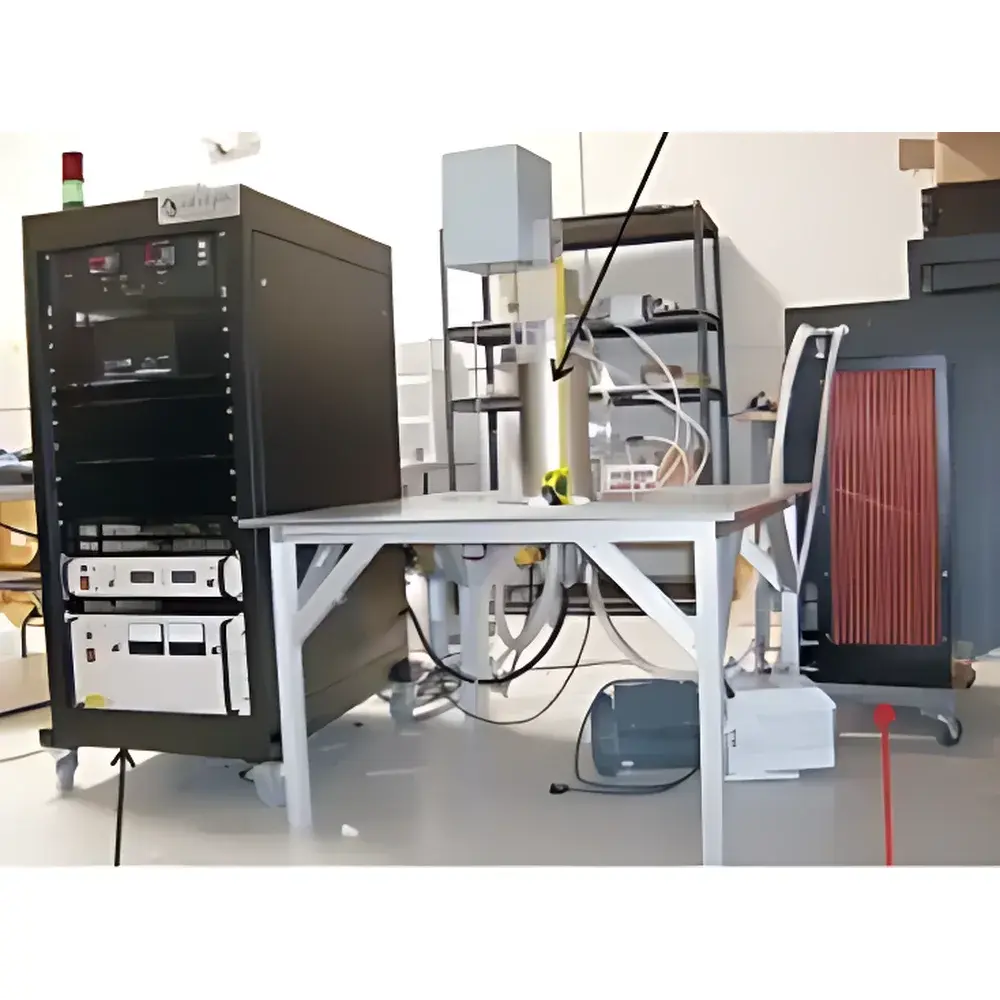
Neutron Generator DD110M / DD110 / DD109M / DD109
| Origin | USA |
|---|---|
| Manufacturer Type | Authorized Distributor |
| Origin Category | Imported |
| Model | DD110M / DD110 / DD109M / DD109 |
| Quotation | Upon Technical Specification Review |
| Neutron Yield (DD110M) | 1 × 10¹⁰ n/s |
| Thermal Neutron Flux (DD110M) | 1 × 10⁷ n/cm²/s |
| Neutron Yield (DD109M) | 2 × 10⁹ n/s |
| Thermal Neutron Flux (DD109M) | 2 × 10⁶ n/cm²/s |
| Primary Neutron Energy | 2.5 MeV (D–D fusion) |
| Operational Mode | Continuous or Pulse-on-Demand (≥ 50 µs pulse width, optional) |
| Mean Time Between Maintenance | ≥ 2000 hours |
| Key Consumables | Replaceable deuterium target, vacuum pump assembly |
| Safety | Interlocked beam shutter, vacuum interlock, radiation-free at standby |
Overview
The DD110M, DD110, DD109M, and DD109 series are compact, sealed-tube neutron generators based on deuterium-deuterium (D–D) fusion reactions. These instruments produce 2.5 MeV fast neutrons via electrostatic acceleration of deuterium ions onto a deuterated target, followed by integrated polyethylene–cadmium–borated slow-down and thermalization within a single monolithic housing. Unlike isotopic neutron sources or reactor-based facilities, this system operates only when powered and under active vacuum—eliminating residual radioactivity during idle periods. The design achieves thermal neutron fluxes comparable to medium-flux research reactors (e.g., 1 × 10⁷ n/cm²/s at the sample plane for DD110M), enabling laboratory-scale access to high-intensity thermal neutron beams without nuclear licensing, shielding vaults, or regulatory oversight typical of fission-based infrastructure.
Key Features
- Monolithic integration: Neutron tube, moderator/reflector assembly (polyethylene + Cd/B₄C layers), and beam exit port co-located in a single <30 cm × 30 cm × 45 cm enclosure—minimizing footprint and simplifying installation in standard Class 1000 cleanrooms or university laboratories.
- Vacuum-enabled operation: Integrated two-stage vacuum system maintains ≤1 × 10⁻⁵ Torr pressure during operation, ensuring stable ion beam current, reproducible neutron yield, and extended target lifetime.
- Thermal neutron delivery: Optimized moderator geometry enables >85% thermalization efficiency; thermal neutrons (E < 0.5 eV) extracted directly through a borosilicate-glass or aluminum collimator port aligned with user-defined sample positions.
- Operational flexibility: Standard continuous-mode output; optional pulse-on-demand capability with programmable gate timing (≥50 µs minimum pulse width, jitter < 10 ns) for time-of-flight (TOF) experiments or radiation-hardness testing.
- Maintenance architecture: Field-replaceable components include deuterium target cartridge, vacuum pump module, and high-voltage feedthrough seals—supporting ≥2000 hours of cumulative beam-on time before scheduled service.
- Safety-by-design: Dual redundant interlocks (vacuum pressure + beam current monitoring), fail-safe shutter actuation (<50 ms closure), and zero neutron emission at standby comply with ANSI N43.3 and IEC 61000-4-2 requirements for non-nuclear laboratory devices.
Sample Compatibility & Compliance
The generator supports diverse sample configurations—including open-beam irradiation, enclosed sample chambers (up to Ø100 mm × 50 mm depth), and collimated beamlines (5–20 mm diameter, L/D ≥ 10). All models meet ISO/IEC 17025 traceability requirements for neutron fluence rate calibration when used with NIST-traceable activation foils (e.g., Au, In, Cu). Thermal neutron spectra are characterized per ASTM E261–22 (Standard Practice for Determining Neutron Fluence by Radioactivation Techniques). No radioactive source declaration is required under U.S. NRC 10 CFR Part 30 or EU Directive 2013/59/Euratom, as the device produces no persistent radionuclides and emits no gamma radiation beyond inherent bremsstrahlung (<10 keV).
Software & Data Management
Control is managed via Ethernet-connected embedded Linux controller running real-time RTOS firmware. The GUI (Windows/macOS/Linux compatible) provides remote monitoring of beam current, vacuum status, target temperature, and pulse timing parameters. All operational logs—including timestamped neutron yield estimates, interlock events, and maintenance alerts—are stored in CSV/SQLite format with SHA-256 integrity hashing. Audit trails comply with FDA 21 CFR Part 11 requirements when configured with optional PKI-based user authentication and electronic signature modules. Raw data export supports HDF5 formatting for integration with Mantid, McStas, or custom Monte Carlo workflows.
Applications
- Neutron Radiography & Tomography: High-contrast imaging of hydrogen-rich materials (e.g., lubricants in turbine blades, water ingress in composites) using Gd- or Li-based scintillators and scientific CMOS detectors.
- Radiation Effects Testing: Single-event effect (SEE) and total ionizing dose (TID) qualification of microelectronics per MIL-STD-883H Method 1019 and ESA/SCC Basic Specification No. 22900.
- Shielding Material Development: Empirical validation of neutron attenuation coefficients for novel boron-carbide–epoxy composites or metal hydride-based barriers.
- Neutron Detector Characterization: Absolute efficiency calibration of ³He tubes, CLYC scintillators, or GEM-based thermal neutron sensors across defined flux gradients.
- Neutron Imaging Research: Implementation of coded-aperture, phase-contrast, or energy-resolved modalities requiring stable, pulsed thermal neutron beams.
FAQ
Does this device require a nuclear license or radioactive material registration?
No. As a vacuum-powered D–D fusion source with no persistent radioisotopes, it is exempt from national nuclear regulatory frameworks including U.S. NRC, UK ONR, and German BfS licensing requirements.
What is the expected lifetime of the deuterium target under continuous operation?
Rated for ≥2000 hours at nominal beam current (DD110M: 1.2 mA); replacement kits include recalibration certificate and vacuum bake-out protocol.
Can thermal neutron flux be spatially mapped across the sample plane?
Yes—using calibrated activation foil arrays or scanning fission chambers; detailed flux mapping protocols are provided in the Instrument Qualification Package (IQP).
Is pulse timing synchronized to external triggers (e.g., accelerator RF, detector gates)?
Yes—the optional Pulse Synchronization Module provides TTL-compatible input/output with <5 ns jitter relative to beam onset.
How is radiation safety verified during commissioning?
On-site survey includes neutron/gamma dose rate mapping per ISO 8529-1, followed by issuance of a Radiation Safety Certificate compliant with IAEA SSG-46 guidelines.







