
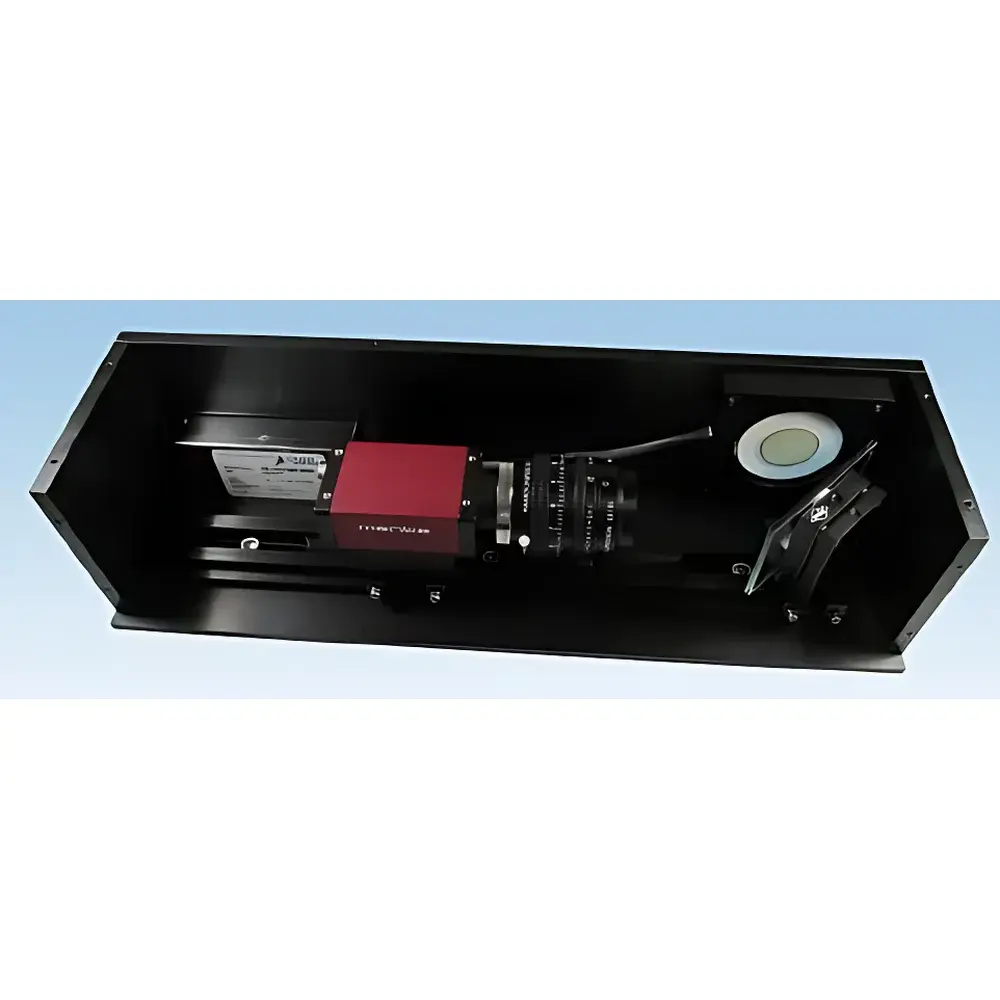
Neutron Imaging Camera NDCam-ND25/ND40 with Microchannel Plate Detector
| Origin | Germany |
|---|---|
| Manufacturer Type | Authorized Distributor |
| Origin Category | Imported Instrument |
| Model | ND25 / ND40 |
| Pricing | Upon Technical Consultation |
Overview
The NDCam Neutron Imaging Camera is a high-performance, research-grade neutron radiography and tomography system engineered for non-destructive evaluation (NDE) and quantitative neutron imaging in scientific, industrial, and regulatory environments. Built around a next-generation microchannel plate (MCP) neutron-sensitive detector architecture, the system operates via thermal and cold neutron conversion—leveraging 10B or Gd-based neutron-absorbing layers coupled to high-gain electron multiplication and low-noise CCD readout. Unlike scintillator-based systems, the MCP detector provides intrinsic sub-50 µm spatial resolution without optical coupling losses, enabling high-fidelity edge detection and contrast sensitivity for hydrogen-rich, low-Z, or radiation-opaque materials. The 45° mirror optics configuration ensures optimal beamline integration at reactor- or accelerator-based neutron sources (e.g., ILL, FRM II, ORNL SNS), minimizing footprint while preserving geometric magnification fidelity and minimizing parallax error.
Key Features
- Modular MCP-based neutron detection platform compatible with both thermal and cold neutron spectra (λ = 0.1–2.0 nm)
- Dual-format imaging capability: ND25 (25 mm active diameter) and ND40 (40 mm active diameter), scalable to larger formats upon beamline integration
- Optimized 45° off-axis mirror optics for direct beamline coupling; eliminates neutron scatter from lens elements and preserves beam collimation
- 1.4 Mpix scientific-grade CCD sensor (optional upgrade to back-illuminated sCMOS with >80% QE in visible range) synchronized to neutron pulse timing
- Real-time frame rates up to 10 Hz (depending on neutron flux and integration time), supporting dynamic in-situ studies (e.g., water transport in fuel cells, lithium diffusion in batteries)
- Robust mechanical housing with vacuum-compatible flange interfaces (CF-63/CF-100) and integrated thermal stabilization for long-exposure stability
Sample Compatibility & Compliance
The NDCam system supports a broad range of sample geometries—from mm-scale biological specimens to cm-scale engineering components (e.g., turbine blades, additive-manufactured alloys, nuclear fuel cladding). Its high neutron detection efficiency (>35% at 25 meV for 10B-MCP variants) and low gamma sensitivity (<1 × 10⁻⁴ γ/e−) ensure reliable imaging in mixed-radiation fields. The platform complies with ISO 17025 requirements for measurement traceability when operated under controlled beam conditions, and supports audit-ready metadata logging per GLP/GMP-aligned workflows. For nuclear safety applications, it meets IAEA-TECDOC-1890 guidelines for neutron imaging system characterization and is routinely deployed in EURATOM-funded safeguards verification programs.
Software & Data Management
Acquisition and reconstruction are managed through NDCam Control Suite v4.x—a cross-platform application built on Qt and HDF5-based data persistence. The suite supports live histogram equalization, flat-field correction, ring artifact suppression (for CT), and DICOM export for medical or archaeological archival. All raw frames include embedded beam monitor signals, shutter timing stamps, and environmental sensor logs (temperature, pressure, humidity). Audit trails comply with FDA 21 CFR Part 11 requirements via role-based access control, electronic signatures, and immutable acquisition logs. Tomographic reconstructions leverage GPU-accelerated FDK and iterative SART algorithms with optional phase-retrieval modules for edge-enhanced contrast.
Applications
- Nuclear materials inspection: cladding integrity, hydride distribution in Zr-alloys, irradiation-induced void swelling quantification
- Energy research: real-time visualization of H2O/O2 distribution in PEM fuel cells, Li-ion battery electrode wetting dynamics
- Archaeometry & paleontology: internal morphology mapping of fossilized bone, ceramic porosity analysis without destructive sectioning
- Biomedical imaging: soft-tissue contrast enhancement in small-animal models using neutron capture radiography (NCR) with 157Gd agents
- Industrial NDT: corrosion under insulation (CUI), adhesive bondline integrity in aerospace composites, additive manufacturing defect screening
FAQ
What neutron source types is the NDCam compatible with?
The system is designed for steady-state reactor beams (e.g., tangential or radial beamlines) and pulsed spallation sources. Optics and detector gating support both continuous and time-of-flight (TOF) modalities.
Does the system support neutron tomography?
Yes—fully integrated with motorized rotation stages (±0.005° repeatability) and supports cone-beam and parallel-beam CT reconstruction pipelines.
Is calibration traceable to national standards?
Spatial calibration uses NIST-traceable grid phantoms; neutron fluence calibration is performed via foil activation or fission chamber cross-check per ASTM E2698.
Can the NDCam be integrated into existing beamline control systems?
It provides EPICS IOC support, Tango device server compatibility, and RESTful API endpoints for remote orchestration within large-scale facility control frameworks.
What maintenance intervals are recommended for the MCP detector?
Under typical reactor beam operation (≤1 × 10⁸ n/cm²/s), MCP gain stability exceeds 12 months; annual vacuum integrity verification and gain mapping are advised.






