
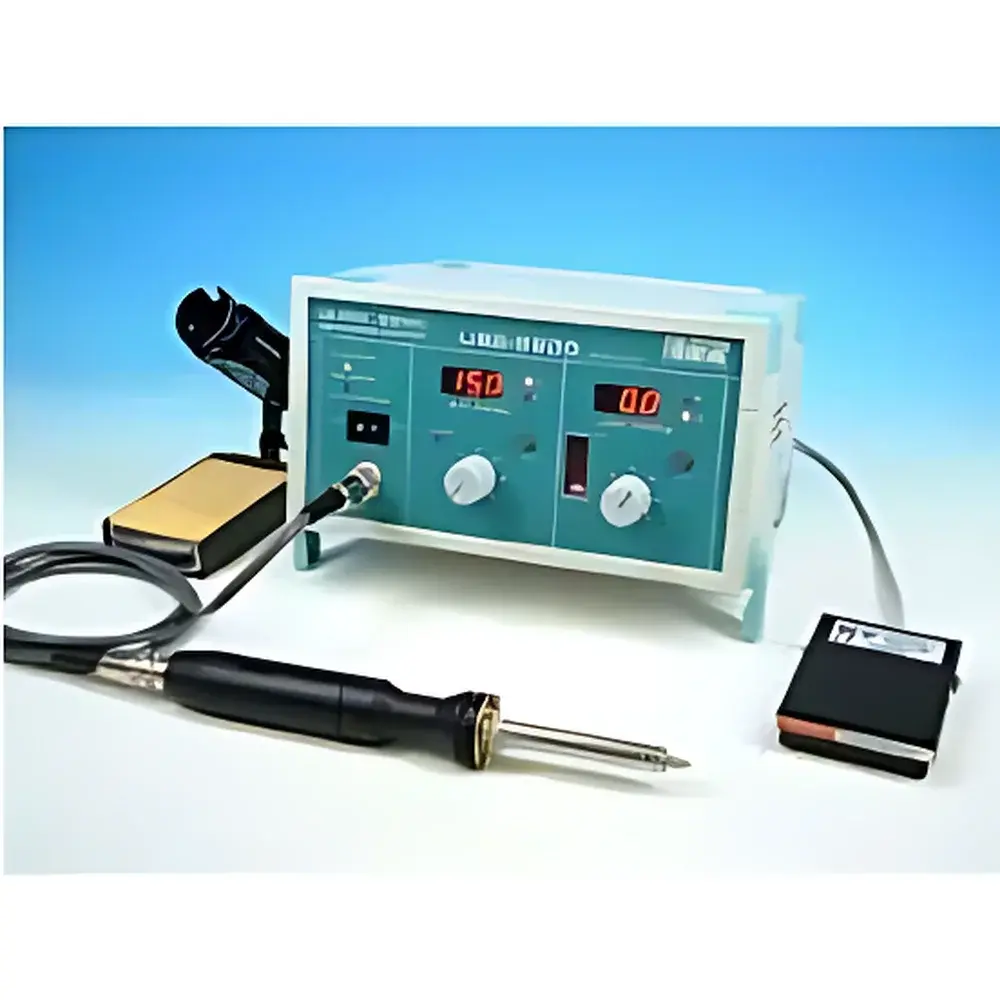
USS-9210 Ultrasonic Spot Welding System for Precision Micro-Joining of Metals
| Origin | Switzerland |
|---|---|
| Manufacturer Type | Authorized Distributor |
| Origin Category | Imported Equipment |
| Model | USS-9210 |
| Pricing | Available Upon Technical Inquiry |
Overview
The USS-9210 Ultrasonic Spot Welding System is an engineered solution for high-precision, low-heat micro-welding of dissimilar and thermally sensitive metallic foils and fine wires. Unlike resistance or laser welding, this system employs high-frequency mechanical vibration (60 kHz ±3 kHz) to induce solid-state bonding at the interface—without bulk melting, oxide disruption, or significant thermal input. The process relies on ultrasonic energy transmission through a ceramic-heated tungsten alloy horn, generating localized plastic deformation and atomic diffusion under controlled normal force. Designed specifically for applications where thermal distortion, intermetallic compound formation, or substrate damage must be avoided, the USS-9210 meets the stringent requirements of microelectronics assembly, photovoltaic interconnection, and advanced sensor packaging.
Key Features
- Microprocessor-based control architecture with real-time resonance tracking and adaptive frequency compensation ensures consistent energy delivery across varying load conditions and tool wear.
- Ceramic-integrated heating element (80 W) enables simultaneous thermal assistance (150–480 °C) with ultrasonic vibration—critical for improving joint ductility in aluminum, magnesium, and tungsten wire bonding.
- Zero-crossing AC switching for heater control provides precise, noise-free temperature regulation with integrated resistance monitoring for closed-loop feedback.
- Compact benchtop design (240 × 130 × 200 mm; 3 kg) integrates seamlessly into cleanroom and R&D environments, with optional footswitch operation (2 m cable) for hands-free process initiation.
- Modular tooling interface supports rapid exchange of 3 mm diameter welding tips and accommodates custom horn geometries for application-specific joint configurations.
Sample Compatibility & Compliance
The USS-9210 is validated for joining thin-gauge metallic substrates ≤ 0.3 mm thickness—including Al, Mg, W, Cu, and Ni alloys—without requiring filler material or flux. It complies with IEC 61000-6-3 (EMC emission limits) and IEC 61000-6-2 (immunity to electrostatic discharge and fast transients). For regulated manufacturing environments, the system supports audit-ready documentation protocols compatible with ISO 9001:2015 quality management systems and GLP-compliant traceability when paired with external data logging hardware. While not certified to FDA 21 CFR Part 11 out-of-the-box, its analog control architecture permits integration with validated SCADA or MES platforms for electronic record retention.
Software & Data Management
The USS-9210 operates via embedded firmware with no proprietary software dependency. All operational parameters—including ultrasonic power output (4–12 W), dwell time, trigger threshold, and temperature setpoint—are adjustable via front-panel rotary encoder and LCD display. Process logs (timestamp, setpoints, and manual operator ID entry) are stored in non-volatile memory for up to 1,000 cycles. Export is supported via RS-232 serial interface (optional USB-to-serial adapter) for CSV-formatted export to third-party statistical process control (SPC) tools. No cloud connectivity or remote access functionality is included—ensuring full data sovereignty and alignment with industrial cybersecurity best practices (IEC 62443 Level 1).
Applications
- Wire bonding of Al/Mg/W leads to thin-film metallization on silicon wafers and flexible PCBs.
- Repair and rework of solder joints on multilayer printed circuit boards without delamination risk.
- Interconnection of aluminum busbars to silicon solar cells in photovoltaic module assembly lines.
- Hermetic sealing of MEMS sensor housings using nickel-iron alloy lids and Kovar frames.
- Joining of battery tab foils (e.g., Al to Cu current collectors) in pouch cell prototyping labs.
FAQ
Does the USS-9210 require compressed air or external cooling?
No—this is a self-contained, air-cooled system with passive heat dissipation from the ceramic heater block and ultrasonic transducer housing.
Can the system weld plastics?
No—the USS-9210 is specifically engineered for metallurgical bonding of conductive metals; it does not support thermoplastic welding, which requires different horn geometry, lower frequencies (20–40 kHz), and amplitude control.
What maintenance intervals are recommended?
Horn tip inspection every 5,000 cycles; transducer coupling grease replacement annually or after 10,000 operating hours; calibration verification against reference thermocouple and power meter every 6 months.
Is CE marking applicable?
Yes—the unit carries CE marking per Directive 2014/30/EU (EMC) and 2014/35/EU (LVD), with technical documentation available upon request from the authorized Swiss distributor.
Can multiple units be synchronized for multi-point welding?
Not natively—each USS-9210 operates as an independent station; synchronization requires external PLC-level coordination via dry-contact I/O signals (provided on rear panel).



