
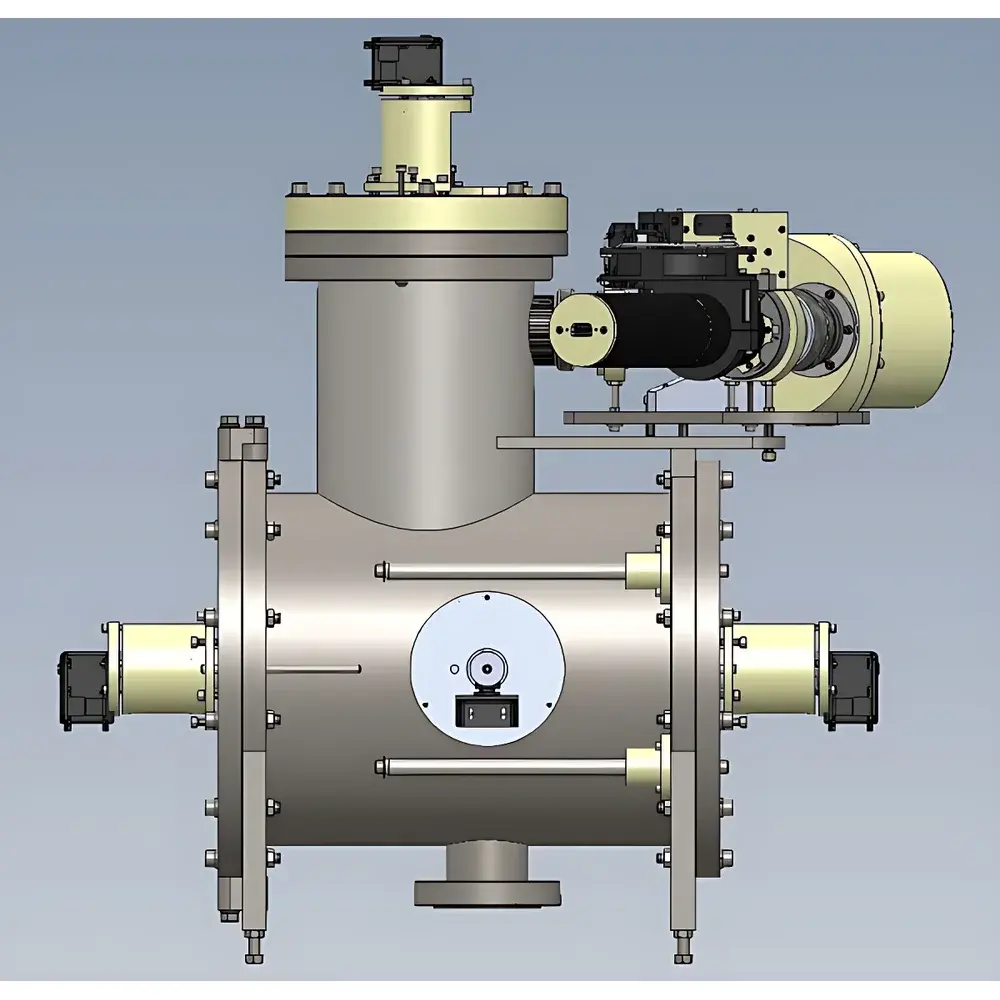
TES-300 UV-Vis Reflectance Spectrophotometer
| Origin | Canada |
|---|---|
| Manufacturer Type | Authorized Distributor |
| Origin Category | Imported |
| Model | TES-300 |
| Optical Design | Single-Beam |
| Detector | CCD Array |
| Wavelength Range | 104–1040 nm |
| Wavelength Selection | Manual Drive |
| Spectral Bandwidth | 10 nm |
| Wavelength Accuracy | ±0.01 nm |
| Stray Light | < 0.01% T |
| Grating | 1200 l/mm, Al/MgF₂ coated (optimized 100–300 nm), user-replaceable |
| Input Focal Length | 200 mm |
| Output Focal Length | 187.9 mm |
| F/# | 4.2 |
| Deviation Angle | 64° |
| Optimal Operational Range | 115–300 nm |
| Full Usable Range | 25–1000 nm (gold coating recommended below 100 nm) |
| Slit | Adjustable entrance and exit slits on dual-arm configuration |
| Grating Drive | Encoded Angular Encoder Grating Drive (AEGD) |
Overview
The TES-300 UV-Vis Reflectance Spectrophotometer is a precision single-beam optical instrument engineered for quantitative and qualitative measurement of spectral reflectance across the deep ultraviolet to near-infrared range (25–1040 nm). Designed for laboratory-based materials characterization, it employs a Czerny–Turner monochromator architecture with a user-interchangeable 1200 l/mm holographic grating, optimized with Al/MgF₂ coating for high throughput between 100–300 nm. The system utilizes a thermoelectrically stabilized CCD array detector to capture full-spectrum intensity data with high signal-to-noise ratio and excellent linearity. Its mechanical design—featuring independently adjustable entrance and exit slits mounted on dual symmetric arms—enables precise control over spectral resolution and radiant throughput. Unlike scanning photomultiplier-based systems, the TES-300 acquires spectra in a single exposure, minimizing drift-related artifacts and supporting repeatable reflectance ratio measurements against calibrated reference standards.
Key Features
- Single-beam optical path with manual wavelength selection via encoded angular encoder grating drive (AEGD), ensuring reproducible positioning accuracy within ±0.01 nm
- User-replaceable grating housed in a sealed, modular barrel assembly—supports rapid reconfiguration for alternate spectral ranges or resolution requirements
- Adjustable input and output slits on mechanically decoupled arms, allowing independent optimization of resolution (down to ~0.5 nm FWHM at 250 nm, dependent on slit width and grating dispersion)
- Al/MgF₂ coated grating optimized for 100–300 nm; gold-coated gratings available as optional accessories for enhanced performance below 100 nm
- Spectral bandwidth fixed at 10 nm (measured at 200 nm), compliant with ISO 9227 and ASTM E275 for standardized reflectance reporting
- Stray light level < 0.01% T at 220 nm, achieved through baffling, multi-stage filtering, and optimized optical train geometry
- Robust mechanical housing with temperature-stabilized optical bench, minimizing thermal drift during extended acquisition sequences
Sample Compatibility & Compliance
The TES-300 accommodates solid, thin-film, and powder samples using standard 1-inch diameter sample holders and optional integrating spheres (e.g., Labsphere RSA-UC-02) for diffuse reflectance measurements. It supports both specular and near-specular geometries (e.g., 8°/h geometry per ASTM E259) when paired with appropriate goniometric stages. All optical components comply with RoHS Directive 2011/65/EU and are certified for CE marking under EN 61326-1:2013 (EMC) and EN 61010-1:2010 (safety). Reflectance calibration traceability is maintained through NIST-traceable SRM 2036 (aluminum mirror) and SRM 1977 (diffuse reflectance standard), enabling compliance with ISO/IEC 17025:2017 requirements for accredited testing laboratories.
Software & Data Management
Instrument control and data acquisition are managed via SpectraView Pro v4.2 software, compatible with Windows 10/11 (64-bit). The application supports real-time spectrum preview, multi-point time-series acquisition, and automated baseline correction using Savitzky–Golay filtering. Export formats include ASCII (.csv), JCAMP-DX (.jdx), and HDF5 for interoperability with MATLAB, Python (SciPy), and LabVIEW environments. Audit trail functionality complies with FDA 21 CFR Part 11 requirements, including electronic signatures, user access levels, and immutable event logging for GLP/GMP-regulated environments. Raw CCD frames and processed reflectance ratios are stored with embedded metadata (wavelength calibration coefficients, slit positions, grating ID, ambient temperature/humidity).
Applications
- Thin-film thickness and optical constant determination (n, k) via Kramers–Kronig analysis of reflectance spectra
- UV-curable coating development and aging studies (degradation onset detection at 254 nm and 365 nm)
- Photocatalyst evaluation (TiO₂, ZnO) through bandgap estimation from Tauc plot derivation
- Quality assurance of anti-reflective and high-reflectance optical coatings in semiconductor lithography tooling
- Forensic pigment analysis in heritage conservation science (e.g., identification of cadmium sulfide vs. zinc sulfide in historical paints)
- Validation of solar reflectance indices (SRI) per ASTM E1980 for cool roof material certification
FAQ
Is the TES-300 suitable for measuring absolute reflectance?
Yes—when used with a NIST-traceable reference standard (e.g., SRM 2036) and proper alignment protocol, the TES-300 delivers absolute reflectance values with an expanded uncertainty of ≤0.4% (k=2) in the 200–800 nm range.
Can the grating be changed in the field without recalibration?
Yes—the AEGD system stores grating-specific calibration coefficients in non-volatile memory; swapping gratings requires only physical replacement and selection of the corresponding profile in SpectraView Pro.
What is the minimum measurable reflectance value?
With 10 s integration and optimized slit settings, the system achieves a noise floor of 0.003% R at 300 nm, enabling detection of low-reflectance absorbers such as black silicon or carbon nanotube arrays.
Does the instrument support fiber-optic coupling?
Optional SMA-905 fiber adapters are available for remote sampling; however, coupling efficiency drops below 150 nm due to silica fiber transmission limits—vacuum UV applications require direct free-space illumination.
Is technical support available outside North America?
Yes—authorized service partners operate in Germany, Japan, Singapore, and Brazil, providing on-site calibration, preventive maintenance, and ISO/IEC 17025-compliant validation documentation.






