
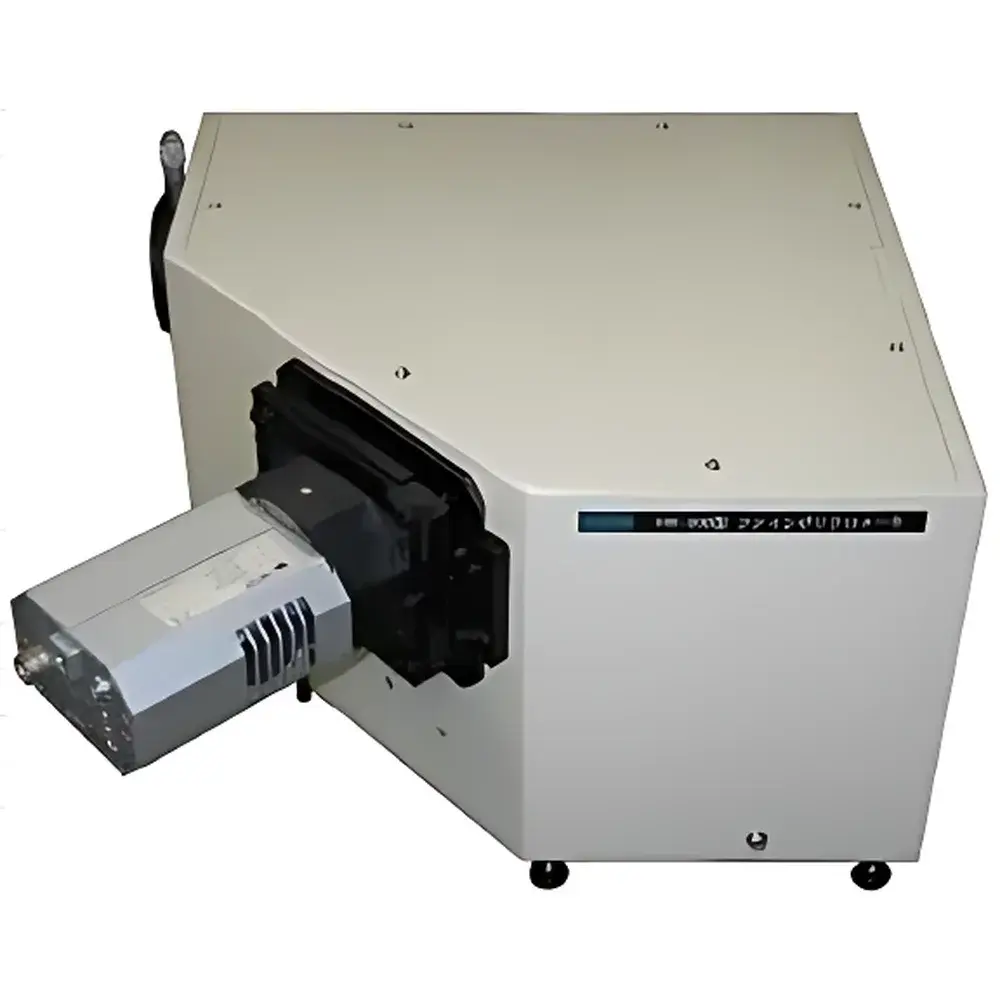
MK-300 Imaging Spectrograph
| Origin | Japan |
|---|---|
| Manufacturer Type | Authorized Distributor |
| Origin Category | Imported |
| Model | MK-300 |
| Price | USD 78,500 (FOB Yokohama) |
| Focal Length | 300 mm |
| Optical System | Aberration-Corrected Imaging Spectrograph |
| f-number | f/4.4 |
| Spectral Resolution (FWHM) | 0.2 nm (within 3 pixels) |
| Imaging Magnification | ~1.25× |
| Stray Light Level | ≤5×10⁻³ |
| Wavelength Accuracy | ±0.2 nm (within 3 pixels) |
| Wavelength Repeatability | ±0.2 nm (within 3 pixels) |
| Grating Exchange Repeatability | ±0.2 nm (within 3 pixels) |
| Spectral Range | 200–1000 nm (with 1200 lines/mm grating) |
| Mechanical Wavelength Coverage | 0–1200 nm |
| Wavelength Drive Mechanism | Sine-bar linear translation |
| Actuation | Stepper motor (PC-controlled via USB) |
| Grating Size | 50 × 50 mm |
| Max. Grating Capacity | 3 (motorized turret) |
| Slit Width Range | 0.01–4.00 mm (symmetrical, continuous, 0.01 mm resolution) |
| Shutter | Manual (optional motorized shutter available) |
| Software Interface | USB-connected wavelength control, scanning, and grating selection |
Overview
The MK-300 Imaging Spectrograph is a high-performance, aberration-corrected optical imaging spectrometer engineered for simultaneous spatial-spectral analysis in research and industrial metrology laboratories. Based on the Czerny–Turner optical architecture with proprietary off-axis parabolic collimation and focusing optics, it delivers diffraction-limited imaging performance across its full 200–1000 nm spectral range. Unlike conventional scanning monochromators or line-scan spectrometers, the MK-300 captures two-dimensional spectral images—preserving both spatial distribution and wavelength-resolved intensity information at each pixel. Its core design principle centers on minimizing astigmatism and coma while maintaining constant magnification and linear dispersion across the focal plane, enabling accurate pixel-to-wavelength calibration and robust multi-point spectral extraction from extended sources such as plasma plumes, semiconductor wafers, biological tissue sections, or fiber-coupled light bundles.
Key Features
- Aberration-corrected optical path optimized for high spatial fidelity and minimal spectral distortion across the entire imaging plane
- Motorized 3-position grating turret with sub-pixel repeatability (±0.2 nm), supporting rapid spectral range reconfiguration without realignment
- High-resolution variable slit (0.01–4.00 mm, symmetrical, micrometer-driven) enabling precise control of spectral bandwidth and throughput trade-offs
- Sine-bar wavelength translation mechanism ensuring linear, backlash-free, and hysteresis-free wavelength positioning over 0–1200 nm mechanical range
- Integrated stepper-motor actuation for fully automated grating selection, slit adjustment, and wavelength scanning—controlled exclusively via USB-hosted software
- Low stray light design (<5×10⁻³) achieved through internal baffling, blackened optical surfaces, and optimized grating blaze matching
- Modular detector interface compatible with standard scientific CCD, sCMOS, and EMCCD cameras (C-mount or F-mount options)
Sample Compatibility & Compliance
The MK-300 supports direct imaging of macroscopic and microscopic samples via fiber-optic coupling (multi-fiber bundles or single-mode fibers), free-space illumination (collimated or focused beam), or microscope-integrated configurations. It complies with ISO 14644-1 Class 5 cleanroom handling standards for optical alignment procedures and meets IEC 61000-4-3 immunity requirements for laboratory electromagnetic environments. While not intrinsically certified for GMP or FDA-regulated production environments, its deterministic wavelength repeatability (±0.2 nm), audit-ready software logging (via optional timestamped acquisition metadata), and traceable calibration protocols support GLP-compliant spectral validation workflows. Optional NIST-traceable calibration kits (Hg/Ne/Ar emission lines) are available for end-user verification per ASTM E275 and ISO/IEC 17025 guidelines.
Software & Data Management
The MK-300 is operated using vendor-supplied Windows-based control software (v4.2+), distributed as a signed 64-bit application with USB HID class driver support. Core functionalities include real-time grating selection, slit width presetting, wavelength sweep programming (linear/logarithmic step modes), and synchronized detector trigger output. All parameter changes are logged with timestamps and user IDs; raw spectral image data (FITS or TIFF format) embed EXIF-like metadata including grating ID, central wavelength, slit width, exposure time, and detector temperature. The software SDK (C/C++ and Python APIs) enables integration into custom LabVIEW, MATLAB, or Python-based automation frameworks. For regulated environments, optional 21 CFR Part 11-compliant audit trail modules provide electronic signature enforcement, role-based access control, and immutable acquisition logs.
Applications
- Plasma diagnostics: Time-resolved spectral mapping of emission lines (e.g., Hα, O II, N II) in laser-induced breakdown spectroscopy (LIBS) and arc discharge systems
- Photovoltaic characterization: Spatially resolved quantum efficiency (SRQE) and electroluminescence (EL) spectral profiling across solar cell substrates
- Biomedical imaging: Hyperspectral fluorescence lifetime mapping of tissue autofluorescence or labeled biomarkers in histopathology slides
- LED and OLED spectral homogeneity testing: Pixel-level chromaticity deviation analysis across display panels and micro-LED arrays
- Fiber-optic sensor interrogation: Simultaneous demultiplexing of wavelength-encoded FBG or LPG sensor arrays
- Remote sensing simulation: Laboratory validation of airborne/spaceborne hyperspectral imager response functions under controlled illumination
FAQ
What detector types are compatible with the MK-300?
Standard C-mount and F-mount interfaces support scientific-grade CCD, back-illuminated sCMOS, and EMCCD detectors with 16–24 mm diagonal sensors. Detector cooling requirements (−15°C to −60°C) must be met externally.
Can the MK-300 operate in vacuum or inert gas environments?
Yes—the main spectrograph housing is sealed and rated IP52; optional vacuum-compatible versions (KF-40 flange, stainless steel body) are available upon request.
Is NIST-traceable calibration included with shipment?
No—calibration certificates and reference lamps are optional accessories; factory calibration uses internal Hg/Ne lines and is documented in the delivery report.
Does the system support external triggering for time-resolved measurements?
Yes—TTL-compatible input/output ports enable synchronization with pulsed lasers, gated detectors, or motion stages with ≤10 ns jitter.
What maintenance is required for long-term wavelength stability?
Annual recalibration is recommended; no routine optical realignment is needed due to monolithic baseplate construction and thermally compensated grating mounts.





