
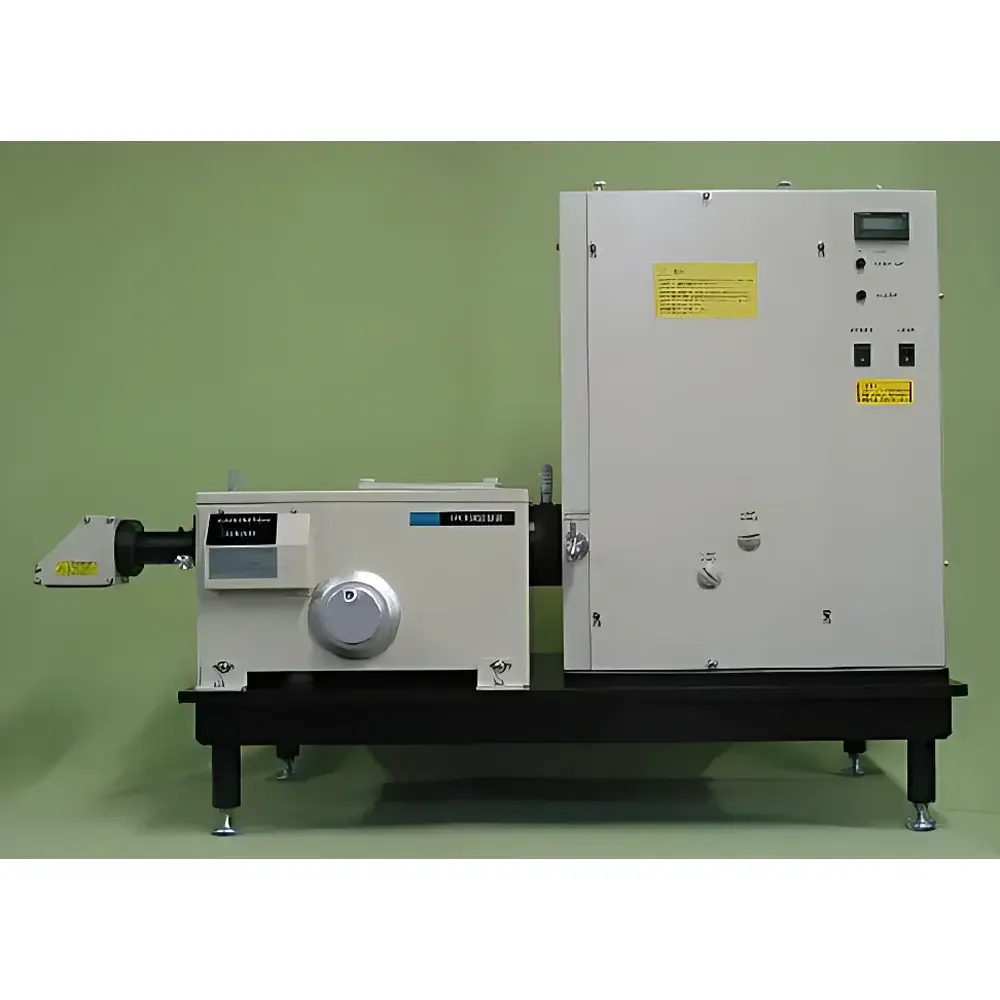
BUNKOUKEIKI SM25 Manual Quantum Efficiency Measurement System
| Origin | Japan |
|---|---|
| Manufacturer Type | Authorized Distributor |
| Origin Category | Imported |
| Model | SM25 |
| Pricing | Upon Request |
Overview
The BUNKOUKEIKI SM25 Manual Quantum Efficiency Measurement System is a precision optical instrumentation platform engineered for spectral responsivity and quantum efficiency characterization of photovoltaic (PV) devices. Developed by BUNKOUKEIKI Co., Ltd.—a Japanese pioneer in spectral response measurement systems and solar simulators—the SM25 implements a monochromator-based, lock-in-amplified optical excitation method to determine external quantum efficiency (EQE) and internal quantum efficiency (IQE) across the 300–1150 nm spectral range. The system employs a high-stability 150 W xenon arc lamp with an ellipsoidal reflector to maximize broadband coupling into a grating monochromator, enabling high photon flux density (>5 mW/cm²) and excellent irradiance uniformity (±5% over 10 × 10 mm field). Its mechanical architecture supports vertical illumination geometry with a fixed optical axis height of 140 mm and ≥80 mm working distance—facilitating integration with probe stations, environmental chambers, or custom sample holders. Designed for R&D laboratories engaged in next-generation PV development—including dye-sensitized, perovskite, organic, and silicon-based solar cells—the SM25 complies with IEC 60904-8 (2022 edition) for spectral responsivity measurements and aligns with JIS C 8912 and ASTM E1021 standards for photovoltaic device evaluation.
Key Features
- Monochromatic light source spanning 300–1150 nm using a precision grating monochromator with motorized 6-position filter wheel for higher-order suppression
- High-intensity xenon lamp (≥150 W) with ellipsoidal reflector and forced-air cooling for thermal stability and long-term irradiance repeatability (±1% over measurement duration)
- Manual beam shutter and integrated safety interlock system: lamp deactivation upon chamber door opening or thermal anomaly detection, with visual alarm indicators
- Adjustable irradiation geometry: 360° rotational capability of monochromatic beam direction for angular responsivity studies
- Defined illumination area of 10 × 10 mm with spatial non-uniformity ≤ ±5%, optimized for standardized test cell sizing and mask-based current collection
- Stable DC/AC biasing support with user-selectable modulation frequency, polarity (P/N or N/P), and signal acquisition mode (lock-in or DC integration)
Sample Compatibility & Compliance
The SM25 accommodates standard PV test structures—including masked and unmasked cells, heterojunction devices, and thin-film samples on rigid or flexible substrates—via manual stage positioning and alignment. It supports both front- and rear-side illumination configurations when paired with appropriate optical accessories. All optical and electrical interfaces are designed to meet GLP-compliant laboratory practices. While the system itself does not embed FDA 21 CFR Part 11 functionality (as it is hardware-centric and PC-controlled via third-party software), its measurement protocols and data output formats are fully compatible with ISO/IEC 17025-accredited calibration workflows. Traceability to NIST-traceable reference detectors and SI-traceable spectral irradiance standards is maintained through documented calibration procedures aligned with JIS Z 8401 and ISO/IEC Guide 98-3 (GUM).
Software & Data Management
Control and data acquisition are performed via Windows-based host software running on an external PC. Users configure measurement parameters including start/end wavelength (300–1150 nm), step resolution (1, 2, 5, 10, 20, or 50 nm), integration time, lock-in time constant, and spectral mismatch factor (MMF) calculation based on AM1.5G reference spectrum (IEC 60904-3). Raw spectral responsivity (A/W), EQE (%), IQE (%), and calculated short-circuit current density (Jsc, mA/cm²) are exported in CSV and ASCII formats for post-processing in MATLAB, Python, or commercial analysis suites. Audit trails—including operator ID, timestamp, instrument configuration log, and calibration certificate references—are retained per measurement session to support quality system documentation requirements.
Applications
- Quantitative EQE/IQE mapping of emerging photovoltaic absorbers (e.g., perovskites, OPVs, QDSCs)
- Optical loss analysis via IQE/EQE ratio decomposition to identify recombination and parasitic absorption contributions
- Validation of anti-reflection coating performance and front-contact grid shadowing effects
- Spectral mismatch correction for outdoor performance modeling and indoor flash testing correlation
- Material bandgap estimation from EQE onset wavelength and Tauc plot derivation
- Inter-laboratory round-robin testing under IEC 60904-8–compliant conditions
FAQ
Does the SM25 include automated sample positioning?
No—the SM25 is a manually operated system; sample alignment, contact probing, and stage adjustment require user intervention.
Is the system compatible with cryogenic or temperature-controlled stages?
Yes—its open optical path and ≥80 mm working distance allow integration with commercial低温 probe stations and environmental chambers (user-supplied accessories required).
Can IQE be measured without chemical etching or selective contact removal?
IQE determination requires knowledge of optical absorption profile; the SM25 provides the EQE input, but absorption data must be obtained separately (e.g., via UV-Vis-NIR transmission/reflection spectroscopy).
What calibration standards are recommended for routine verification?
NIST-traceable silicon photodiode reference detectors (e.g., Hamamatsu S1337 series) calibrated at 400–1000 nm intervals are recommended for annual system verification.
Is firmware or software update support available internationally?
Yes—BUNKOUKEIKI provides remote diagnostic support and software revision updates through authorized distributors, with documentation available in English and Japanese.




