
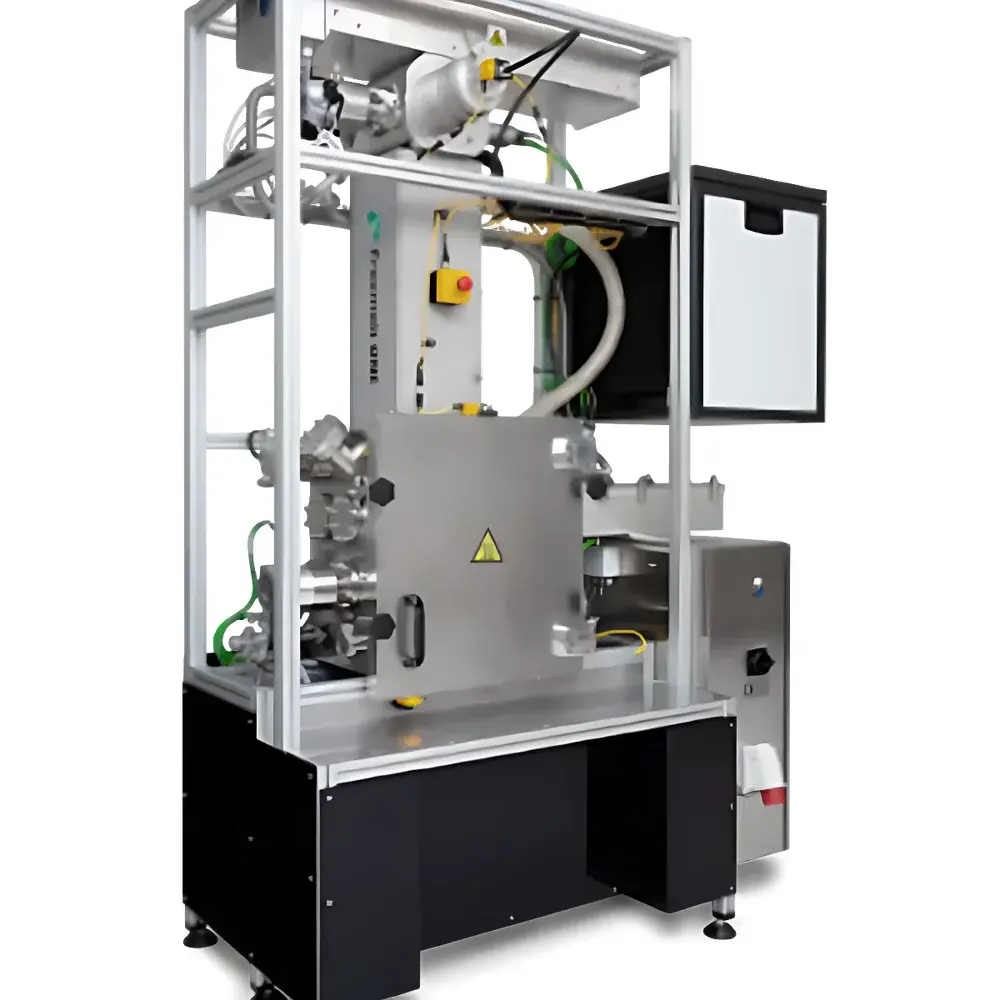
Freemelt ONE Electron Beam Powder Bed Fusion (EB-PBF) Metal 3D Printer
| Brand | Freemelt |
|---|---|
| Model | Freemelt ONE |
| Beam Power Range | 0–6 kW |
| Accelerating Voltage | 60 kV |
| Build Envelope | 100 mm H × 100 mm Ø |
| Base Pressure (Chamber) | ≤1×10⁻⁶ hPa |
| Base Pressure (Gun) | ≤1×10⁻⁷ hPa |
| Pump-Down Time | <15 min |
| Cathode Heater | CO₂ Laser |
| Operating Environment | High Vacuum |
| Beam Control | Fully Open-Loop Path Programming |
| Thermal Management | Top-Mounted Electromagnetic Preheating System |
| In-Situ Monitoring | Electron Imaging (No Optical Viewport Required) |
| Process Atmosphere | Vacuum Only (No Inert Gas Required) |
Overview
The Freemelt ONE is a research-grade electron beam powder bed fusion (EB-PBF) additive manufacturing system engineered specifically for advanced metal materials development. Unlike production-oriented EB-PBF platforms, the Freemelt ONE operates on a fundamentally open architecture—providing full access to raw beam control parameters, real-time process data streams, and low-level hardware interfaces. Its core principle relies on thermionic emission from a tungsten cathode, accelerated by a 60 kV potential, generating a focused electron beam capable of delivering up to 6 kW of controllable thermal energy directly into metallic powder beds under high vacuum (≤1×10⁻⁶ hPa). This enables precise, repeatable melting of refractory and reactive alloys—including Ti-6Al-4V, Inconel 718, stainless steels, and emerging high-entropy compositions—without reliance on inert gas shielding or optical observation windows. The absence of gas flow eliminates convective heat loss and powder entrainment, while the vacuum environment suppresses oxidation and supports in-situ electron imaging for layer-wise defect analysis.
Key Features
- Open-Loop Beam Path Programming: Full user control over beam current, dwell time, scan speed, and trajectory—enabling custom scanning strategies, multi-pass sintering, and localized thermal history modulation.
- Stable High-Power Beam Delivery: Maintains consistent spot quality across the entire 0–6 kW power range, critical for reproducible melt pool dynamics and microstructural control in thick-layer (>100 µm) builds.
- Vacuum-Optimized Thermal Architecture: Top-mounted electromagnetic preheating system stabilizes powder bed temperature prior to melting—eliminating mechanical powder handling risks and reducing thermal gradients that cause cracking in brittle alloys.
- In-Situ Electron Imaging Capability: Integrated electron-optical subsystem acquires real-time secondary electron images of each powder layer, enabling quantitative porosity assessment and melt track verification without optical viewport contamination or maintenance downtime.
- Gas-Free Processing Environment: Operates exclusively under high vacuum, removing the need for argon or nitrogen supply infrastructure and eliminating electrostatic charging of fine powders—a common source of layer non-uniformity in gas-assisted systems.
- Modular Hardware Interface: Standardized API access to vacuum gauges, beam deflection coils, and temperature sensors supports integration with external DAQ systems and third-party control software compliant with IEEE 1851 and OPC UA standards.
Sample Compatibility & Compliance
The Freemelt ONE accommodates a broad spectrum of conductive metallic feedstocks, including but not limited to titanium alloys (Ti-6Al-4V, CP-Ti), nickel-based superalloys (Inconel 625, 718), tool steels (H13, M2), cobalt-chrome, and aluminum alloys (AlSi10Mg, Scalmalloy®). Its vacuum-based process meets ASTM F3184–22 requirements for material qualification in medical device manufacturing and aligns with ISO/ASTM 52900:2021 definitions of powder bed fusion. All vacuum and electrical subsystems conform to IEC 61000-6-4 (EMC immunity) and IEC 60204-1 (safety of machinery). Data logging and parameter traceability support GLP-compliant workflows; audit trails are exportable in CSV and HDF5 formats for regulatory submission.
Software & Data Management
The system ships with Freemelt Studio—a cross-platform application built on Qt and Python 3.11—providing GUI-based beam path generation, real-time vacuum monitoring, and synchronized acquisition of beam current, stage temperature, and electron image frames at up to 30 Hz per layer. Raw sensor data is timestamped with nanosecond precision using PTPv2 (IEEE 1588) synchronization. All configuration files adhere to YAML schema specifications, enabling version control via Git. Exported datasets include calibrated beam position coordinates, layer-wise thermal profiles, and metadata compliant with FAIR principles (Findable, Accessible, Interoperable, Reusable). Optional integration with MATLAB® and Python-based machine learning pipelines supports automated feature extraction for porosity classification and melt pool stability prediction.
Applications
The Freemelt ONE serves as a primary platform for metallurgical R&D laboratories engaged in alloy design, process–structure–property mapping, and qualification of next-generation AM materials. It is widely deployed in academic institutions (e.g., KTH Royal Institute of Technology, ETH Zurich), national labs (e.g., Sandia National Laboratories, Fraunhofer IAPT), and corporate innovation centers developing orthopedic implants with tailored osseointegration surfaces, turbine blades with functionally graded microstructures, and lightweight structural components for electric vehicle powertrains. Its ability to process oxygen-sensitive alloys like niobium and molybdenum—without degradation—makes it indispensable for nuclear and aerospace prototyping where compositional fidelity is non-negotiable.
FAQ
Does the Freemelt ONE require inert gas purging during operation?
No. It operates exclusively under high vacuum (≤1×10⁻⁶ hPa), eliminating the need for argon or nitrogen supply lines, gas recirculation systems, or associated safety interlocks.
Can users modify beam scan patterns in real time during printing?
Yes. Freemelt Studio supports dynamic loading of new scan vector sets between layers via TCP/IP interface, enabling adaptive process correction based on in-situ monitoring feedback.
Is the system compatible with FDA 21 CFR Part 11-compliant electronic records?
While the base firmware does not include Part 11 features, the open data architecture allows integration with validated third-party e-signature and audit trail modules certified for regulated environments.
What is the typical maintenance interval for the electron gun?
Under standard R&D usage (≤200 hours/year), cathode replacement is recommended every 1,500–2,000 operational hours; gun alignment verification is performed semiannually using built-in beam centroid calibration routines.
Does the system support multi-material deposition in a single build?
Not natively. The Freemelt ONE uses a single powder reservoir and uniform beam optics. However, sequential material changes between builds are supported via rapid chamber venting (<15 min) and standardized powder handling protocols aligned with ISO 22067-1.




