
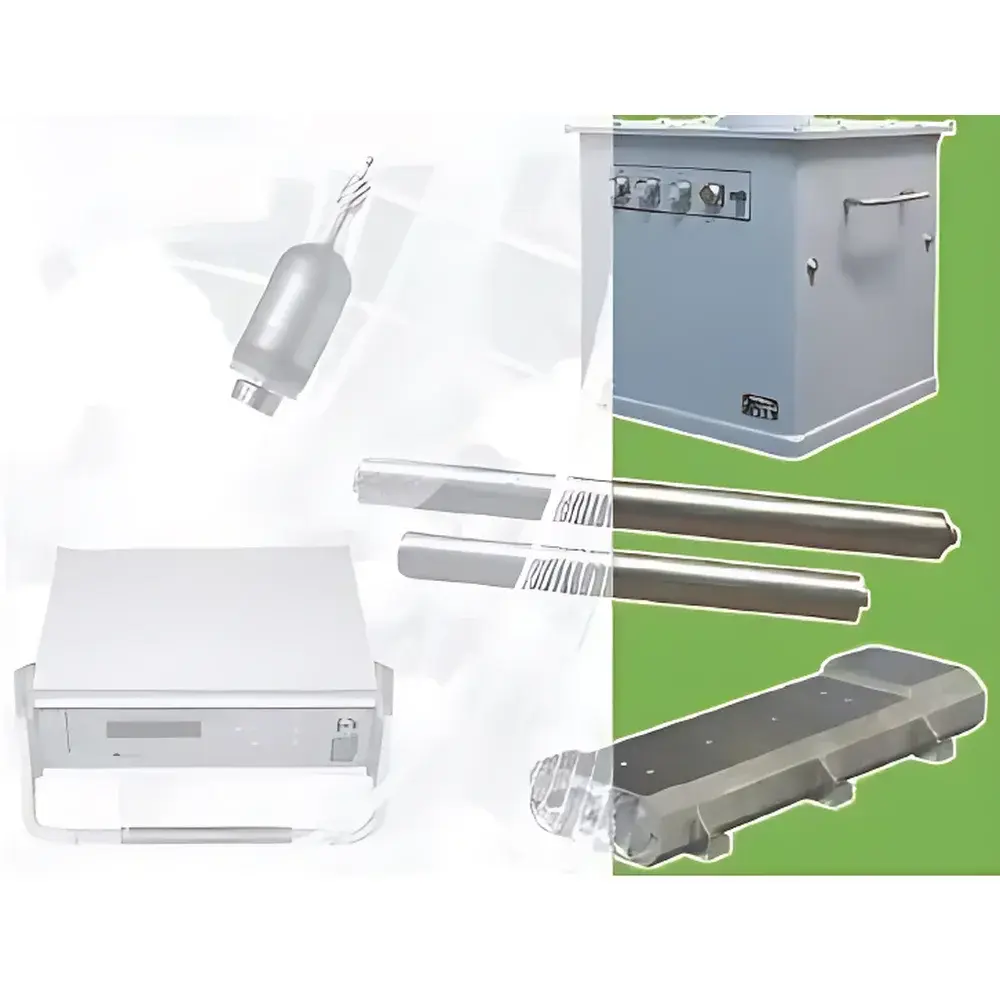
Vniia Neutron Generator Tube
| Origin | Russia |
|---|---|
| Manufacturer Type | Authorized Distributor |
| Origin Category | Imported |
| Model | ING10-20 / ING101-105 |
| Pricing | Available Upon Request |
Overview
The Vniia Neutron Generator Tube (models ING10-20 and ING101-105) is a compact, sealed-tube pulsed neutron source engineered for downhole logging applications in oilfield and geological exploration. Based on the deuterium-tritium (D–T) fusion reaction, it generates fast neutrons (14.1 MeV) via ion acceleration across a high-voltage gap within a miniature accelerator structure. Unlike isotopic sources (e.g., 252Cf), this electrostatic neutron generator offers on-demand, gated output with precise temporal control—enabling time-of-flight (TOF) spectroscopy, neutron activation analysis (NAA), and porosity/reservoir fluid characterization in borehole environments. Its robust ceramic-metal hermetic construction ensures operational stability under high temperature (up to 175 °C) and mechanical shock conditions typical of wireline and LWD (Logging While Drilling) toolstrings.
Key Features
- Pulsed neutron output with adjustable pulse duration from 10 nanoseconds to 10 milliseconds—optimized for both short-pulse TOF measurements and longer-duration capture-gamma assays.
- Maximum neutron yield up to 1 × 10¹¹ n/s per pulse, scalable via repetition rate and beam current tuning.
- Repetition frequency programmable from single-shot mode to continuous operation at up to 10 kHz—supporting high-statistics data acquisition without thermal saturation.
- Integrated high-voltage power supply (up to 150 kV) and low-noise ion source control electronics housed within a pressure-rated, radiation-hardened stainless steel envelope.
- Compliant with IEC 61513 (nuclear instrumentation safety) and designed to meet API RP 67 requirements for downhole tool electromagnetic compatibility (EMC) and mechanical integrity.
Sample Compatibility & Compliance
The ING10-20 and ING101-105 are not sample-contact instruments; rather, they serve as neutron irradiation sources for in-situ formation interrogation. As such, compatibility is defined by deployment environment—not material handling. Units are qualified for use in boreholes with diameters ≥95 mm and maximum static pressures up to 140 MPa. All models conform to Russian GOST R IEC 61513-2017 and carry EAC (Eurasian Conformity) marking for import into EAEU member states. Documentation includes full traceability of tritium loading (certified activity ≤ 1.85 × 10¹⁰ Bq), vacuum integrity test records, and neutron output calibration certificates issued by VNIIA’s accredited metrology laboratory (Rosstandart Accreditation No. RA.RU.21PT02).
Software & Data Management
Neutron pulse timing, HV ramp profiles, and beam current monitoring are controlled via RS-422 or CAN bus interface compatible with industry-standard logging tool platforms (e.g., Schlumberger MAXIS, Halliburton LogIQ, Baker Hughes TeleScope). Firmware supports synchronized trigger outputs for gamma-ray spectrometers and neutron detectors, enabling real-time coincidence logic for background suppression. Pulse parameter logs—including timestamped yield, pulse width, and repetition rate—are embedded in standard DLIS (Digital Log Interchange Standard) v2.0 frames. Audit trails comply with ISO/IEC 17025:2017 requirements for measurement uncertainty reporting and are compatible with GLP-compliant data review workflows.
Applications
- Carbon/Oxygen (C/O) ratio logging for hydrocarbon saturation estimation in cased-hole environments.
- Neutron-induced gamma-ray spectroscopy (NGS) for elemental quantification (Si, Ca, Fe, Cl, S) in formation rock matrices.
- Time-dependent die-away analysis (TDDA) for thermal neutron decay constant mapping—correlating with formation porosity and fluid salinity.
- Well-to-well reservoir continuity assessment using pulsed neutron interference testing (PNIT).
- Geosteering support in horizontal wells via real-time lithology discrimination based on neutron moderation signatures.
FAQ
What is the tritium half-life, and how does it affect operational lifetime?
Tritium has a physical half-life of 12.32 years; nominal generator service life is rated at 5 years under typical logging duty cycles (≤2000 hours total beam-on time), limited primarily by target degradation rather than tritium decay.
Can the ING101-105 be integrated into existing LWD tool strings?
Yes—mechanical interfaces follow API RP 77 dimensional standards; electrical and communication protocols are configurable to match OEM toolbus architectures including MWD telemetry synchronization.
Is regulatory licensing required for field deployment?
Yes—users must obtain national nuclear regulatory authorization (e.g., Rosatom license in Russia, NRC or Agreement State license in the U.S.) covering possession, transport, and use of tritium-activated neutron generators.
Does the unit include built-in neutron output calibration verification?
Each unit ships with a factory-measured neutron yield curve (vs. HV and D₂ gas pressure), validated using a calibrated He-3 proportional counter traceable to PTB (Physikalisch-Technische Bundesanstalt) reference standards.
What maintenance is required between logging runs?
No routine maintenance is required; however, post-run visual inspection of high-voltage feedthroughs and vacuum integrity verification via residual gas analysis (RGA) are recommended after every 500 operating hours or prior to critical well campaigns.
Related Products





