
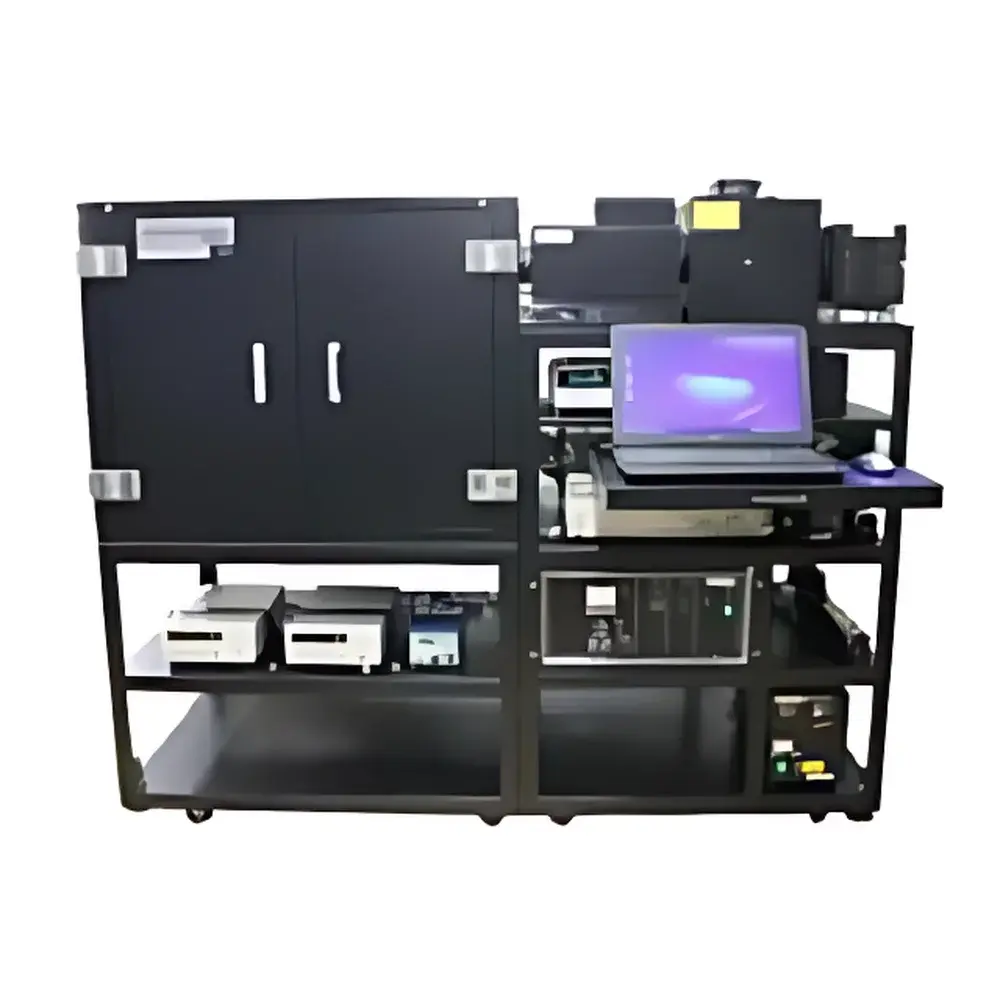
Bunkoukeiki VC Series-1 CCD Spectral Responsivity Measurement System
| Brand | Bunkoukeiki |
|---|---|
| Origin | Japan |
| Model | VC Series-1 |
| Wavelength Range | 300–1300 nm |
| Light Source | Xenon & Halogen Lamps |
| Effective Illumination Area | 10×10 mm (optional 40×40 mm) |
| Irradiance Stability | ±0.5% over 60 min |
| Irradiance Level | 10–50 µW/cm² (energy-stabilized, monochromatic) |
| Target Samples | CMOS image sensor modules, bare sensor dies, digital camera bodies |
| Compliance | ISO/IEC 17025-aligned calibration traceability (NMI-Japan referenced) |
Overview
The Bunkoukeiki VC Series-1 CCD Spectral Responsivity Measurement System is a precision optical metrology platform engineered for quantitative characterization of spectral quantum efficiency and relative responsivity of solid-state photodetectors. Based on monochromator-coupled, energy-stabilized illumination and calibrated reference photodiode traceability, the system implements a standardized spectral irradiance method compliant with ISO 15739 (Imaging sensors — Determination of noise, dynamic range, and saturation signal level) and ASTM E1376 (Standard Test Method for Spectral Responsivity of Photovoltaic Devices). It delivers high spatial uniformity (<±1.5% across 10×10 mm field) and temporal stability (±0.5% irradiance drift over 60 minutes), enabling repeatable, inter-laboratory comparable measurements of quantum efficiency (QE), responsivity (A/W), and spectral non-uniformity across the full 300–1300 nm range—spanning UV-A through visible to near-infrared (NIR).
Key Features
- Dual-source optical architecture: Switchable xenon lamp (300–800 nm, high UV output) and tungsten-halogen lamp (600–1300 nm, stable NIR continuum) with automated source selection and spectral gap compensation.
- High-resolution monochromator: Czerny-Turner design with 0.1 nm minimum bandwidth and <0.05 nm wavelength repeatability, enabling precise spectral scanning at user-defined step intervals (0.1–10 nm).
- Energy-stabilized monochromatic illumination: Real-time feedback loop using NIST-traceable silicon photodiode monitors irradiance at sample plane; active lamp power modulation maintains ±0.5% constancy during spectral sweeps.
- Uniformity-optimized optical train: Collimated beam delivery with Köhler illumination geometry and diffuser-integrated homogenizer ensures <±1.5% spatial irradiance variation over 10×10 mm active area (optionally expandable to 40×40 mm with recalibrated uniformity mapping).
- Modular sample stage: Motorized XYZ translation with tilt adjustment (±2°) and vacuum chuck compatibility for bare CMOS die mounting; supports both sensor modules and fully assembled camera bodies via configurable mechanical fixtures.
- Thermally stabilized enclosure: Ambient temperature control (±0.3°C) minimizes dark current drift and thermal QE shift—critical for low-light responsivity validation under ISO 15739 dark-frame protocols.
Sample Compatibility & Compliance
The VC Series-1 accommodates a broad class of optoelectronic devices requiring spectral responsivity certification: front-side illuminated (FSI) and back-side illuminated (BSI) CMOS image sensors, scientific-grade sCMOS and EMCCD modules, industrial line-scan arrays, and consumer camera assemblies (including lens-on configurations with removable optics). All measurement procedures align with ISO/IEC 17025 requirements for testing laboratories, supporting documented uncertainty budgets per GUM (Guide to the Expression of Uncertainty in Measurement). System calibration certificates reference Japan’s National Metrology Institute (NMI-Japan) spectral irradiance standards and include full spectral responsivity transfer data from primary standard detectors. Optional GLP-compliant audit trail logging meets FDA 21 CFR Part 11 requirements for regulated R&D environments.
Software & Data Management
Bunkoukeiki’s SpectraView Pro v4.2 software provides integrated instrument control, spectral acquisition, and metrological post-processing. It supports automated multi-point uniformity mapping, dark-current subtraction per ISO 15739 Annex B, and responsivity normalization to absolute units (A/W or electrons/photon). Raw spectral datasets are exported in HDF5 format with embedded metadata (wavelength, irradiance, integration time, temperature, calibration ID), ensuring FAIR (Findable, Accessible, Interoperable, Reusable) data principles. Batch reporting complies with ISO 15739 Table 1 formatting, including QE curves, peak responsivity wavelengths, and FWHM bandwidths. Audit logs record all parameter changes, user actions, and calibration events with timestamped digital signatures.
Applications
- Quantitative evaluation of quantum efficiency roll-off in advanced BSI CMOS sensors beyond 900 nm.
- Validation of anti-reflective coating performance across UV-VIS-NIR bands for medical endoscopy and machine vision sensors.
- Characterization of spectral crosstalk in RGB Bayer filter stacks under monochromatic excitation.
- Verification of NIR sensitivity for automotive LiDAR receiver modules and driver-monitoring systems.
- Supporting ISO 15739-based dynamic range and SNR modeling for computational photography pipelines.
- Traceable calibration of reference sensors used in radiometric test benches and camera MTF stations.
FAQ
What reference standards are used for spectral irradiance calibration?
Calibration is performed against NMI-Japan certified silicon photodiodes (model SRM-1920a equivalent) with spectral responsivity uncertainties ≤0.8% (k=2) from 300–1100 nm, extended to 1300 nm via indium gallium arsenide (InGaAs) reference detector cross-validation.
Can the system measure quantum efficiency (QE) directly?
Yes—QE (%) is calculated in real time using the formula: QE(λ) = [1240 × R(λ)] / λ(nm), where R(λ) is measured responsivity in A/W; all required constants and correction factors (including reflection loss and fill factor) are configurable per sample type.
Is the 40×40 mm illumination option validated for uniformity?
Yes—optional large-field optics undergo full uniformity mapping using a 100-point scanning photodiode array; delivered certificate includes spatial deviation contour plot and RMS non-uniformity value (<±2.3% across 40×40 mm).
Does the system support automated dark-frame acquisition?
Yes—software-controlled shutter sequencing enables synchronized dark-frame capture at identical integration times and temperatures, per ISO 15739 Section 7.3 requirements for noise analysis.
Are firmware and software updates provided post-purchase?
Bunkoukeiki offers 3 years of complimentary maintenance including security patches, bug fixes, and minor feature enhancements; major version upgrades require optional Software Maintenance Agreement (SMA).





