
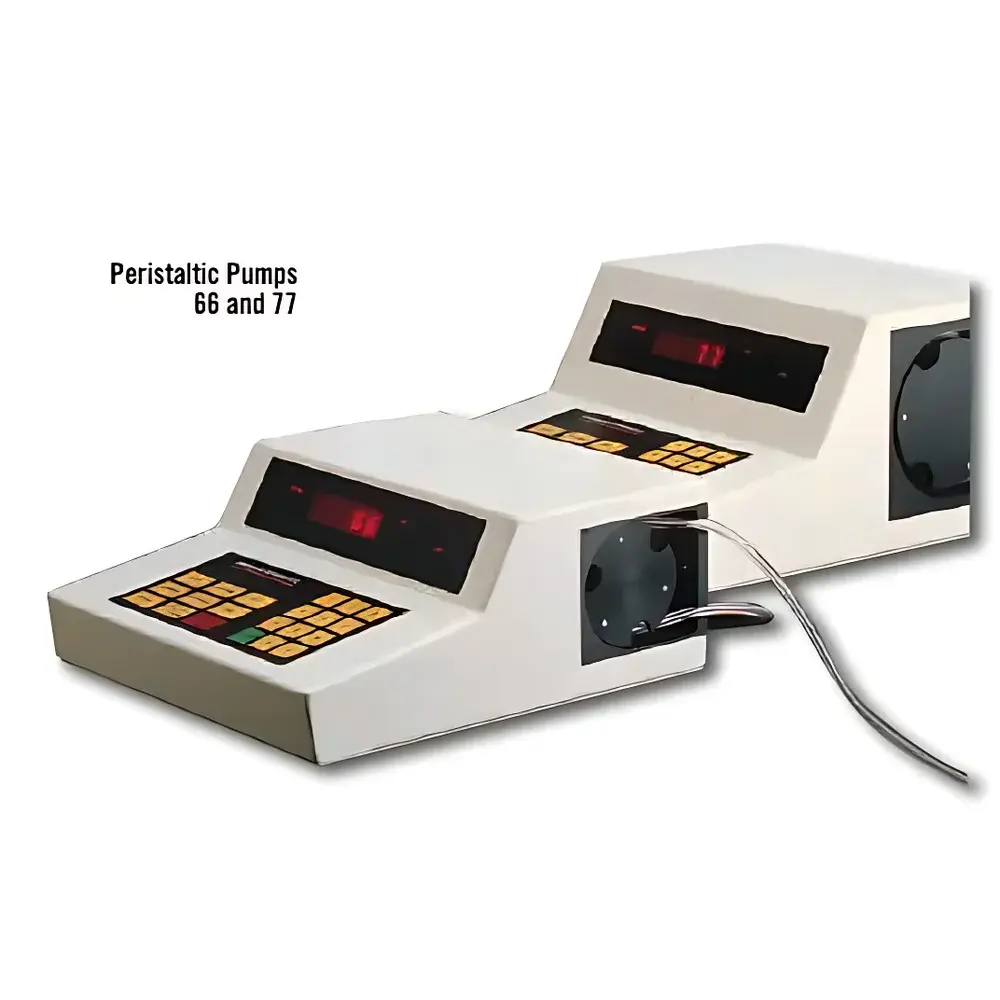
Harvard Apparatus Peristaltic Pump Models 66 and 77
| Brand | Harvard Apparatus |
|---|---|
| Origin | USA |
| Model | Peristaltic Pump 66 and Peristaltic Pump 77 |
| Rotor Configuration | 3-roller, single-channel |
| Tubing ID Range | 1.6–3.2 mm (Model 66) / 3.2–6.4 mm (Model 77) |
| Minimum Flow Rate | 0.01 mL/min |
| Maximum Flow Rate | 210 mL/min (Model 66) / 750 mL/min (Model 77) |
| Flow Accuracy | ±1.0% |
| Communication Interface | RS-232C |
Overview
The Harvard Apparatus Peristaltic Pump Models 66 and 77 are precision-engineered, microprocessor-controlled peristaltic pumps designed for reliable, pulse-free fluid delivery in demanding laboratory environments. Based on the principle of positive displacement via occlusive roller compression—where rotating rollers sequentially compress flexible tubing to propel fluid forward—these pumps eliminate fluid contact with internal mechanical components, ensuring contamination-free operation and simplifying cleaning, sterilization, and regulatory validation. Engineered for long-term stability and repeatable volumetric delivery, both models feature a robust 3-roller head architecture optimized for consistent occlusion across their respective tubing ranges. The Model 66 is calibrated for low-to-moderate flow applications using narrow-bore tubing (1.6–3.2 mm ID), while the Model 77 accommodates higher-volume transfers with wider tubing (3.2–6.4 mm ID), making the pair complementary in multi-scale fluid handling workflows—from microfluidic perfusion systems to bioreactor feed lines and analytical sample introduction.
Key Features
- High-accuracy flow control with ±1.0% volumetric accuracy across the full operating range, validated per ISO 8536-4 and ASTM D3948 guidelines for peristaltic pump performance assessment.
- Dual-model scalability: Model 66 supports precise low-flow delivery (0.01–210 mL/min); Model 77 extends dynamic range to 750 mL/min without sacrificing resolution or repeatability.
- RS-232C serial interface compliant with EIA/TIA-232-F standards, enabling bidirectional communication with host computers, LIMS, or programmable logic controllers for automated protocol execution and audit-ready data logging.
- Three-roller rotor design ensures uniform tubing compression, minimizing pulsation amplitude (<5% peak-to-peak variation under steady-state conditions) and extending tubing service life relative to two-roller alternatives.
- Front-panel digital display with intuitive push-button controls allows local parameter adjustment—including speed setpoint, direction, and run/stop status—without requiring external software.
- CE-marked and RoHS-compliant construction; all electronics meet IEC 61010-1 safety requirements for laboratory electrical equipment.
Sample Compatibility & Compliance
These pumps are compatible with a broad spectrum of chemically resistant, USP Class VI-certified peristaltic tubing materials—including silicone, PharMed® BPT, C-Flex®, and Tygon® E-3603—enabling safe handling of aqueous buffers, organic solvents, cell culture media, and mildly corrosive reagents. No wetted parts beyond the tubing ensure full compatibility with sterile, pyrogen-free, and animal-component-free processes. Both models support Good Laboratory Practice (GLP) and Good Manufacturing Practice (GMP) workflows through configurable run-time logging, user-accessible calibration records, and traceable parameter history. While not intrinsically rated for hazardous locations, they may be deployed in ISO Class 5–8 cleanrooms when paired with appropriate tubing and housing enclosures.
Software & Data Management
Harvard Apparatus provides optional PC-based control software (PumpWare™ v4.x) supporting Windows OS platforms, which enables remote configuration, real-time flow monitoring, time-based ramping profiles, and CSV-exportable event logs. All RS-232C transactions include timestamped command acknowledgments and error codes, facilitating 21 CFR Part 11 compliance when deployed with validated system configurations—including electronic signatures, audit trails, and role-based access controls. Pump firmware supports non-volatile memory storage of up to 10 user-defined protocols, each with independent speed, duration, and direction parameters, eliminating manual reconfiguration between sequential experiments.
Applications
- Cell culture perfusion and media exchange in bioreactors and organ-on-chip platforms
- Controlled reagent addition in HPLC, FPLC, and continuous-flow synthesis systems
- Calibration standard delivery in clinical chemistry analyzers and environmental water samplers
- Drug dissolution testing per USP and , where consistent, low-pulse flow is critical for sink condition maintenance
- Neuroscience microdialysis probe perfusion and in vivo infusion studies requiring ultra-low flow stability
- Quality control sampling in pharmaceutical manufacturing lines under cGMP conditions
FAQ
Can these pumps be integrated into automated liquid handling platforms?
Yes—both models support TTL-compatible start/stop triggers and full RS-232C command sets, allowing seamless integration with robotic workstations, PLCs, and third-party control software via ASCII protocol.
What tubing sizes are certified for use with each model?
Model 66 is validated for tubing inner diameters from 1.6 mm to 3.2 mm; Model 77 is validated for 3.2 mm to 6.4 mm. Use outside these ranges may compromise accuracy, occlusion integrity, or tubing lifespan.
Is calibration documentation provided with the instrument?
Each unit ships with a factory calibration certificate traceable to NIST standards, including flow verification data at three points across the operational range (low, mid, and high flow), along with instructions for user-performed recalibration.
Do the pumps support continuous operation at maximum speed?
Yes—both models are rated for indefinite duty cycle at any speed within specification, provided ambient temperature remains ≤40°C and adequate ventilation is maintained around the motor housing.
How is flow rate accuracy verified during routine QC checks?
Accuracy is confirmed using gravimetric measurement per ISO 8536-4: a calibrated analytical balance records mass change over a timed interval, with density-corrected volume calculated and compared against the pump’s setpoint value.



