
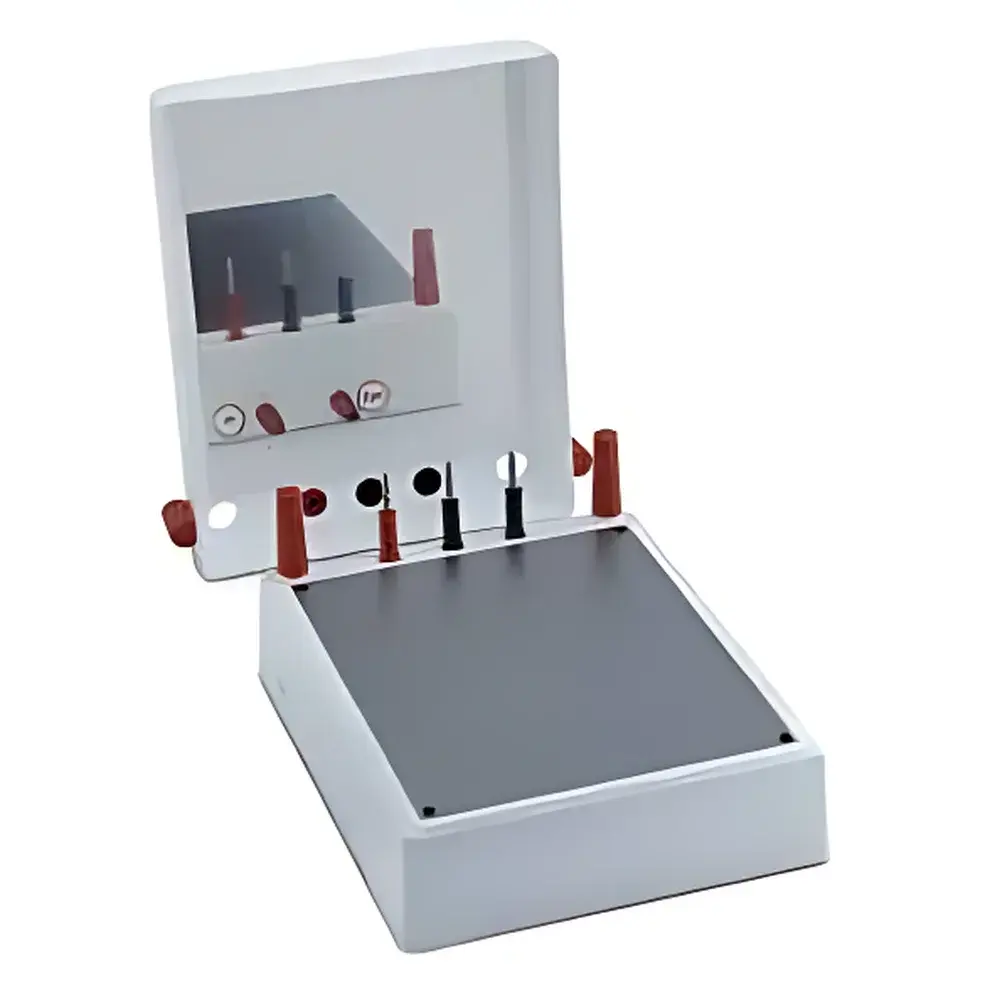
Fastblot B43 Semi-Dry Electroblotting System
| Origin | Germany |
|---|---|
| Manufacturer Type | Authorized Distributor |
| Origin Category | Imported |
| Model | Fastblot B43 |
| Pricing | Available Upon Request |
Overview
The Fastblot B43 Semi-Dry Electroblotting System is an engineered solution for rapid, high-efficiency protein transfer from polyacrylamide gels to solid supports—including nitrocellulose and PVDF membranes—using semi-dry electrophoretic blotting principles. Unlike traditional wet transfer systems, the Fastblot B43 operates on a low-resistance, high-field-strength configuration where the gel-membrane sandwich is placed directly between two parallel electrode plates saturated with minimal buffer volume. This design leverages controlled direct-current (DC) electric fields across a thin buffer layer to drive charged proteins orthogonally through the gel matrix and onto the membrane surface. The system is optimized for reproducible transfer of proteins ranging from 10 kDa to >150 kDa, including challenging high-molecular-weight targets, without significant diffusion or smearing—critical for downstream immunodetection and quantitative western blot analysis.
Key Features
- Platinum-coated titanium anode and stainless-steel cathode ensure exceptional corrosion resistance, long-term conductivity stability, and zero maintenance under repeated high-current operation.
- Active flow-through cooling system continuously circulates temperature-regulated buffer to dissipate Joule heat generated during high-voltage transfer—preventing thermal denaturation, gel warping, and membrane drying.
- Electrode surface area of 16 × 20 cm accommodates standard mini- and midi-format gels; maximum compatible gel dimensions are 15.5 × 19.5 cm, enabling full coverage with precise field uniformity.
- Integrated corner spacers maintain consistent 1–2 mm inter-electrode gap across the entire assembly—eliminating localized short-circuiting and ensuring homogeneous current distribution.
- Minimal buffer consumption (typically 100–200 mL per run) reduces reagent cost, waste generation, and setup time; complete transfers achieved in 10–30 minutes depending on protein size and gel thickness.
Sample Compatibility & Compliance
The Fastblot B43 supports a broad range of electrophoretic formats, including SDS-PAGE (Laemmli and Tris-Tricine), native PAGE, and gradient gels (4–20%, 8–16%). It is compatible with both pre-cast and hand-cast gels, as well as multiple membrane types (0.2 µm and 0.45 µm PVDF, nitrocellulose, and low-fluorescence variants). All materials in contact with buffers or samples comply with EU REACH and RoHS directives. While not certified as medical device or IVD equipment, the system meets general laboratory instrumentation requirements under ISO/IEC 17025 for method validation support and is routinely deployed in GLP-compliant western blot workflows where traceability, repeatability, and documentation integrity are essential.
Software & Data Management
The Fastblot B43 is a standalone hardware platform with no embedded microprocessor or digital interface; operation is fully manual via external DC power supply (not included). However, its design enables seamless integration into regulated environments: users may log transfer parameters (voltage, time, buffer composition, ambient temperature) in electronic lab notebooks (ELNs) compliant with 21 CFR Part 11 when paired with validated data capture workflows. Protocol templates—including optimized settings for common molecular weight ranges and membrane types—are provided in the bilingual (English/German) user manual, supporting audit-ready documentation practices.
Applications
- Routine western blotting in academic, pharmaceutical, and biotech laboratories requiring high-throughput protein detection.
- Transfer of large proteins (>100 kDa) and multi-subunit complexes where conventional semi-dry systems often yield incomplete or uneven blotting.
- Preparative blotting for subsequent N-terminal sequencing or mass spectrometry sample recovery.
- Validation studies supporting antibody characterization, biosimilar comparability, and QC release testing of recombinant therapeutics.
- Teaching laboratories emphasizing hands-on electrophoresis fundamentals with reduced buffer handling and shorter experiment cycles.
FAQ
What power supply specifications are recommended for optimal performance?
A programmable DC power supply capable of delivering 0–25 V and 0–2.5 A (constant voltage or constant current mode) is required. Voltage ramping is not supported; stable setpoint operation is advised.
Can the Fastblot B43 be used for RNA or DNA blotting?
While primarily optimized for protein transfer, nucleic acid blotting (e.g., northern/southern) is feasible with protocol adaptation—though wet transfer remains preferred for high-fidelity nucleic acid applications due to lower risk of depurination.
Is the cooling system compatible with chilled buffer recirculation?
Yes—the integrated flow path accepts external chillers or refrigerated circulators operating between 4 °C and 25 °C, enabling temperature-controlled transfer for thermolabile samples.
How frequently should electrode surfaces be cleaned?
Under normal use, platinum-coated anodes and stainless-steel cathodes require cleaning only if visible residue accumulates; gentle wiping with deionized water and lint-free cloth is sufficient—no polishing or chemical treatment is necessary.
Does the system include buffer trays or gel alignment fixtures?
No—buffer reservoirs and gel positioning aids (e.g., alignment frames, sponge stacks) are supplied separately as optional accessories to accommodate user-specific sandwich configurations and membrane handling preferences.



